




WaterAid in partnership with Cummins Inc. is committed to provide members of the most vulnerable communities the know-how and resources to access to safe, clean, sufficient water.
Seventeen year-old, Sumayya Haruna Muhammad smiles brightly as she stands in the hallway of Government Secondary School Zuba, and her confidence can be felt everywhere, her smile saying she belongs here. Until just a few months ago, her confidence was frequently crushed — a task left to something as natural as her monthly cycle.
“It was because of this that I would stay at home for those five days of my period in the past, as I couldn’t take care of myself well in school,” Sumayya says, her voice firm, yet coloured by the memory of those trying days. “And now, the toilet is clean, there’s water and I can go confidently to my classes.”
Sumayya’s journey from a school student who missed regular days of school to a motivated individual who never wants to miss a day, also captures a bigger story, a tale unfolding across Nigeria’s Federal Capital Territory – one of partnership, investment and the underlying power of basic human dignity.
A Necessary Partnership
With Abuja’s urban sprawl obtruding more and more into the hinterland, the communities of Bwari and Gwagwalada Area Councils have become sandwiched between the neglect of a rural condition and the promise of an urban one. Schools such as Government Secondary School Zuba, and Government Secondary School Byazhin have hundreds of students but up till had lacked the most basic hygiene infrastructure to get the schools closer to the modern age.
That gap was addressed head-on by the 20-month initiative, which was recently completed by WaterAid Nigeria with funding from the global power generation company Cummins Inc. Over 10,000 residents in these underserved communities now have access to clean water, thanks to proper sanitation and hygiene education basics, that should not be luxuries anywhere.
But for Cummins, this is more than just corporate philanthropy it expresses in action their Planet 2050 sustainability program. We have built three gender-inclusive restroom blocks in various schools,” says Ify Alex-Anene, Cummins’ Corporate Social Responsibility lead. The objective is to provide sustainable water and wash facility for improved access.”
A century old power generation company with operations in Nigeria for over 13 years, water for the organisation is a blend of technical crisis and moral stand. “As our CEO Jennifer Ramsey says, water is the great uniter,” Alex-Anene says.
At Government Secondary School Byazhin, principal Dr Julie Essence-Abontai reflects on the value of a new project beyond bricks and mortar.
“What we are seeing here today is not structures alone,” she adds, pointing to the brand-new toilet blocks and water points dotted around the school compound. “It’s a perfect embodiment of what happens when people and institutions decide to care.
Principal’s words come from experience. She knew firsthand the impact that substandard facilities had on their comfort, confidence and, crucially, attendance. Yet today, with the WASH facilities in the premises, the entire learning environment has been upgraded.
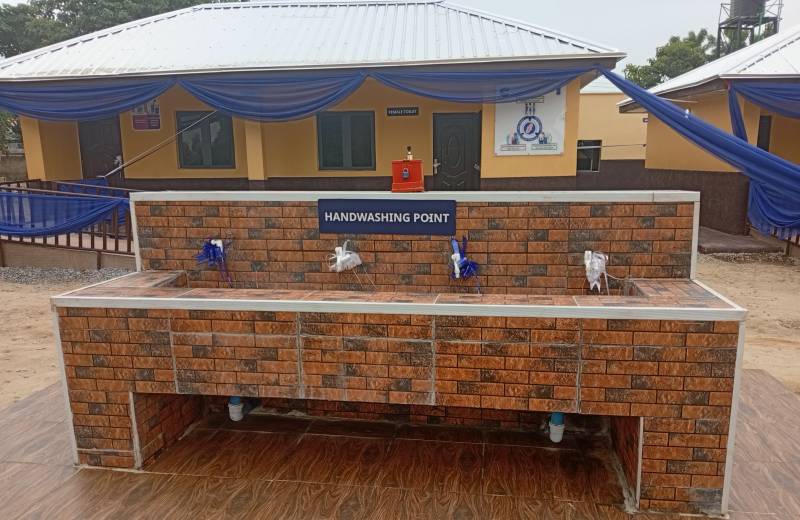
“This had a huge impact and is greatly enhancing our environment and will make for more comfortable and dignified learning for all of our students,” Dr. Essence-Abontai says, beaming as students and teachers celebrate what has now given them a renewed commitment to excellence.
Beyond Bricks and Mortar
The ripple effect is best captured in the voices of the students themselves. At GSS Byazhin, Head Girl Olatunde Busanlami speaks with the candour of someone who all too vividly recalls the “before times.”
“I am delighted our school was selected for this WASH facility,” she says. “It was not convenient for me to use the bush, I had to endure until I get home but now I, and all other girls in the school, feel very comfortable to use the new facility.”
For her counterpart, Head Boy Mohammed Abubakar Inuah, it is the practical benefits that are key: “Previously we had water supply but not enough, now there is enough for everyone.”
These aren’t merely testimonials — they are evidence of equity in education in action. When students — especially girls — are able to go to school without worrying about their basic sanitation needs, attendance rises, performance does too, and futures become brighter.
The project’s influence goes well beyond individual schools. WaterAid adopted a three-fold strategy of rejuvenating Environmental Health Clubs, conducting menstrual hygiene safety training, and re-activating three WASH Committees for local enthusiasm and the continued functioning of the infrastructure.
It’s a comprehensive strategy that signals a deeper understanding of sustainable development – that infrastructure is only part of the equation; it’s worthless without community buy-in and the capacity of local management.
Evelyn Mere, Country Director, WaterAid Nigeria, says: “Together we are stronger, and so much more can be achieved when we work together. “We have achieved so much and we are proud of what we have achieved and what the partnership with Cummins has made possible. This project is proof of what can be achieved when government, private sector and civil society come together.”
Government Commitment
Support from local authorities has been integral to the project’s success. The executive chairman of Bwari Area Council was full of appreciation as he promised to work together in the future, saying “We want to say we are give thanks so much in Bwari Area Council for all the contribution, development you are bring to Bwari Area Council. And also to tell you and to asure you, that as you know us, Bwari Area Council, our doors are open for this support and we want this development to come to our communities and our societies.”
This government support indicates possibility of scaling-up these interventions in the FCT and beyond.
Looking Forward
The success of the project is the best of both the worlds, laud and a responsibility. It said it was urging the FCT administration and the Area Councils to invest more in inclusive, climate resilient WASH infrastructure, while calling for a coordinated approach to embed such interventions into the planning and systems for service delivery by the government.
The women soon-to-be-graduates are testimony to how these solar water systems and disabled-accessible toilets aren’t just short-term fixes but are part of a wider approach that is environmentally sustainable and socially inclusive.
A Model for Change
The day Sumayya Haruna Muhammad reports to bear in Garishu II Secondary School, Zuba to prepare for morning and evening lessons, is not the same anymore as it was a few months ago; now she goes to all her classes every day; at any time of the month. Her self-assuredness is a powerful reminder that access to basic human dignity should not be revolutionary — but in many situations and places around the world, it is.
The joint initiative of WaterAid Nigeria and Cummins Inc. is an example of what can be achieved when private sector resources, development know-how and community demands converge. The model becomes a template for change in the face of infrastructural deficiencies in the education sector in Nigeria.
For the 10,000-plus people who are directly benefiting from this effort, the difference is already profound. For the countless others like them across Nigeria and beyond, it is a symbol of hope that the most fundamental human dignity – cleaning water, decent toilets and good hygiene – may be within reach.

