



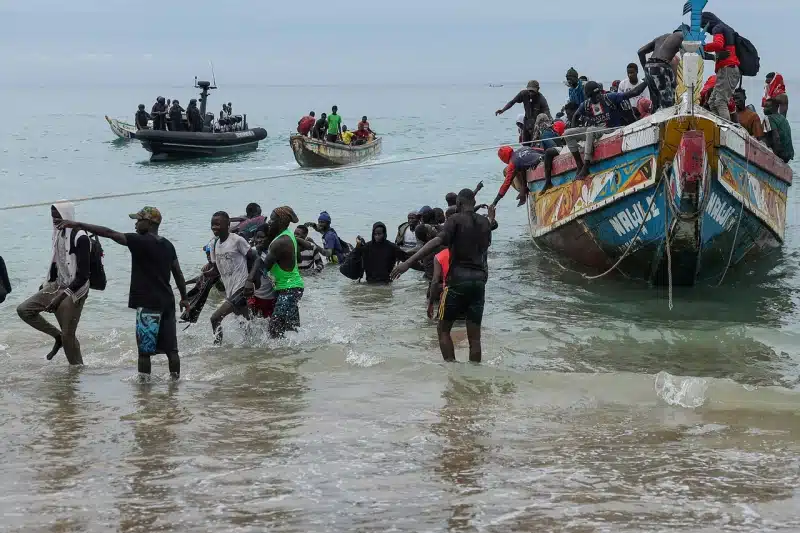

Four boats. 759 people. One Tuesday.
The four rescues were part of a wider movement of people attempting the Atlantic crossing to Spain’s Canary Islands. They were not an isolated case.
Start on 3 November. The navy reached a pirogue carrying 221 people, about 130 kilometres off Djiffère. It had left The Gambia. Twenty-two of those on board were minors.
Three days later came Kébémer.
A pirogue ran aground on Friday 6 November near Tébène 2, in the Louga region. By Saturday evening the Interior Ministry had recovered 21 bodies and found one survivor. On Sunday the official toll reached 34. Later reports went higher.
The survivor swam to the beach. According to InfoMigrants, he said the passengers had waited two days in the crowded boat, offshore, for smugglers to bring the engine and fuel.
Then, overnight between 9 and 10 November, local media reported that police stopped yet another launch at Cambérène beach in Dakar. Departures like that begin on a beach, long before migrants rescued off Senegal ever meet a patrol boat.
On Tuesday, the navy was out again. Add the 817 people helped earlier in the week by naval and land units, and the total reaches 1,576.
Look past the figure and another pattern emerges. The rescues are happening alongside a renewed wave of departures from Senegal’s coastline, even as police and naval patrols attempt to disrupt the networks organising them.
Across the water, the Canary island of El Hierro, home to about 11,400 people, declared an emergency. More than 3,300 people had landed there in about 30 boats since the start of November, Al Jazeera reported. Spanish maritime rescue pulled 3,261 people from the sea in the first six days of the month alone. That pressure is the far end of the route the migrants rescued off Senegal had set out on.
For much of 2026, arrivals had remained well below the record levels of 2024. But November brought a sharp reversal, with maritime rescue services pulling 3,261 people from the sea around the Canary Islands in the first six days alone.
So the migrants rescued off Senegal do not prove the route is under control. They show how busy it has become. Senegal says it will go after the smuggling networks. Officials from Dakar and Madrid also discussed closer operational cooperation on 6 November.
There is a harder question too. The navy did not say where the migrants rescued off Senegal on Tuesday were taken, or what happens to them next. A rescue ends one danger. It does not explain why so many keep boarding.
Madrid is counting arrivals. Kébémer is counting its dead. On Tuesday, the navy was counting the living.


