



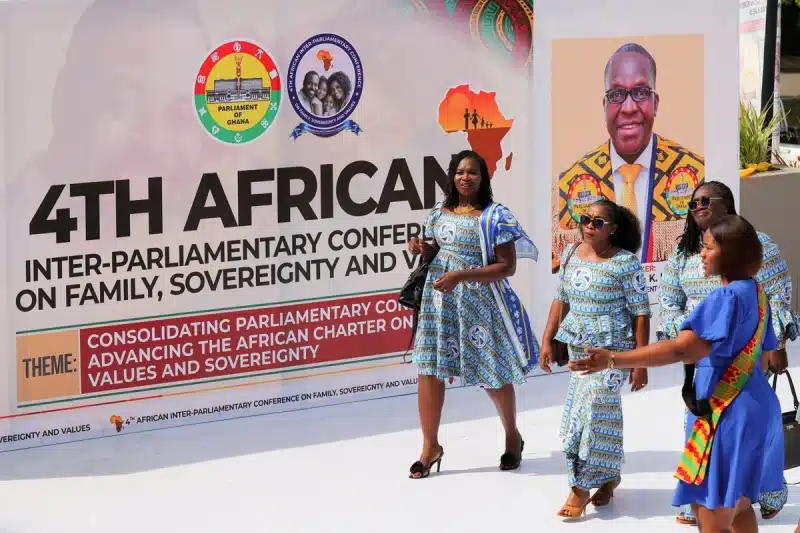

Lawmakers from more than 20 African countries have endorsed a landmark continental document affirming traditional African family values, following a four-day parliamentary conference held at Ghana’s Parliament House in Accra.
The 4th African Inter-Parliamentary Conference on Family, Sovereignty and Values ran from 3 to 6 June under the theme “Advancing the African Charter on Family, Sovereignty and Values.” It brought together speakers of parliament, deputy speakers, legislators, policy experts, faith-based organisations, and civil society representatives for what organisers described as a defining moment in a growing continental movement.
The draft charter aims to establish a continental legal and moral framework to safeguard traditional African social norms, religious beliefs, and national sovereignty against what organisers described as foreign ideologies.
The first three conferences were hosted by Uganda in Entebbe beginning in 2023, and the number of attendees has grown each year. The Accra gathering represented the widest participation yet.
Delegates said the conference reflected growing continental support for policies designed to protect African family values amid rapid social and political changes.
Bagbin: African family is the foundation of sovereignty
Ghana’s Speaker of Parliament, Rt. Hon. Alban Sumana Kingsford Bagbin, delivered the keynote address on the opening day. He told delegates that true sovereignty “is born, nurtured, and sustained in the smallest unit of governance on Earth, the African family.
Bagbin did not mince his words. He cautioned that conditioning aid on the alteration of African family values and domestic laws violates the principle of sovereign equality enshrined in the United Nations Charter, adding: “We expect in turn the same respect for our sovereignty.”
Addressing delegates, he said: “When you return to your respective capitals, let the resolutions we adopt here not gather dust in the archives of our secretariats. Let them be translated into active bills, robust budgetary allocations, and rigorous oversight.”
He argued that Africa must remain firm in protecting its cultural identity while engaging with the wider world, declaring: “Our laws must look like the people they are written to protect.
A charter written by Africans for Africans
The initiative’s supporters say the Charter provides a common framework for protecting African family values while respecting the diverse legal systems and cultural traditions across the continent.
Uganda’s Sarah Opendi, Chair of the Uganda Parliamentary Forum on the Family, was both the founding chair of the first African Parliamentary Council and the primary legal and political architect of the African Charter put forward for adoption at the Accra meeting.
The Charter is an attempt to unite African countries in support of African family values and cultural heritage, and to urge African heads of state to oppose what delegates regard as novel international demands that conflict with those values.
Speaker Bagbin linked the Charter’s implementation to the African Union’s Agenda 2063, specifically Aspiration 5, which envisions “an Africa with a strong cultural identity, common heritage, shared values, and ethics,” arguing that defending African family values is inseparable from the continent’s broader goals of integration, industrialisation, and sustainable development.
Opendi called on African lawmakers to reduce reliance on external funding for future continental initiatives. “It is time African parliaments do what they deem fit rather than relying on grants and funds that come with strings attached,” she said.
Delegates argued that strengthening African family values requires greater domestic investment in family-centred policies, education, and cultural preservation programmes.
Countries represented at the conference included Burundi, Chad, Cameroon, Sierra Leone, Liberia, Togo, Côte d’Ivoire, Kenya, Uganda, Tanzania, Eswatini, Zimbabwe, Zambia, South Sudan, Namibia and several others.
18 countries approve the African Family Values Charter
Lawmakers from 18 of the 20 represented countries approved the Charter. The document calls on signatory states to enact national laws that safeguard African culture and cultural values.
Supporters argued that the Charter offers a practical roadmap for incorporating African family values into national legislation and public policy frameworks.
In a draft communiqué issued at the conclusion of the conference, participants expressed concern about what they described as escalating threats to African family values, national sovereignty, and societal values. Discussions encompassed African family systems, sovereignty and cultural preservation, value-based education and youth development, gender, marriage and family well-being, as well as technology, media, and global influence.
South Africa and Mozambique abstain
Two delegations declined to adopt the Charter. South Africa’s head of delegation, Zandile Majozi, stated that while the country respects the charter’s objectives, the provision defining marriage as exclusively between a man and a woman is inconsistent with the country’s Constitution and the international legal principles it upholds.
Mozambique also announced its abstention, with the head of its delegation, Carlos Tembe, citing logistical challenges and legislative scheduling constraints in a letter addressed to Speaker Bagbin.
Conference rooted in a three-year continental push
For decades, Western countries and international organisations have tried to link foreign aid to conditions requiring African countries to adopt policies that many on the continent say contradict deeply held cultural and religious convictions. The annual conference movement, which began in Uganda, was born directly out of that tension.
Speaker Bagbin proposed that the Charter be formally adopted by regional legislative bodies, including the Pan-African Parliament, the ECOWAS Parliament, and the East African Legislative Assembly, arguing that a harmonised continental standard would prevent “forum-shopping” and resist external legal pressures.
For many delegates, the Accra conference was not merely about drafting a charter. It was about safeguarding Africa’s right to define itself.
Human rights organisations have challenged the initiative. The International Planned Parenthood Federation Africa and partner groups issued a joint statement warning that the weaponisation of “family values,” “African culture” and “sovereignty” as political tools risked justifying exclusion and discrimination, and could divert public attention from urgent national priorities.
Supporters of the Charter dismissed such criticisms as an extension of the same external pressure the conference was convened to resist. They insisted that the debate ultimately centres on who has the authority to define African family values and determine how they should be reflected in national laws.


