




Niger has moved to reclaim undeveloped Agadem oil fields from China’s state oil giant, China National Petroleum Corporation (CNPC).
The military government said late on Saturday, according to AFP, that it is withdrawing all unexploited Agadem oil fields from China National Petroleum Corporation (CNPC) and its subsidiaries.
It is the sharpest turn yet in a two-year quarrel, and the Agadem oil fields are now its centrepiece.
Foreign Minister Bakary Yaou Sangaré read the statement on state television. He chairs the committee that negotiates with the oil companies.
Six months and ten days after a partnership protocol was signed on 18 May, he said, the committee saw no significant progress. In remarks carried by AFP, Sangaré said: “Faced with this inertia, the Niger state is compelled to take measures.”
The three companies in the firing line are CNPC-NP, the Zinder refinery operator SORAZ and the pipeline operator WAPCO. A 45-day deadline, set on 13 October, has now run out.
At the heart of it is money. Niger’s negotiators say more than CFA 3,000 billion in revenue from oil exports since 2024 has not been repatriated to Niger. AFP puts the government’s estimate at more than $5 billion
Both figures are Niamey’s own. No public response from CNPC had been reported by Sunday.
The committee wanted more than cash. It asked for an independent audit of Agadem’s reserves. It also wanted a plan to replace foreign workers gradually, and proof that local firms win subcontracts.
The package goes well beyond the Agadem oil fields. Niger will stop paying maintenance and financing costs on the export pipeline to Benin. It wants back what it says it wrongly bore. Penalties will hit CNPC and WAPCO over the unrepatriated earnings.
It will also charge fees to use the pipeline that feeds the Zinder refinery, which it now treats as public domain. Work visas will be withdrawn where companies break the rules. Legal action will follow over environmental damage.
Reports of the statement do not say which Agadem oil fields are affected, or how many. The wording covers only fields not yet in production.
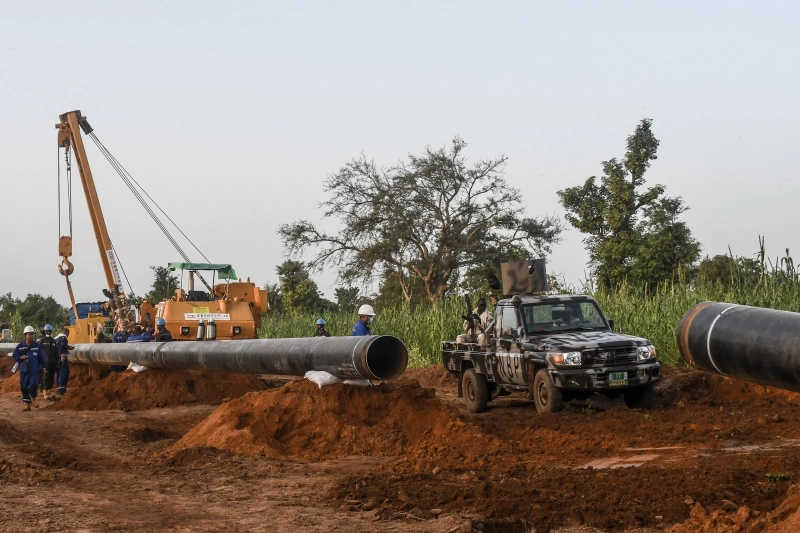
That matters because the Agadem oil fields are the engine of Niger’s oil industry. CNPC has run the crude there since 2011, according to AFP. A 1,950-kilometre pipeline carries it to Benin’s coast. Output has settled near 110,000 barrels a day.
Niamey also demanded the reopening of two projects in the Agadem area. AFP reported that they carry an announced $1 billion investment. They should lift output from 110,000 to 145,000 barrels a day by the end of 2029.
So Niger wants more oil, faster, from the Agadem oil fields, and from a partner it says is not delivering. Yet it also needs that partner.
The pipeline cannot simply be replaced, and CNPC built it. Niger also took a $400 million advance from the company against future oil sales in April 2024.
The quarrel did not start on Saturday. AFP notes that company executives and workers were expelled in 2025. On 18 May this year, the two sides signed the protocol meant to settle matters. It reportedly gave Niger a 45 per cent stake in WAPCO.
Niamey is not claiming a clean sheet. The committee’s own statement admits delays on the state’s side. These include audits of oil and pipeline spending, and the settling of debts between the state oil company Sonidep and SORAZ.
The door is also open. Niger says it remains willing to talk to a Chinese delegation sent to Niamey for the purpose.
The pipeline ends at Benin’s Sèmè-Kpodji terminal, the sea outlet for Niger’s crude. That ties a third country to the quarrel. It also fits a wider pattern, as military-led governments across the Sahel press foreign firms for a bigger share of resource wealth.
Read closely, this looks less like an eviction than a bargaining chip. Fields already in production are not mentioned. Only the undeveloped Agadem oil fields are in play. Talks are on offer, and the pipeline still binds both sides.
But one question hangs over it. If CNPC will not develop the Agadem oil fields, who will? Niamey has not said, in reports so far.
Barrels in the ground are the easy part of the oil business. Who gets paid when they come out is the real fight, and Niger has just raised the stakes.


