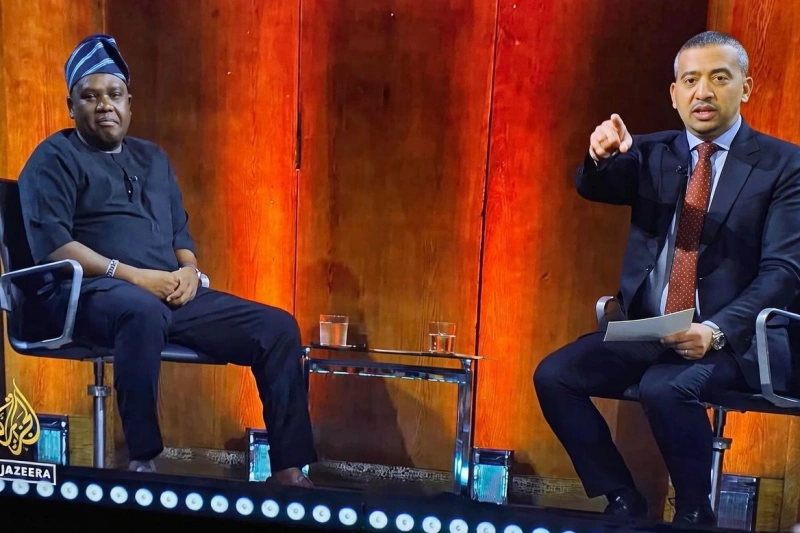
A tense television exchange between Nigerian presidential aide Daniel Bwala and journalist Mehdi Hasan has triggered widespread debate online after airing on Al Jazeera’s Head to Head programme.
Clips from the Bwala Mehdi Hasan interview began circulating across Nigerian social media platforms shortly after the broadcast, drawing strong reactions from supporters of the government as well as critics. The discussion quickly expanded beyond the personalities involved and touched on deeper questions about Nigeria’s political rhetoric, economic policy and public trust in leadership.
Recorded in Doha as part of Al Jazeera’s long-running interview series, the Bwala Mehdi Hasan interview placed the presidential aide in front of a panel that included journalists and policy analysts who challenged several positions taken by the administration of President Bola Ahmed Tinubu.
What caught viewers’ attention was not only the sharp tone of the questioning. The conversation gradually opened into a broader argument about Nigeria itself. It explored how the government explains the country’s direction and how many citizens experience the situation on the ground.
As the exchange unfolded, familiar themes in Nigeria’s national debate surfaced one after another. These included insecurity, economic pressure and the credibility of political actors. Several moments in the Bwala Mehdi Hasan interview illustrated how wide that divide has become.
When Past Statements Returned
One of the most dramatic portions of the Bwala Mehdi Hasan interview came when Hasan confronted Bwala with statements he made during the 2023 presidential election campaign.
At that time, Bwala was a vocal critic of Tinubu’s candidacy. Hasan quoted remarks attributed to him in which he had accused Tinubu of serious misconduct during the election period. Among the allegations was the claim that political structures connected to the campaign operated like a militant arm intended to influence the outcome.
Bwala rejected the framing of those earlier remarks. The statements, he said, reflected the reality of political competition at the time.
In politics, he argued, positions can change as circumstances evolve.
Hasan pressed the point further. If accusations made during campaigns can later be dismissed as simply part of opposition messaging, he asked, how should the public judge the credibility of such claims in the first place?
For many viewers watching the Bwala Mehdi Hasan interview, that moment captured a wider concern about Nigeria’s political culture, where alliances shift quickly and yesterday’s critic may become today’s defender.
Denials and Disputed Facts
Another uncomfortable moment came when Hasan began reading statements Bwala himself had made during the election period.
Hasan cited remarks suggesting Bwala had been deeply distressed by the outcome of the 2023 vote. Bwala quickly objected, saying the quote might not belong to him and suggesting the interviewer could be confusing sources.
The exchange set the tone for the rest of the segment. Both men appeared to be working from sharply different interpretations of the same political events.
Throughout the Bwala Mehdi Hasan interview, Hasan relied on reports and figures from international organisations such as Amnesty International and the World Bank, particularly when discussing insecurity and poverty.
Bwala responded by questioning how some international institutions portray Nigeria. In his view, external reports sometimes overlook the country’s internal political dynamics and the complexity of its security challenges.
The disagreement highlighted a broader issue in Nigerian public discourse. Competing narratives often exist around the same facts.
Security and International Cooperation
Security policy also became a focal point during the Bwala Mehdi Hasan interview.
Hasan raised questions about reports of United States military involvement in operations targeting extremist groups within Nigerian territory. Bwala described the situation as part of intelligence cooperation between Nigeria and its international partners.
For the government, such collaboration reflects a strengthening of Nigeria’s security architecture. Critics argue that the issue raises questions about transparency, civilian protection and the role of foreign actors in domestic security operations.
The discussion illustrated how debates over counter-terrorism frequently intersect with broader political narratives about sovereignty and accountability.
Economic Reform and Public Hardship
Economic policy produced some of the most sustained exchanges in the Bwala Mehdi Hasan interview.
Bwala defended the administration’s economic reforms, including the removal of fuel subsidies and the unification of exchange rates. He described the changes as necessary steps to stabilise the country’s finances.
He noted that institutions such as the International Monetary Fund and the World Bank have broadly supported the direction of the reforms.
The exchange echoed an argument that has become familiar in Nigeria’s policy debates.
Government officials often highlight macroeconomic signals such as foreign reserves, exchange-rate stability and international endorsement of reforms. They argue that these indicators show the economy is gradually stabilising.
Critics focus on a different set of indicators. They point to rising food prices, transportation costs and the growing number of families struggling to keep children in school.
For many Nigerians following the Bwala Mehdi Hasan interview, the disagreement reflected the difference between economic indicators discussed in policy circles and the pressures people experience in everyday life.
Fact Check: Claims in the Bwala–Hasan Interview
Claim 1: Security Situation
Statement during the interview
Daniel Bwala said insecurity in Nigeria is not worsening and argued that the first two years of the administration experienced “substantial peace.”
Available data
Conflict monitoring by the Armed Conflict Location & Event Data Project (ACLED) shows an increase in conflict-related fatalities between 2025 and early 2026. Analysts say casualty levels in some regions resemble “wartime conditions.” Reports also document continuing attacks on schools in northern Nigeria.
Context
Security analysts note that violence trends in Nigeria vary significantly by region. Some areas have seen improved military coordination, while others continue to experience banditry and insurgent activity.
Assessment: Disputed
Claim 2: Foreign Reserves and the Naira
Statement during the interview
Bwala argued that Nigeria’s foreign reserves are at a multi-year high and said exchange-rate reforms have stabilised the economy.
Available data
According to figures from the National Bureau of Statistics, reserves have strengthened compared with previous years and have helped cushion currency volatility.
However, the naira remains under pressure. As of early March 2026, the official exchange rate is around ₦1,380 to the dollar, while the parallel market rate remains weaker.
Context
Economists note that reserve growth can stabilise markets but does not automatically reduce inflation or food prices in the short term.
Assessment: Partly accurate
Claim 3: Out-of-School Children
Statement during the interview
Bwala suggested that widely reported figures about Nigeria’s out-of-school children may lack context because some students have been relocated to safer learning centres.
Available data
Estimates from UNICEF and Save the Children indicate that between 18 million and 28 million Nigerian children and adolescents remain outside formal schooling.
The highest concentration is in the North-East and North-West regions.
Context
Education experts say insecurity, poverty and displacement have disrupted schooling in many communities for more than a decade.
Assessment: Contested
A Debate Beyond the Interview
By the end of the programme, the discussion had drifted beyond the specific allegations raised during the exchange.
Instead, the conversation began to circle around a deeper issue that frequently surfaces during election cycles in Nigeria. The issue is how seriously campaign rhetoric should be taken once political alignments change.
Statements made during campaigns often disappear once alliances shift. Critics say this weakens public trust, while politicians argue that evolving circumstances require flexibility.
For viewers, the Bwala Mehdi Hasan interview offered a rare unscripted moment in which those tensions played out in real time.
It also left a broader question hanging in the air. Do political statements made during election campaigns reflect genuine conviction, or are they simply strategic tools in the struggle for power?
In a country where public debate is increasingly shaped by economic hardship and security concerns, that question continues to resonate well beyond the television studio.