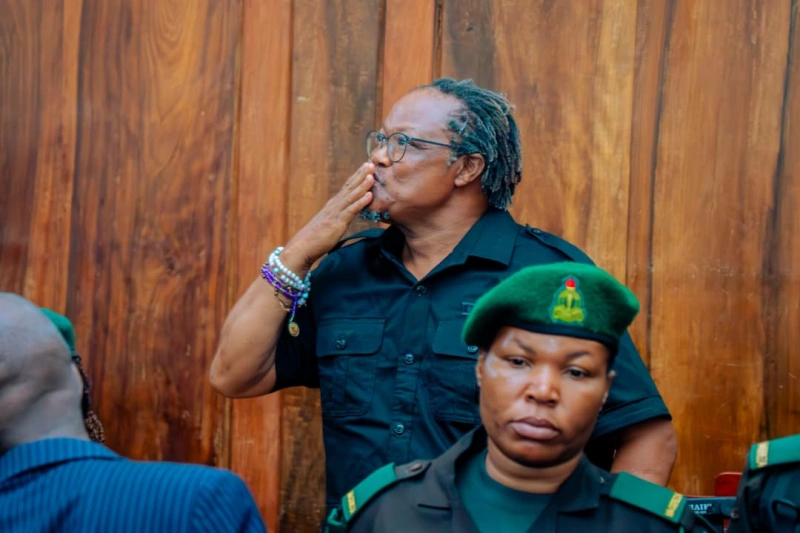
The state needed to prove three things to convict Tundu Lissu of treason. On Friday, the High Court delivered its Lissu treason verdict, saying prosecutors failed on the second.
The Citizen reported that the High Court’s Dar es Salaam Sub-Registry delivered the Lissu treason verdict on 6 November 2026. The court found that prosecutors did not prove the Chadema chairman intended to intimidate the government.
Presiding Judge Dunstan Ndunguru told the court the offence has three elements. The accused must owe allegiance to the United Republic. He must intend to intimidate the government. And he must show that intention through published writings or other overt acts.
The judge said the last two were contested at trial and central to deciding Lissu’s guilt or innocence.
The first element was not disputed. Lissu acknowledged that he was a Tanzanian citizen and therefore owed allegiance to the United Republic.
The case behind the Lissu treason verdict rested on words, not weapons. On 3 April 2025, Lissu addressed party aspirants at Chadema’s offices in Dar es Salaam, in the middle of its “No Reforms, No Election” campaign. Prosecutors said he used the meeting to urge people to stop the October election and to mobilise rebellion.
On intent, The Citizen reported before the judgment that prosecutors argued that seeking to block elections held under the Constitution defies the legal framework the government must enforce. Lissu answered that his remarks never named the government or any senior official. He also said no witness had claimed the government was frightened.
The prosecution replied, The Chanzo reported, that it only had to prove an intention, not an effect. That was the central legal dispute the judges had to resolve.
The full reasoning behind the Lissu treason verdict has not yet been widely reported. In the accounts available at the time of writing, neither the final order nor what it means for his release had been confirmed.
It has been a long road. Police arrested Lissu on 9 April 2025 after a rally in Mbinga, in the Ruvuma region. He was charged with treason the next day under Section 39(2)(d) of the Penal Code. Treason is not bailable in Tanzania, so he has spent 576 days in custody. When first charged, he also faced separate counts of publishing false information.
The trial was never straightforward. Prosecutors initially relied on video evidence from that meeting, but the judges ultimately excluded the footage and the related forensic report. On 22 October 2025, The Chanzo reported, the court found the police witness offering the footage was not qualified to do so. The related forensic report was rejected soon after.
That left the question of intent resting on people. Prosecutors called 17 witnesses, though they had listed 30. Lissu, who defended himself, argued that most anonymous witnesses had first been arrested as suspects over alleged plans for violence, then became witnesses once their own files were withdrawn. Those were his claims.
There was a further wrinkle. The Chanzo reported that a Jambo TV journalist who testified for the prosecution told the court the station’s own team livestreamed the meeting. Lissu did not operate the camera or tell anyone to post the footage, the witness said.
On 21 August 2026, the judges ruled that he had a case to answer. Justice Ndunguru chaired the panel with Justices James Karayemaha and Ferdinand Kiwonde. That ruling was only a threshold test. The final judgment required the judges to assess the evidence and determine whether the prosecution had proved the charge beyond reasonable doubt.
The politics around the Lissu treason verdict are hard to separate from the law. President Samia Suluhu Hassan was declared winner of the 29 October 2025 election with about 98 per cent of the vote. A commission appointed by her government later counted at least 518 deaths in the unrest that followed. The opposition and rights groups say thousands died.
Chadema says 71 of its leaders now face treason or terrorism charges. Defence lawyers in those cases are likely to study the Lissu treason verdict closely.
Pressure ahead of the Lissu treason verdict came from abroad too. The UN Working Group on Arbitrary Detention found in February that his detention was arbitrary. In July, the Commonwealth Ministerial Action Group urged a political and legal way out within 30 days. British MP Alicia Kearns and 23 other parliamentarians then wrote to President Samia. “Political disagreement is not treason,” Kearns wrote on X. Kenya’s former chief justice, David Maraga, called for Lissu’s unconditional acquittal on the day.
For the family, the Lissu treason verdict came in the middle of a funeral. Lissu’s elder brother Alute, a veteran constitutional lawyer, died on 1 November after a long illness. Before the judgment, family spokesman Vincent Lissu Mughwai said, “We believe the judges will act professionally, deliver justice and free Tundu.”
Lissu told the judges in his final submission, “I am a patriot. I am not a traitor.” On the question of intent, the court has now found that the prosecution failed to prove its case.