



On December 25, 2025, US airstrikes in Nigeria targeted Islamic State-linked militant camps in Sokoto State, northwestern Nigeria. The operation, carried out in coordination with Nigerian security forces, aimed to disrupt extremist networks responsible for attacks on civilians, including Christian communities. United States Africa Command (AFRICOM) reported several militants were killed.
The U.S. President authorised the strikes, which were carried out under the guidance of the Secretary of Defense alongside Nigerian security forces. The operation targeted militants responsible for attacks on civilians, including Christian communities, and officials said it was part of ongoing cooperation rather than a single, isolated action.
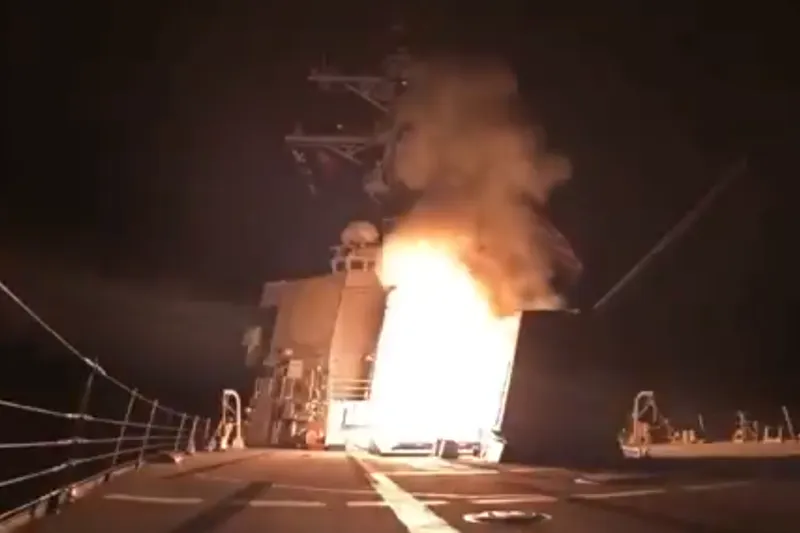
Pentagon video showed Tomahawk cruise missiles being launched from a U.S. Navy ship in the Gulf of Guinea. AFRICOM said the targets were selected based on verified intelligence. Precautions were taken to limit civilian risk. No civilian casualties were reported as of December 26, though assessments were ongoing.
Nigeria’s Ministry of Foreign Affairs confirmed that the strikes were part of existing security cooperation with the United States. The ministry said terrorism threatens all citizens, regardless of faith or ethnicity, and reaffirmed Nigeria’s commitment to maintaining internal security.
The airstrikes followed months of discussion between U.S. and Nigerian authorities about escalating attacks by Islamic State affiliates and Boko Haram factions. Earlier in 2025, the U.S. had designated Nigeria as a “country of particular concern” for religious freedom, warning that further action could follow if violence continued.
Nigeria faces multiple security challenges. The National Human Rights Commission reported that at least 2,266 people were killed by bandits or insurgents in the first half of 2025.
The northeast is the main zone of jihadist violence. Islamic State West Africa Province (ISWAP) has stepped up attacks on military bases and infrastructure in Borno State, using drones and coordinated assaults. Boko Haram, once considered weakened, has also returned. Suicide attacks, which had decreased in frequency, have resumed, causing new fears for civilians.
In northwest Nigeria, armed groups, locally referred to as bandits, are active in Zamfara, Katsina, and parts of Sokoto. They kidnap people, raid villages, and carry out deadly attacks. Both Muslim and Christian communities are affected.
Sokoto has seen fewer major attacks than the northeast, but officials say that senior figures and financiers linked to extremist groups rarely stay in active conflict zones. The Christmas Day strikes targeted such individuals based on intelligence, rather than recent local attacks.
Christian communities have been particularly affected. Open Doors reported that more than 4,000 Christians were killed in Nigeria for their faith in 2024. Muslims have also suffered from extremist attacks and bandit violence.
Nigerian authorities emphasise that the security crisis is not only about religion. Land disputes, climate pressures, poor local governance, and cross-border arms flows all contribute to violence. Analysts agree that multiple factors sustain insecurity in Nigeria.
The strikes mark a significant step in U.S. engagement in West Africa, where Washington usually focuses on training and intelligence sharing. A State Department official said the approach combines military support with diplomatic engagement.
The operation came at a time when regional security coordination was under strain. Earlier in 2025, Niger pulled out of the Multinational Joint Task Force, which made it harder to share intelligence and left border areas less secure. Armed groups took advantage of the gaps.
Since 2000, the U.S. has given Nigeria more than $2 billion in support for training, equipment, and aircraft. This has helped to improve the country’s security forces, but some past operations ended up harming civilians, which drew criticism.
Reactions to the airstrikes were mixed. U.S. officials called the strikes necessary to disrupt extremist networks. Nigerian authorities emphasised cooperation and sovereignty. No further strikes have been announced.
Earlier on Christmas Day, a suspected suicide bombing at a mosque in northeastern Nigeria killed at least five people, showing that extremist violence continues.
Whether the airstrikes signal more direct U.S. military involvement or remain a targeted intelligence operation is unclear. Nigeria’s security issues, driven by insurgency, crime, and structural weaknesses, will not be solved by force alone.

