



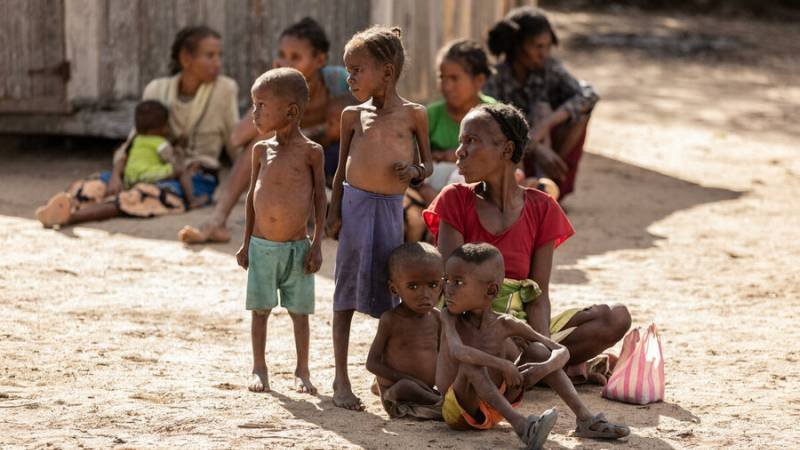
Southern Madagascar faces a deadly famine. But unlike Cape Verde and Namibia, where drought is also a reality, this crisis stems from deeper failures of governance, planning, and global neglect.
Berenty Village, Southern Madagascar – Selambo wakes before sunrise, ties an empty yellow jerrycan to her hip, and walks. Eight kilometres to the nearest well. Then back again, hoping the water hasn’t dried up or turned brown.
At 50, she has lived through many dry seasons. But she says this one is different. “The rain stopped four years ago,” she says, squatting beside what used to be her family’s cornfield. “We plant. We pray. Nothing grows.”
Across Madagascar’s Grand Sud, over one million people face chronic food insecurity. At least 400,000 are on the brink of famine. Children forage for cactus and roots. Mothers wait for trucks carrying corn or pulses, sometimes for weeks.
The UN calls it one of the worst humanitarian crises in Africa. Climate scientists have warned for years this was coming. But the bigger question is this: Why is Madagascar starving, while other drought-hit nations, like Cape Verde and Namibia are not?
“My Children Forage While I Wait for Rain”
In nearby Ambory, 14-year-old Tsimotso leads his siblings through dry brush, searching for tubers. “Last year, our fields were dust,” he says. His voice is flat, resigned. “We ate whatever we could find.”
Vilisoa, a 27-year-old mother, holds her six-month-old son as an aid worker wraps a coloured measuring tape around the baby’s arm. The result is red, severe acute malnutrition. “My other children know what to find in the bush,” she says. “They’ve become experts at survival.”
Lessons from Across the Ocean: Cape Verde
Cape Verde, a small island nation off the coast of West Africa, receives less rainfall than southern Madagascar. But it has avoided famine for decades.
Why? According to Dr. Vera Duarte, former minister and UN rapporteur, the answer lies in what the Cape Verde government has done – preparedness.
“We’ve lived with drought forever. But we invested in desalination, food reserves, and early warning systems,” she says. “We didn’t wait for disaster, we planned for it.”
The government partners with farmers on drought-resistant crops and uses solar-powered desalination to support water needs. When rains fail, the country doesn’t wait for aid, it moves to protect lives.
Namibia’s Model: Blending Tradition and Science
Namibia, too, faces recurrent drought. In 2019, it declared a state of emergency, mobilising emergency funds and deploying water trucks and borehole repairs.
“We blend indigenous grazing knowledge with science,” says Dr. Helena Amutenya, a government agricultural adviser. “We act before things collapse.”
Namibia’s early action and rural support systems have helped avoid full-scale famine, even when the rains disappear.
What Went Wrong in Madagascar?
“This is not just climate, it’s systemic failure,” says Pasqualina Disirio, country director for the World Food Programme (WFP). “Rain-fed agriculture is vulnerable, yes. But the bigger issue is governance and investment.”
According to the World Bank, Madagascar hasn’t modernised its southern water systems since the 1960s. There are no large-scale irrigation projects. No functioning disaster response infrastructure. No national adaptation plan for the South.
And when early warnings came, satellite data, rainfall anomalies, child malnutrition alerts, they were either ignored or downplayed.
Women Battling the Crisis, and the Solutions
In Erada, 35-year-old Sailambo has built rainwater tanks with a group of women. “We collect whatever we can,” she says. “We can’t wait for government promises anymore.”
These women have also started seed exchanges, revived traditional soil preservation methods, and formed food-sharing groups for the most vulnerable.
“If we don’t lead, we die,” Sailambo says plainly.
But their work is underfunded. Their voices rarely heard.
Climate Apartheid and Global Indifference
Madagascar emits just 0.01% of the world’s carbon emissions. Yet it suffers one of the worst climate-related hunger crises globally. President Andry Rajoelina has called it climate apartheid, where poor countries pay the price for rich nations’ emissions.
But despite this moral framing, global funding has lagged. The WFP appealed for $70 million. Only a fraction has come.
“If there were guns, the world would pay attention,” says Landry Ninteretse of 350.org. “But there’s no war here, just hunger.”
What Needs to Happen
- National action: Madagascar’s government must prioritise the South in its development plans. That means irrigation, water infrastructure, and food storage.
- International solidarity: Wealthy countries must fulfil climate finance promises, not just for mitigation, but for adaptation in places like Madagascar.
- Local leadership: Women like Sailambo and youth like Tsimotso are not victims, they are solutions in motion. They deserve funding, training, and platforms.
A Warning for All
Southern Madagascar isn’t just a crisis zone. It is a warning.
The famine here wasn’t inevitable. Drought doesn’t always equal starvation. But when poverty meets poor planning, and the world looks away, disaster follows.
The last meaningful rain came four years ago. When the next one comes:
Will action come with it? Or will we wait again, until more children must learn the science of survival instead of the joy of being full?
Reporting for this article was based on interviews with local residents, aid workers, and researchers, as well as analysis of climate data and humanitarian reports from international organisations.

