We have a curated list of the most noteworthy news from all across the globe. With any subscription plan, you get access to exclusive articles that let you stay ahead of the curve.
We have a curated list of the most noteworthy news from all across the globe. With any subscription plan, you get access to exclusive articles that let you stay ahead of the curve.
We have a curated list of the most noteworthy news from all across the globe. With any subscription plan, you get access to exclusive articles that let you stay ahead of the curve.
We have a curated list of the most noteworthy news from all across the globe. With any subscription plan, you get access to exclusive articles that let you stay ahead of the curve.
Maduro’s capture dominated headlines for its dramatic military execution, but the real impact is on millions of Venezuelans facing hunger, displacement, and a fragile economy.
By Mercie Wamoyi(KBC – Nairobi) and Oruruo Samuel Okechukwu
Part Two of a Two-Part Series on Kenya’s Renewable Energy Transition
The wind turbines of Lake Turkana stretch across the desert like white giants. But for the Turkana people who once called this land home, they symbolise a harsh trade-off: clean electricity for the nation, at the cost of displacement and disruption for local communities.
The Lake Turkana Wind Power Project—with 365 turbines generating 310 megawatts of electricity—is Kenya’s renewable energy ambition made manifest. But indigenous pastoralist communities were displaced without adequate consultation or compensation. Courts later ruled the land acquisition irregular, though they allowed time for regularisation. The resulting social upheaval triggered inter-ethnic tensions, substance abuse, and increased vulnerability among displaced populations.
“The biggest challenge has been the procedure with which the land was acquired,” says Muturi Kamau, National Coordinator of the Kenya Oil and Gas Working Group. “I don’t think that is one of the issues that, to this day, has been addressed.”
My name is Engr. Thomas Cheruiyot Sigowa CEO and Founder of Afriwatt Engineering Ltd A renewable energy company operating in East Africa and forecasting to establish operations across Africa
Thomas Cheruiyot Sigowa, CEO of Afriwatt Engineering Ltd, adds that while legal victories exist—like those affirming irregular acquisition—they rarely result in compensation. “There are sufficient legal structures. New reforms may not be necessary. Strict adherence to existing laws will deliver land justice,” he argues.
This is the other side of Kenya’s renewable revolution: a struggle over power—not just electrical, but political, economic, and communal.
Policy vs. practice
While policies exist, enforcement remains weak. Samuel Mwanza, a sustainable finance expert at Kenya Broadcasting Corporation, notes:
“Corruption and limited institutional capacity undermine implementation. Politicians sometimes bend laws to please electorates, allowing environmental violations.”
The high cost of green technologies—solar panels, batteries, EVs, and waste-to-energy systems—remains a significant hurdle despite subsidies.
Urban growth, uneven gains
Urbanisation is relentless. Cities like Nairobi, Mombasa, Nakuru, Kisumu, and Eldoret expand rapidly, outpacing infrastructure development. While projects like Dandora waste-to-energy facilities exist, gaps in capacity persist.
Climate vulnerability: A vicious cycle
Kenya’s renewable push is undermined by climate unpredictability. Most agriculture remains rain-fed. Droughts shrink hydropower capacity (21% of the national mix), forcing reliance on fossil backups and threatening grid stability.
Despite an 83% literacy rate and 76.5% electricity access by 2023 (World Bank), Mwanza warns of low public awareness:
“BEHAVIOURAL change is limited. People don’t fully understand energy conservation or support for renewable projects. This affects acceptance.”
The reality gap
In Kitui County, Rose Ndila celebrates liberation from 10-kilometre walks to charge a phone. But in Nairobi’s informal settlements—Kibera, Mathare—residents still rely on kerosene, charcoal, or illegal and dangerous grid hookups.
In Turkana County, however, EU-funded mini-grids from Renewvia and Kudura are
improving lives. “Tariffs are much lower compared to the national grid,” says Kamau. “Land use fees are paid to the community—creating a win-win situation where access and development co-exist.”
Resilience in arid lands
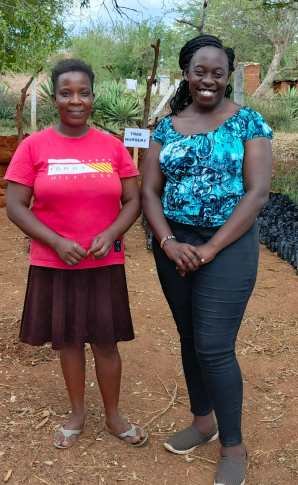
Faith Matata Mulengwa in red a beneficiary of modern green farming practices from Makueni County. She stands in this picture with our reporter in Konya – Noel Cynthia Atieno
In Makueni County, Faith Matata Mulengwa, a farmer from Kai sub-location, exemplifies adaptation. Once a maize farmer, Faith pivoted to drought-resistant crops like millet, sorghum, cowpeas, and green grams. She also turned to grass farming, specialising in Boma Rhodes and Centurus, thriving in Ukambani’s arid climate.
“Centurus grows best here. I used savings from my SACCO job to secure land and train other farmers,” she says.
Through WhatsApp groups sharing climate forecasts and training from KALRO, she now runs a field school helping farmers turn challenges into opportunities. Yet she faces hurdles: lack of certified seeds, poor timing, and unpredictable rainfall.
Her story demonstrates grassroots innovation often overlooked in top-down energy narratives—and underscores the need to invest in community-driven solutions.
The consent challenge
Community consultation remains inconsistent. Kamau notes:
“Free, prior and informed consent is not anchored in policy. The investor’s approach often determines whether they get the social license to operate.”
Muturi Kamau, National Network Coordinator of the Kenya Oil and Gas Working Group (KOGWG)
Sigowa concurs but adds nuance:
“Informed consent is often used for paperwork rather than real empowerment. Public awareness campaigns are needed to make consultation meaningful.”
Compared to countries like Canada, where consent for indigenous peoples is codified, Kenya is “barely scratching the surface,” Kamau observes.
The monopoly problem
Kenya’s energy sector is centralised. In contrast to Rwanda’s open market, Kenya’s monopolised system limits small players and community initiatives.
The Makueni Solar Cooperative, serving 3,000 people, offers an alternative. But it remains isolated from national support. Ruth Nzioka, a solar technician, has helped schools and hospitals reduce costs—but scaling her work means navigating bureaucracy tailored to corporate utilities, not grassroots actors.
Sovereignty vs. dependency
Kenya’s renewables boom is fuelled by foreign loans. Chinese-funded infrastructure and IMF austerity measures deepen debt stress and limit domestic control over energy choices.
“Some foreign investments bring skills and economic growth. Others leave communities displaced and ecosystems damaged,” Sigowa notes.
This paradox—energy independence funded by external debt—raises urgent questions about sovereignty and social equity.
Grid politics and infrastructure control
Approaching 100% renewable electricity by 2030 requires technical upgrades—but also political will. Subnational governments allocate less than 2% to climate activities. Rural areas, especially ASALs (arid and semi-arid lands), remain marginalized.
Outages are 40% higher in these areas. Without equitable grid investment, Kenya risks a two-tiered system—green cities and grey peripheries.
Navigating the regulation maze
Startups like Wisdom Innovations and Sanivation struggle under red tape. Feed-in Tariffs and energy auctions favor big players. Meanwhile, projects like Solar Mamas train women in solar tech, but lack pathways to scale due to licensing and financing barriers.
International pressure and constrained choices
Global expectations add pressure. Chinese loans required specific procurement rules. IMF loan conditions forced energy subsidy cuts. The 2023 Africa Climate Summit amplified Kenya’s leadership—but tied it to global financing frameworks.
Grassroots movements, like Elizabeth Wathuti’s Green Generation Initiative, plant trees and build awareness. Yet even they must adapt to global donor agendas, straining local priorities.
The fragmented system
Monitoring and evaluation systems are disjointed. Agencies, donors, and counties use incompatible metrics, leading to double-counting and policy blind spots.
A solar charging station may serve a village still lacking clean water, clinics, or schools. National success masks local complexity.
The unfinished revolution
Kenya’s renewable journey marks true progress. Entrepreneurs like Ndila, Nzioka, and Faith Mulengwa show what’s possible. Achieving 90% renewable electricity is impressive.
But the full story includes Turkana’s displaced, urban energy poverty, rural neglect, and foreign debt. The renewable future must confront not just technical challenges, but also systemic injustice.
The turbines at Lake Turkana will keep spinning. But the communities beneath them deserve more than token inclusion. They deserve justice.
Success must not be measured only in gigawatts, but in equity. A just energy transition means power—clean, affordable, and political—reaching all Kenyans.