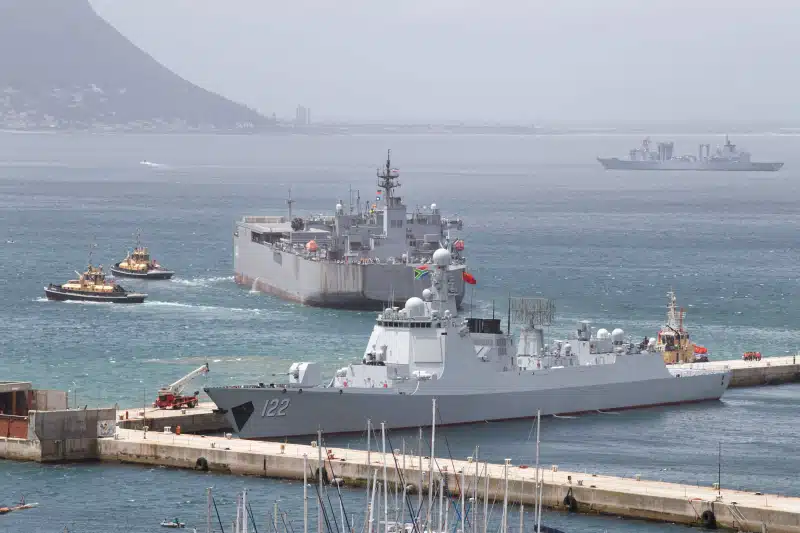
What looks like a routine drill at sea has wider meaning: the South Africa naval exercise in Cape Town highlights shifting alliances and growing pressure on African diplomacy.
Official statements emphasise routine objectives: maritime safety, anti-piracy coordination, and basic interoperability. Those activities are not unusual for navies operating in busy sea lanes. What makes this exercise different is not what the ships are doing, but who is doing it together, and where. The convergence of these particular navies in South African waters points to a global order that is shifting in ways that are becoming harder to ignore.
The timing sharpens the message. Russia’s invasion of Ukraine has dragged into its third year, with no settlement in sight and casualties continuing to mount. Moscow’s armed forces have been stretched and damaged by the war, yet the Kremlin remains determined to show it has not been pushed to the margins of global affairs. A Russian naval presence in Cape Town, even a modest one, is meant to signal exactly that. When similar exercises were held in 2023, their coincidence with the anniversary of the Ukraine invasion drew angry reactions from United States officials and leaders in the European Union. This year’s rebranding, after the postponement of the earlier “Mosi III” drills, appears designed to be less overtly confrontational. Few observers believe the underlying intent has changed.
China’s central role in coordinating the exercise points to ambitions that stretch well beyond East Asia. Over the past two decades, the Chinese navy has expanded at a pace unmatched by any other force, now boasting the world’s largest fleet by number of vessels. Exercises like this allow China to operate far from home waters and to deepen military relationships that sit alongside its economic footprint. For Beijing, South Africa offers a strategic prize: a partner positioned astride critical sea routes around the Cape of Good Hope and a respected voice in African and Global South diplomacy. Defence cooperation reinforces economic ties built through projects linked to the Belt and Road Initiative, quietly underlining China’s claim to global reach.
Iran’s presence introduces a different, more uneasy dynamic. Internationally, Tehran remains under heavy sanctions over its nuclear programme and its backing of armed groups across the Middle East. At home, the picture is even more unsettled. Since the death of Mahsa Amini in 2022, Iran has experienced waves of protest that have refused to fade away. Women have openly defied hijab laws, students have organised strikes, and acts of civil disobedience have become part of daily life in many cities. The authorities have responded with force, carrying out mass arrests and executions, yet the sense of legitimacy the regime once relied on appears badly eroded.
Against that backdrop, Iranian warships in South African waters are as much about projection as partnership. They offer Tehran a chance to appear confident abroad while grappling with deep unrest at home. There are practical incentives too. Working alongside the Chinese navy exposes Iranian officers to more advanced doctrine and operational practices. Building relationships beyond the Middle East may also matter if tensions in the Persian Gulf escalate again. For South Africa, however, hosting Iranian vessels raises uncomfortable questions about how far strategic cooperation can be separated from the domestic conduct of its partners.
To understand why Pretoria agreed to host the exercise, it helps to look at its increasingly strained relations with Western capitals. The 2023 drills triggered accusations from Washington that South Africa was undermining its long-standing claim to non-alignment. The US ambassador went as far as alleging that Russian ships had collected weapons from a South African naval base, a claim the government denied and said it could not substantiate. The episode sparked a diplomatic storm and revived threats to South Africa’s preferential trade access to the United States, arrangements that remain vital for manufacturers and farmers.
South African officials insist those tensions are being overstated. Defence representatives describe “Will for Peace 2026” as a routine multilateral engagement, no different in principle from exercises held with Western partners in the past. Deputy Defence Minister Bantu Holomisa has brushed off criticism, arguing that South Africa remains non-aligned and free to cooperate militarily with any country it chooses. Participation, the government says, does not amount to an endorsement of another state’s domestic politics or foreign policy. It is a position Pretoria has repeated often in recent years.
Still, patterns matter. Joint exercises with the United States that were once routine have been cancelled. Military cooperation with Western partners has cooled. At the same time, ties with China and Russia have deepened, and Iran has entered the picture. Taken together, these moves suggest a deliberate shift. South Africa appears to be betting that its future influence lies more with the BRICS grouping than with traditional Western allies. That calculation reflects ideology, rooted partly in the African National Congress’s history and Cold War relationships, but it also reflects a judgement about where global power and growth may be heading.
Domestically, the decision has opened new political fault lines. The Democratic Alliance has demanded greater transparency, pressing for parliamentary briefings on the cost, command structure, and strategic rationale behind the exercise. Party leaders argue that South Africa is drifting into alignment with states whose actions clash with the values it once championed, and that economic risks are being brushed aside. For a governing coalition already under strain, foreign policy has become another point of contention.
Those risks are not theoretical. South Africa’s economy remains deeply tied to trade with the United States and the European Union. The automotive industry depends heavily on preferential access to American markets, while agricultural exporters rely on similar arrangements. With unemployment stubbornly above 32 percent and growth projections hovering around 1.5 percent for 2026, any disruption to these relationships would be felt quickly and painfully.
There is little guarantee that the alternative will deliver relief. China dominates South Africa’s trade statistics, but not in a way that flatters Pretoria. Containers arrive full; far fewer leave in the opposite direction. Without addressing that imbalance, closer integration could entrench South Africa as a consumer market rather than an equal economic player. Russia and Iran, both operating under heavy sanctions, have little capacity to fill the gap. Once the language of multipolarity is set aside, the economic case looks thin.
The ripple effects extend beyond South Africa. Across the continent, governments are watching closely. Countries such as Kenya and Ghana have maintained relatively close ties with Western partners while still engaging China economically. Their leaders may see Pretoria’s approach as a warning rather than a model. Diversifying partnerships is one thing; appearing to choose sides in an increasingly polarised world is another.
Nigeria, Africa’s largest economy, offers a contrast. Abuja has welcomed Chinese investment in infrastructure while preserving security cooperation with the United States and Europe. It has avoided gestures that might be read as openly antagonistic to any major bloc. That balancing act is not without tension, but it underscores that alternatives exist.
For smaller African nations, there is far less room to experiment. Countries like Zambia, Mozambique, and Zimbabwe are already carrying heavy Chinese debts and hosting major Chinese-backed projects. Those realities make foreign policy less a matter of choice than of constraint. South Africa’s example suggests one possible direction: a full embrace of the BRICS-aligned camp. Whether that path delivers development or simply swaps one dependency for another remains an open question.
East Africa sits at the centre of these tensions. Chinese naval facilities in Djibouti and growing interest in ports along the Red Sea and Indian Ocean have already unsettled Western planners. South Africa’s decision to host these exercises may encourage other governments to deepen military ties with China, Russia, or Iran. It may also provoke stronger responses from Western powers, raising the cost of such alignments for states that can least afford additional pressure.
From a military perspective, the drills do address real needs. Piracy in the Mozambique Channel and around the Horn of Africa threatens shipping routes vital to South Africa’s economy. Improving the capacity of the South African National Defence Force to operate in these environments has clear value. Yet the choice of partners shapes the lessons learned. Training alongside Chinese and Russian forces nudges South Africa away from the Western standards and systems that have long underpinned its defence planning.
The consequences are most visible in the navy itself. Ageing vessels remain in service longer than planned, maintenance costs continue to rise, and strategic choices made today can bind future governments to obligations that are difficult to unwind.
Looked at more broadly, the exercise is not an isolated event. It mirrors China’s steady push to build military relationships across Africa, the Middle East, and Latin America. Beijing has established its first overseas military base in Djibouti, invested heavily in ports with potential dual-use functions, and expanded arms sales to developing countries. “Will for Peace,” despite its gentle title, adds another marker to that expanding footprint.
Russia’s role, though constrained by the war in Ukraine, serves a different purpose. Moscow is keen to show that efforts to isolate it have limits. Russian Foreign Minister Sergei Lavrov has toured Africa repeatedly, presenting Russia as an alternative partner unburdened by lectures on governance or human rights. For the Kremlin, the symbolism of participation outweighs the scale of forces involved.
Brazil and India, both founding members of BRICS, are absent. India’s uneasy relationship with China, shaped by unresolved border tensions and competition across the Indo-Pacific, leaves little appetite for naval drills that could be read as taking sides. Brazil has taken a different route, maintaining close economic ties with Beijing while avoiding steps that might strain relations with the United States or Europe. Their caution exposes how fragile BRICS unity becomes once security and defence enter the picture.
All of this places South Africa in a difficult spotlight. For years, Pretoria has described its foreign policy as non-aligned, pragmatic, and rooted in multilateralism. Hosting this exercise strains that narrative. Many African governments still value the flexibility that comes from engaging all sides, and a shift toward rigid bloc politics threatens that room for manoeuvre.
Transparency, or the lack of it, deepens the unease. Despite calls from opposition parties, the government has released little detail about the costs or long-term implications of the drills. That silence fuels suspicion about what agreements may sit behind the public programme. In a democracy, decisions with such wide-ranging diplomatic and economic consequences demand scrutiny.
The broader direction of South African foreign policy is becoming harder to deny. Positions taken on Ukraine, the cooling of Western military ties, and now the hosting of Chinese, Russian, and Iranian warships point in the same direction. The choice reflects genuine grievances about global inequality and historical injustice. It also carries tangible risks that extend well beyond symbolism.
The “Will for Peace” label sits uneasily with the reality of the participants. China is asserting itself more aggressively in the South China Sea and around Taiwan. Russia is prosecuting the largest European war since 1945. Iran continues to repress dissent at home while backing armed groups abroad. South Africa’s willingness to stand alongside these states, even briefly, sends a signal that will be read carefully in capitals far from Cape Town.
When the exercise ends on January 16, the ships will depart and the harbour will return to its familiar rhythms. The questions raised will linger. South Africa has revealed something about how it sees its place in a changing world. Whether that judgement proves prescient or costly remains uncertain. What is clear is that the waters off Cape Town have, for a moment, reflected a global order in flux — and a country navigating currents that may shape not only its own future, but the choices facing much of Africa in the years ahead.