



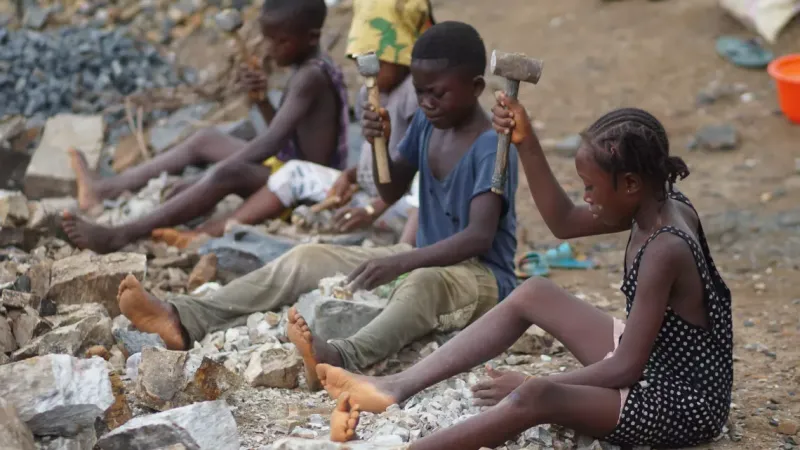

At dawn in Lagos, the streets fill with schoolchildren in uniforms, but not every child is headed for the classroom. Some walk toward mechanic shops, markets, or strangers’ houses where they will spend the day scrubbing, carrying, or cooking.
Across Africa, this parallel childhood defines millions of lives, a silent crisis of child and domestic servitude in Africa.
A Silent Workforce in Plain Sight
The International Labour Organization estimates that nearly 10 million domestic workers over age 15 labour across the continent, the vast majority women and girls. But the numbers barely scratch the surface. In Nigeria alone, a 2022 NBS/ILO survey found 24.7 million children in child labour, with nearly 23 million engaged in hazardous work, from construction sites to cramped homes where they serve as domestic “helpers.”
“They are the invisible workforce that keeps middle-class life functioning,” says one researcher. “But society treats them as if they don’t exist.”
Apprenticeships or Exploitation?
In Kano, Awwal, just 13, earns barely one dollar a day in a mechanic shop alongside 20 other boys under 18. Elders call it “apprenticeship,” a long-standing tradition across West Africa. But with no contracts, no regulation, and no schooling, the line between training and exploitation blurs. Boys lift engines; girls vanish into households. Both pay with their education and health.
Childhood Stolen Across Borders
The practice is not limited to Nigeria. In Guinea, “confiage” – child fostering, often turns into hidden servitude, with girls as young as five enduring overwork, beatings, and abuse. In Addis Ababa, studies found 28% of child domestic workers had their wages withheld. In Kampala, some girls earn less than $15 a month.
Sadly, it follows a very familiar pattern: lost schooling, stunted health, and futures traded for survival.
Colonial Echoes, Modern Chains
The roots lie deep in history. During colonial era, Kenya’s “Red Book” system, African workers’ movements were tightly controlled. In apartheid South Africa, domestic workers described daily “dehumanisation.”
Decades later, many still work without contracts or fair pay, often referred to by demeaning labels like “housegirl” or “boy.”
Gulf Migration Trap
For many, migration seems like escape. Agencies promising mouth waterin jobs in Saudi Arabia, Kuwait, and the UAE. Instead, women often fall into the kafala system, where employers seize passports and control every aspect of their lives. Amnesty International and media investigations have documented cases of Kenyan and Ethiopian women returning home scarred or never returning at all.
One survivor recalled being beaten daily and called a “Black animal.” Others died in suspicious “suicides.” The 2023 Global Slavery Index estimated 740,000 people in Kenya alone living under modern slavery conditions, many of them domestic workers.
Why Families Say Yes
Poverty and deprivations are the key drivers for the cycle. Parents send children away, convinced they will learn skills, eat better, or marry well. Instead, most are exploited. Communities normalize it with claims of “teaching responsibility.” Yet a nine-year-old working ten-hour days is not learning responsibility, they are losing childhood.
Stirring of Resistance
Change is emerging. Nigeria’s Devatop Centre runs campaigns against child domestic exploitation. Guinea’s ACEEF rescues girls from abusive households. APSEF teaches migrant girls in Mali to recognize and resist exploitation. South Africa, Mauritius, and Seychelles have ratified the ILO Domestic Workers Convention, offering a framework of contracts and protections others could follow.
Advocates agree the solutions are known: enforce child rights laws, make schools genuinely free, regulate apprenticeships, provide safety nets, and crack down on exploitative recruitment agencies.
Continent’s Choice
Africa stands at a crossroads. Its growth and progress rest uneasily on the backs of unseen children and women, millions working unpaid, unprotected, and unheard.
Child and domestic servitude in Africa has to stop, it must be addressed with urgency and dignity, else, the continent’s promise of prosperity will remain shadowed by stolen childhoods and invisible labour.


