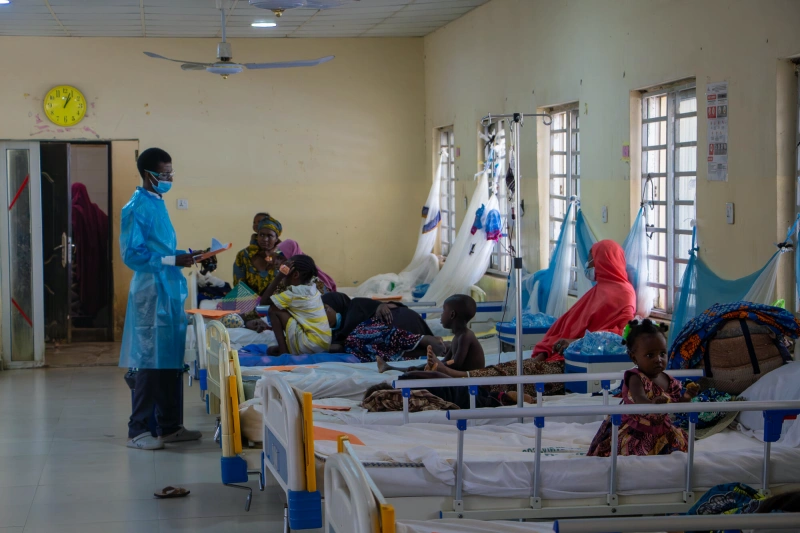
A three-day Senegal doctors strike starts on Monday, leaving public hospitals to treat emergencies only. It lands just as diphtheria spreads across the country.
Diphtheria is a highly contagious bacterial infection that mainly affects the nose and throat. It can cause breathing difficulties, heart complications and death if left untreated, particularly in children. The disease is preventable through routine vaccination, but outbreaks can occur where immunisation coverage is incomplete.
The Autonomous Union of Doctors, Pharmacists and Dental Surgeons of Senegal (SAMES) has called the stoppage for 28, 29 and 30 September, nationwide. A statement signed on Sunday by its secretary-general, Dr Diabel Dramé, says only emergency care will be covered.
The latest Senegal doctors strike is the fourth walkout in three weeks. The first three lasted 48 hours each.
The union says its demands date back to 2023. It struck in February 2025 over recruitment, pay and the status of doctors in specialist training, then joined a general strike on 10 July this year.
The Senegal doctors strike campaign took shape in September. On 7 September, a meeting with the health ministry collapsed before it began. The union’s delegation walked out because Health Minister Ibrahima Sy was not in the room from the start. The ministry says he was held up by other duties and planned to join later.
Strikes followed on 8 and 9 September, 16 and 17 September, and 23 and 24 September. After a meeting with the minister on 18 September, the union said it had seen no concrete progress and no verifiable commitments.
The union claims 99.64 per cent compliance with the Senegal doctors strike on 23 and 24 September, against 97.5 per cent on the first day, 8 September. Those figures are its own and have not been independently checked.
Its latest statement says the state has shown no real will to respond and vows that “SAMES will not yield”. It also calls the ministry’s reversal on a promise to withdraw a circular on housing allowances unacceptable. The union says that August circular could undermine housing support for medical staff.
The platform behind the Senegal doctors strike is long, but three themes run through it: jobs, careers and pay.
The union wants more doctors, pharmacists and dental surgeons recruited into the public service, and a special status for the medical corps. It also seeks a fairer allowance system, higher pensions and better-equipped hospitals, particularly outside Dakar.
The union sees a contradiction. Public health facilities lack staff, it says, yet qualified doctors, pharmacists and dental surgeons are out of work.
Al Jazeera reported that, according to the National Medical Council’s president, 5,236 doctors were registered at the end of 2024, 4,407 of them in the public sector. It also quoted Dramé on the wait for answers: “We waited, we hoped and we followed up.”
The timing is what sets this Senegal doctors strike apart. Senegal confirmed its first diphtheria case of the current outbreak on 1 August.
By 20 September, the health ministry counted 114 confirmed cases and 11 deaths across 31 health districts in 12 regions. On 3 September, the count stood at 34 cases and six deaths.
Kédougou, in the south-east, has the most cases, with 33. On 16 September, the union’s own figures put strike compliance in its Kédougou zone at 100 per cent.
Emergency care continues during the Senegal doctors strike. The ministry describes diphtheria as preventable by vaccination and has urged parents to check their children’s vaccination status. Its SAMU emergency line is 1515.
The strike has critics. Dr Doudou Sagna wrote in a Seneweb opinion piece that the earlier stoppage could have been postponed, because staff were needed to investigate, screen and treat cases. He accepted the right to strike, which Article 25 of the constitution protects, but said it must respect essential services.
The union’s demand has changed shape. Since 31 August it has asked for decision-makers at the table, a clear agenda and binding commitments. That makes the Senegal doctors strike as much about trust as pay.
Money is part of the picture. According to International Monetary Fund estimates cited by Al Jazeera, public-sector debt stood at 132 per cent of GDP at the end of 2024. The economy still grew 6.7 per cent in 2025. Any settlement would land on a tight budget.
The ministry said on 9 September that it had arranged continuity of care and remained ready to resume talks. At the time of writing, it had not published a response to the 72-hour notice.
The ministry says its door is open. The union says it has been knocking since 2023. Until the Senegal doctors strike ends on Wednesday, anyone needing routine care is left waiting outside.