



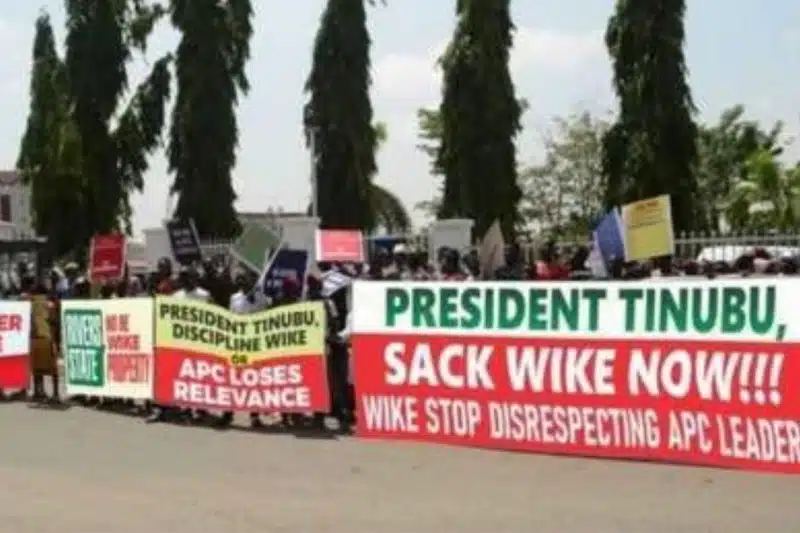
Wike sack calls that began as a small protest outside the All Progressives Congress headquarters in Abuja have grown into an organised campaign, placing the Minister of the Federal Capital Territory at the centre of one of the ruling party’s most consequential internal crises.
Inside the party secretariat, officials received an open letter that marked what many observers now see as a critical juncture in Nigeria’s most turbulent political feud. The APC Leaders Forum and the Tinubu Shettima Solidarity Movement had put their demands in writing, calling for the immediate dismissal of a minister they accused of insubordination, anti party activities and threatening national unity.
The letter, dated 7 January and signed by Chief Dr. Emeka Okoro, Dr. Adekunle Balogun, Alhaji Ibrahim Yusuf and Mallam Abdulkareem Isiaka, pulled no punches. Wike, they wrote, had launched vicious attacks on APC National Secretary Ajibola Basiru despite not being a registered member of the party. His comments during a visit to Oyigbo Local Government Area five days earlier, accusing Basiru of meddling in Rivers politics and warning that those who interfered would get their fingers burnt, amounted to intimidation and direct insult.
“REMOVE NYESOM WIKE AS MINISTER OF THE FEDERAL CAPITAL TERRITORY.”
The protesters were not isolated voices. Within days, other groups joined the chorus. The National Democratic Coalition in the United States urged President Bola Tinubu to act, warning that Rivers State would not know peace whilst Wike remained in office. Political commentators noted the shifting ground beneath the minister’s feet.
For a man accustomed to dictating terms, the organised nature of the opposition represented something new. These were not random critics but coordinated movements within the ruling party itself, claiming to speak for APC unity and the president’s Renewed Hope Agenda. They vowed to sustain protests across the country until their demand was met.
The accusations followed a pattern. Wike’s ongoing feud with Governor Siminalayi Fubara had escalated in recent weeks, with the minister touring local governments to rally support for President Tinubu’s 2027 re election whilst simultaneously attacking the governor he once installed. The groups described this as political sabotage, undermining an APC led state government from within a federal cabinet position.
They pointed to his public claim of controlling two political parties, his suggestion that nobody could enter Rivers State without his permission, and his dismissal of Fubara’s emergence as a mistake to be corrected in 2027. Each statement, they argued, revealed a minister operating beyond his constitutional remit and challenging presidential authority itself.
By Sunday morning, as Wike’s convoy rolled into Obio Akpor Local Government Area for another leg of his thank you tour, the pressure had reached a point where silence was no longer tenable. Before party leaders, traditional rulers and supporters, he finally addressed what everyone had been discussing.
His voice carried the familiar authority, but those who knew him well might have detected something beneath the surface.
“PEOPLE SHOULDN’T DISTURB THEMSELVES OVER ANYONE SAYING I SHOULD BE SACKED. THAT DECISION DOES NOT LIE WITH THEM.”
The words were defiant, yet the very act of responding marked a shift. For weeks, Wike had ignored similar calls. Now he was acknowledging them publicly, framing his position not as invulnerability but as presidential prerogative.
“If my appointor believes I can’t offer anything again, he has the right,” Wike continued. “It’s not that you should tell him.”
The formulation was careful, almost diplomatic, a recognition that his fate rested entirely with President Tinubu. He emphasised his achievements in the FCT, insisted that Rivers people were proud, and stressed that his work spoke for itself.
“IF YOU ARE NOT DOING WELL, NOBODY WILL TALK ABOUT YOU.”
But embedded within the bravado were signs of calculation. He reminded the gathering that Tinubu knows his worth and that the president does not need others advising him on such matters. The subtext was clear. These protesters, these letters and these demands carried no weight because they did not come from the one person whose opinion mattered.
Yet he had felt compelled to say it. That in itself revealed the pressure.
Throughout the address, Wike returned repeatedly to themes of power and control. “Politics is an interest, the interest of your people,” he told the crowd. “Power is not given, we struggle for it.” He invoked Donald Trump and Venezuela, spoke of Obio Akpor’s voting strength, and reminded everyone that no governor had won Rivers without the local government’s blessing.
The subtext ran through every statement. He remained formidable, still capable of delivering results, and still essential to Tinubu’s 2027 ambitions in the South South.
“TELL MR PRESIDENT THAT WHAT WE DID FOR HIM IN 2023, WE WILL DO EVEN BETTER IN 2027.”
But the circumstances of the declaration mattered. This was not Wike at the height of his power, casually dismissing irrelevant critics. This was a minister surrounded by loyalists in his home territory, defending his position against an organised campaign within the party that employed him.
The protesters had announced plans to expand their demonstrations nationwide. More groups were likely to join. Crucially, they were operating within the APC’s own structures, using party loyalty and concern for 2027 electoral prospects as their justification.
Wike’s response reflected an awareness that he stood at a crossroads. His insistence that only Tinubu could remove him was technically correct but politically incomplete. If enough pressure built within the party, if enough APC leaders concluded his presence was causing more harm than good, and if the Rivers crisis continued to escalate, presidential calculations could shift.
The thank you tours themselves carried a note of urgency. Wike was demonstrating his grassroots support, his ability to mobilise voters, and his continued relevance to any national political strategy. Each rally served as evidence of his value and a reminder of what the president stood to lose by sacking him.
Yet the venues mattered. He was speaking in Rivers to his base, in areas where his influence remained strong. He was not addressing the protesters in Abuja, not engaging with the APC groups calling for his removal, and not confronting the broader criticism of his role in the ongoing state crisis.
Minority Leader Kingsley Chinda told the gathering that Obio Akpor controlled 684,000 votes out of 3.5 million registered voters in Rivers.
“JUST GO HOME. TELL US WHAT YOU WANT US TO DO AND WE WILL DO IT.”
The deference was absolute, but the numbers also highlighted the stakes. Rivers remained crucial to any presidential calculation. Wike’s utility to Tinubu rested substantially on his ability to deliver those votes in 2027. If that capacity came into question, if the crisis with Fubara worsened, if other power brokers emerged, or if the chaos he was accused of creating outweighed his electoral value, the balance could tip.
The impeachment proceedings against Fubara had resumed just three days earlier, with 26 lawmakers citing allegations including extra budgetary spending of over ₦800 billion. The timing, whilst the president was out of the country, prompted fresh warnings that Rivers could descend into deeper instability.
Previous impeachment attempts in 2023 and 2025 had been halted following direct presidential intervention, including emergency consultations and federal security involvement. The question now was whether the president would continue shielding his minister’s interests in Rivers or whether mounting pressure within his own party would force a different calculation.
Observers noted that Wike’s comments on Sunday lacked his usual edge. Where he typically attacked opponents by name and dismantled their arguments piece by piece, he instead offered a general dismissal of critics. Where he usually projected absolute confidence in his position, he acknowledged that it depended on another man’s judgement.
“To his detractors,” one news account reported, “the minister explained that he chose to be a politician and not a pastor, a trader, a public commentator or journalist, urging them to allow him to play his politics.”
“I CHOSE TO BE A POLITICIAN. ALLOW ME TO PLAY MY POLITICS.”
The phrasing suggested weariness and a sense of being misunderstood or unfairly targeted. It lacked the aggressive certainty that had defined Wike’s public persona through years of political combat.
The groups calling for his removal were explicit about their strategy. They would maintain protests at the APC secretariat. They would mobilise rallies across states and local governments. They would not relent until President Tinubu acted decisively to remove what they called a threat to party unity and national stability.
The sustained nature of the campaign distinguished it from previous criticism. This was not a momentary outcry over a controversial statement. It was organised, coordinated and framed in terms of party interest rather than personal grievance.
Wike had built his political career on being indispensable, the man who delivered results, commanded loyalty and controlled structures no politician could ignore. His appointment to Tinubu’s cabinet reflected that perceived value.
But indispensability is never absolute in politics.
His response on Sunday, acknowledging the calls whilst insisting on presidential prerogative and defending his performance whilst accepting that his position depended on Tinubu’s judgement, revealed an awareness of the changed landscape.
They were not the statements of a minister secure in his power.
They were the words of a man at a breaking point, holding his ground whilst the ground itself shifted beneath him, aware that forces beyond his control were now determining his political survival.

