




The Wike Fubara feud unfolding in Rivers State goes beyond a routine falling-out between political allies. It has evolved into a struggle over authority and loyalty that raises serious questions about federal influence, state autonomy, and the durability of democratic governance in Nigeria.
What Nyesom Wike is doing goes beyond hardball politics. It reflects conduct that is incompatible with constitutional democracy and increasingly resembles the abuse of public office, yet it unfolds in plain sight, normalised by Nigeria’s long tolerance for political impunity.
The Unconstitutional Demand: “Whatever You Say We Should Do”
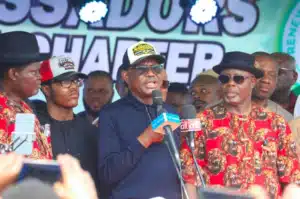
The most chilling moment in this saga occurred on 4 January 2026 in Okrika Local Government Area, when Senator George Sekibo publicly declared to Wike:
“Whatever you say we should do, is what we will do.”
This was not a pledge of ideological alignment. It was a declaration of total obedience to an individual. It is the language of fealty, not democracy.
That Wike accepted this pronouncement without correction, and appeared to relish it, reveals a conception of power that is deeply troubling. He does not act like a minister accountable to the president and the constitution. He behaves like a godfather entitled to permanent loyalty, even from an elected governor who constitutionally answers only to the people.
The episode was not isolated. Local government chairmen publicly described Wike as their “political godfather.” Assembly leaders offered prayers and affirmations of loyalty. These were not spontaneous gestures of admiration. They were rituals of submission demanded by a system where one man controls political careers, contracts, and access to power.
This is not democratic mobilisation. It is political coercion.
A Minister Destabilising His Home State
As Minister of the Federal Capital Territory, Wike holds executive office in the cabinet of Bola Tinubu. He swore an oath to uphold the Constitution of the Federal Republic of Nigeria.
That same constitution vests executive authority in Rivers State exclusively in Siminalayi Fubara.
Yet for over two years, Wike has acted as if Rivers State remains under his personal jurisdiction. He has:
-
maintained influence over a parallel legislative bloc,
-
repeatedly sponsored impeachment efforts against a sitting governor,
-
mobilised traditional rulers and local government officials against the state executive,
-
conducted “thank you tours” that function as assertions of territorial dominance rather than political outreach.
This is not legitimate opposition politics. Wike is not an opposition leader. He is a federal minister serving in the same ruling party as the governor he seeks to unseat. His conduct amounts to federal-level interference in state governance, an aberration that undermines the logic of Nigeria’s federal system.
When Wike publicly declares that his political career ends if Fubara secures a second term, he is effectively asserting a veto over Rivers’ democratic future. That is not opposition. It is an attempt to privatise electoral outcomes.
The Weaponisation of the Rivers Assembly
The most potent instrument of this coercion has been the Rivers State House of Assembly, led by Speaker Martin Amaewhule and lawmakers aligned with Wike.
On 8 January 2026, impeachment notices were again served on Governor Fubara and his deputy, citing charges that are substantively similar to those raised in October 2023 and again before the March 2025 emergency rule. In practice, the allegations have surfaced at moments when the governor has sought to assert autonomy, giving the proceedings the appearance of political leverage rather than neutral constitutional oversight.
A familiar sequence has followed:
-
assertion of autonomy by the governor,
-
legislative retaliation,
-
paralysis of governance.
This is not separation of powers. It is institutional capture. A legislature that answers to a private political patron rather than constituents ceases to function as a democratic body.
Emergency Rule and the Collapse of Constitutional Guardrails
The Supreme Court judgment of 28 February 2025, which criticised the collapse of legislative functioning in Rivers, provided legal justification for subsequent federal action. But the sequence of events that followed raised serious concerns.
Within weeks, oil pipelines were vandalised. On 18 March 2025, the president declared a state of emergency, suspending the governor, deputy governor, and the entire assembly for six months.
Legally, the move was contentious. Analysts questioned whether Section 305 of the Constitution permits such sweeping suspensions and whether the National Assembly’s approval met the required constitutional threshold. Over forty lawsuits challenged the declaration. None halted its implementation.
The outcome was politically convenient. A defiant governor was removed, governance was handed to a sole administrator, and a factional conflict was temporarily neutralised.
Whether by coincidence or structural weakness, emergency powers designed to protect democracy ended up resolving a godfather–godson feud. That alone should trouble any serious federal democracy.
The Defection That Broke the Chain
Governor Fubara’s defection to the APC in December 2025 fundamentally altered the balance of power. It removed Wike’s ability to isolate him as an opposition governor and disrupted the former governor’s claim to be Abuja’s indispensable Rivers intermediary.
The reaction was telling. Wike’s anger was not ideological. It was personal. The defection represented escape from supervision, from control, and from enforced loyalty.
The subsequent “thank you tours” across Rivers State were less about gratitude than about reasserting dominance and reminding political actors that the old hierarchy still expected obedience. They also betrayed insecurity. Power that must constantly announce itself is already under strain.
When Loyalty Demands Become Abuse of Office
Here lies the most serious issue. When a serving federal minister demands personal loyalty from elected officials, traditional rulers, and legislators, conditioning political survival on obedience, this conduct arguably falls within the scope of abuse of office as contemplated under Nigeria’s criminal and anti-corruption statutes.
The normalisation of such behaviour does not make it lawful. It merely makes it unchallenged.
Reports of pre-inauguration “agreements” allegedly binding Governor Fubara’s exercise of constitutional powers, witnessed by senior political figures, are especially disturbing. No private contract can override constitutional authority. If such agreements exist and are enforced, they amount to an attempt to privatise state sovereignty.
The Cost to Rivers People
While elites wage political war, governance collapses. Budgets stall. Projects remain unfinished. Civil servants operate in fear and confusion. Rivers State, one of Nigeria’s wealthiest and most strategic, has been locked in dysfunction for nearly two years.
This is the real tragedy. Political dominance pursued at any cost ultimately impoverishes the public realm.
What Is at Stake
Strip away the personalities. The central question is simple:
Can an elected governor govern independently, or must he submit to a godfather’s authority?
If the latter prevails, elections become ceremonial, constitutions ornamental, and federalism a fiction. Rivers State then becomes not an exception, but a warning.
When the Abnormal Becomes Normal
What is unfolding in Rivers State is not merely political rivalry. It is the gradual normalisation of conduct that erodes democratic accountability.
A federal minister demanding obedience. Legislators serving patrons instead of constituents. Emergency powers resolving factional disputes. Agreements that subordinate constitutional authority to personal loyalty.
Democracies rarely collapse in dramatic moments. They decay when the abnormal becomes accepted, when abuses are excused as “politics,” and when impunity is mistaken for strength.
Whether President Tinubu decisively checks this drift or manages it for short-term political convenience will determine not only Rivers State’s future, but the credibility of Nigeria’s constitutional order.
For the people of Rivers, the cost of this struggle is already clear. While political gladiators battle for control, the state bleeds. And unless this cycle is broken, it will not be the last state to suffer such a fate.

