



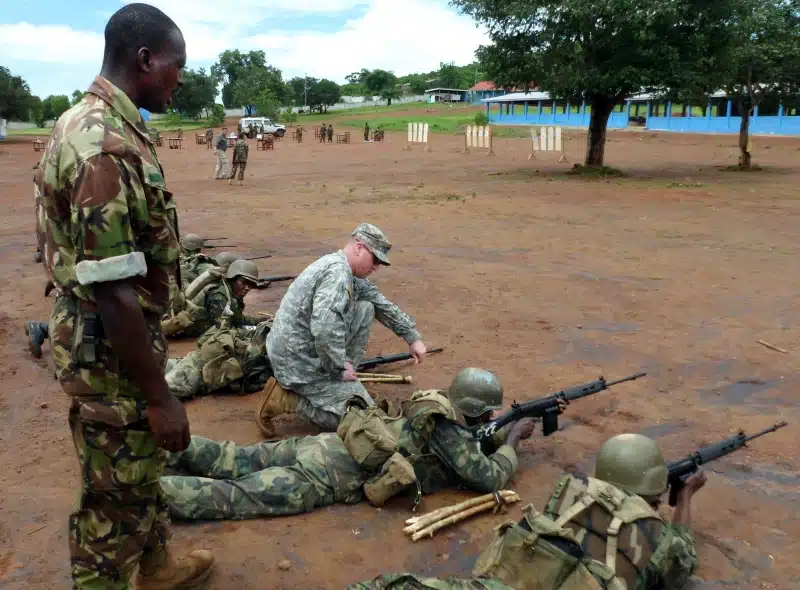
The United States has sent about 200 military advisers to Nigeria and is simultaneously pushing new legislation in Congress focused on religious violence in the country. Together, the moves signal a sharper turn in Washington’s approach at a time when Africa’s most populous nation is battling multiple security crises.
The arrival of US troops in Nigeria was confirmed in February 2026 by US Africa Command and Nigeria’s Defence Headquarters, marking the most direct American military involvement in the country under President Donald Trump’s current term.
The advisers arrive weeks after Christmas Day 2025 airstrikes in Sokoto State, where US forces, working alongside Nigerian authorities, struck camps linked to Islamic State militants. Several fighters were reported killed.
US Military Deployment Expands Advisory Role
The 200 additional personnel reinforce a smaller advisory team already operating in the country. Both governments stress that the Americans will serve strictly in a non-combat capacity, with Nigerian forces retaining full operational control.
Major General Samaila Uba, spokesperson for Nigeria’s Defence Headquarters, publicly confirmed the arrangement.
Their focus will be practical. One priority is improving coordination between ground troops and aircraft, a gap some Nigerian officers privately acknowledge has slowed past operations.
Intelligence is another area of emphasis. The goal is to move surveillance information more quickly from collection points to commanders in the field, reducing delays caused by technical or bureaucratic bottlenecks.
The advisers will also assist with maintenance planning for aircraft and drones. Nigeria has invested heavily in new aerial platforms, but keeping them operational has proved difficult. Spare parts, servicing routines and logistics planning have not always kept pace with acquisitions, limiting their impact.
Compared with large-scale American deployments once seen in parts of the Sahel or the Horn of Africa, this mission is relatively small. Even so, it represents something of a reset. Relations between Washington and Abuja have faced strain in the past, particularly when human rights concerns triggered restrictions under the Leahy Law.
Congress Introduces Nigeria Religious Freedom and Accountability Act
The military engagement coincides with legislative action in Washington.
On 10 February 2026, Republican congressmen Rep. Riley Moore of West Virginia and Rep. Chris Smith of New Jersey introduced the Nigeria Religious Freedom and Accountability Act of 2026, designated H.R. 7457.
Rep. Riley’s involvement deepened after he travelled to Nigeria in late 2025 as part of a congressional delegation. He spent time in parts of the Middle Belt affected by the violence, meeting survivors, speaking with pastors and community leaders, and listening to families forced from their homes.
In Abuja, he also held discussions with senior security officials, including National Security Adviser Nuhu Ribadu. Those conversations shaped his push for stronger US action.
The bill would require the Secretary of State to submit annual reports to Congress on efforts to address religious persecution and mass atrocities in Nigeria, with particular attention to violence against Christians.
More controversially, it calls for an assessment of whether armed Fulani militias meet the criteria for designation as a Foreign Terrorist Organisation.
Christian Persecution and the Terror Designation Debate
Advocacy organisations such as International Christian Concern and Open Doors have documented thousands of Christian deaths, church burnings and attacks on farming communities across Nigeria’s Middle Belt.
In many reported cases, attackers allegedly separated victims by religion before carrying out killings. Some incidents have included jihadist rhetoric or suspected coordination with extremist groups.
Supporters of the proposed designation argue that, at certain periods, attacks in parts of central Nigeria have rivalled or even exceeded casualty levels associated with Boko Haram and Islamic State West Africa Province.
An official Foreign Terrorist Organisation designation would allow for asset freezes, travel bans, sanctions on financiers and expanded intelligence scrutiny.
The proposal, however, remains contentious. The Fulani are not a single organisation but a vast and diverse ethnic group spread across West Africa. Millions are pastoralists with no link to armed violence. Critics argue that any designation would need to be narrowly defined to avoid stigmatising entire communities and deepening tensions.
The Middle Belt and the Cost to Nigeria’s Food Supply
At the centre of the crisis is Nigeria’s Middle Belt, broadly aligned with the North Central states. This is not simply another conflict zone. It is one of the country’s most important agricultural corridors.
Benue, Plateau, Nasarawa and neighbouring states supply yams, maize, rice, soybeans and livestock to markets nationwide. When villages empty and farmers abandon their land, the impact extends far beyond one district.
In some of the worst-affected areas, cultivation has dropped sharply. Fields lie unused. Families have fled. Local agricultural officials estimate that output in certain communities has fallen by as much as a third, and in extreme cases even more.
The consequences ripple outward. Reduced harvests strain supply chains, push up prices and contribute to food inflation already burdening households across the country.
Whatever terminology is used, the economic cost is clear.
Disputed Narratives and the Nature of the Violence
For years, Nigerian authorities and some international observers have described the crisis as a “farmer-herder conflict.” That label remains deeply contested.
Many communities in predominantly Christian areas reject the framing. They argue that what they face is not a land dispute that spiralled out of control, but organised militia attacks on settled farming villages.
Survivors describe patterns that recur with disturbing regularity. Gunmen arrive at night. Homes are burned. Churches are attacked. By morning, communities are emptied and casualties counted. Residents say villages with overwhelming Christian populations are often the ones targeted.
Critics contend that calling the violence a symmetrical communal clash obscures what they see as coordinated assaults.
At the same time, broader pressures cannot be ignored. Nigeria remains flooded with small arms. Governance gaps persist in rural areas. Criminal networks exploit insecurity. Long-standing ethnic and religious fault lines heighten volatility.
Yet beyond the debate over terminology lies a harder reality: civilians are bearing the brunt. Communities have been uprooted. Families now live in displacement camps. Farmland that once sustained local economies sits idle.
Military Strain and Hard Limits
Nigeria’s armed forces are stretched thin. Troops continue battling insurgents in the northeast, confronting bandit gangs in the northwest, responding to militia attacks in central states and managing tensions in parts of the southeast.
That range of operations has tested manpower and equipment. Officers privately acknowledge issues including corruption, weak logistics, morale challenges and maintenance backlogs that ground aircraft and delay deployments.
The arrival of 200 American advisers may strengthen coordination and intelligence processes. But few officials see it as transformative. Structural weaknesses built over years cannot be corrected overnight. Meaningful progress would require sustained political will and institutional reform.
What This Means for US-Nigeria Relations
The troop deployment and Rep. Riley’s bill together suggest Washington is taking a firmer approach than in recent years.
The move aligns with AFRICOM’s broader efforts to counter Islamic State affiliates in West Africa. It also comes at a time when major powers are paying closer attention to Nigeria, including amid China’s expanding economic presence.
Still, the approach carries risk.
Some Muslim advocacy organisations, including MURIC, argue that the international debate is becoming one-sided. They warn that framing the crisis primarily through a religious lens could deepen divisions in already tense communities.
Within government circles, the response has been cautious. Officials have welcomed additional training and intelligence cooperation, while pushing back against language suggesting genocide, insisting the security landscape is more complex than some foreign lawmakers portray.
Reactions remain divided. Christian advocacy groups welcome the attention. Security analysts question effectiveness. Government officials emphasise sovereignty.
An Uncertain Turning Point
The American footprint remains limited compared with past US missions elsewhere in Africa. Still, it marks a notable shift in Washington-Abuja security ties.
Whether the arrival of 200 advisers and pending legislation will significantly alter Nigeria’s trajectory remains unclear.
The country continues to confront insurgency, militia violence, organised banditry and food insecurity at once. Foreign assistance may sharpen certain capabilities, but it cannot substitute for domestic reform.
Ultimately, the decisive choices will be made in Abuja.
For now, Congress debates its bill and AFRICOM expands its advisory role. In communities across central Nigeria, residents wait to see whether any of it changes what happens after nightfall.

