



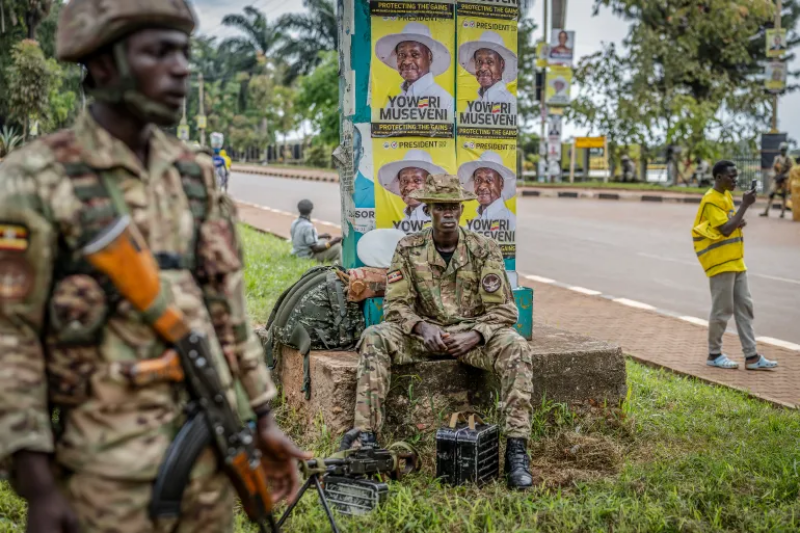
On Tuesday evening, Uganda internet blackout ahead of the 2026 election plunged the country into digital darkness. At precisely 6:00 p.m. local time, the Uganda Communications Commission (UCC) ordered a nationwide shutdown, severing online access for a country preparing to vote just 48 hours later. More than 18 million registered voters were cut off from digital tools that have become central to political participation, transparency, and accountability.
UCC head Nyombi Thembo described the move as a “nation-scale disruption.” The phrase was striking not only for its bluntness, but for what it implied. An election conducted deliberately in partial silence. As polling day approaches, the blackout has cast a long shadow over Uganda’s democratic process, reviving concerns about the use of digital restrictions as a tool of political control.
A Familiar Contest, a Familiar Tactic
The timing is no accident. President Yoweri Museveni, now 81, is seeking a seventh term, extending a grip on power that began in 1986 after a guerrilla war. His main challenger, Robert Kyagulanyi, widely known as Bobi Wine, is 43, a former pop star turned politician who has energised Uganda’s young, urban electorate with promises of reform and generational change.
The 2026 election is effectively a rematch of 2021, a vote marred by widespread violence, dozens of deaths, mass arrests, and allegations of systematic rigging. Claims Bobi Wine has never accepted. That election, too, was preceded by an internet shutdown.
Uganda’s political choreography, it appears, is repeating itself.
The Justification and the Reversal
The government insists the blackout is necessary to prevent “misinformation, disinformation, electoral fraud, and related risks.” That rationale, however, has been undermined by recent official statements. Only days before the shutdown, senior officials, including Nyombi Thembo, publicly dismissed reports of an impending internet cut as “false and misleading.”
The abrupt reversal has fuelled public suspicion that the shutdown is less about safeguarding the vote than managing it.
Independent network monitor NetBlocks confirmed the outage as a deliberate government action. The measures extend well beyond basic internet access. Mobile data services are restricted, new SIM card registrations suspended, and outbound data roaming to certain countries blocked. Satellite internet services, including Starlink, have been affected by licensing and import restrictions, according to government statements.
Exemptions apply almost exclusively to government and “embedded regulatory” services. The result is a digital environment in which the state retains visibility, while much of the public remains disconnected.
Opposition Cut Off, Oversight Crippled
For the opposition, the blackout is more than an inconvenience. It is existential. Bobi Wine’s National Unity Platform (NUP) has relied heavily on digital tools to mobilise supporters, share evidence of security force abuses, and document electoral irregularities. With the internet down, that infrastructure has largely collapsed.
Wine has condemned the shutdown as evidence of regime insecurity, urging supporters to remain resilient and explore alternative means of communication. His defiant message, “Uganda will be free,” has resonated among supporters, even as practical avenues for coordination narrow.
The effects ripple outward. Voters struggle to share information about polling locations, delays, or suspicious activity. Opposition poll watchers, who rely on real-time reporting to lawyers and party officials, have been effectively silenced. Allegations of covert ballot stuffing sites, reportedly located in universities, military barracks, and isolated buildings, are far harder to assess when digital documentation is impossible.
Opposition figures describe this dynamic as “rigging by darkness,” manipulation enabled not by force alone, but by the absence of scrutiny.
Media Silenced, Economy Disrupted
Journalists face similar constraints. Editors in media offices in Kampala and other cities say they have lost access to tools normally used by field reporters to file stories, verify information, and transmit reports to local and international audiences. The internet shutdown follows earlier government restrictions, including limits on live broadcasts of riots or protests, which have already affected real-time election coverage.
The economic impact, while secondary to democratic concerns, is already being felt. Businesses that rely on online banking, mobile money, logistics, and e-commerce report disruptions to routine operations. Prior to the shutdown, the Uganda Revenue Authority issued public notices encouraging taxpayers to complete online tax filings.
During the 2021 shutdown, which lasted more than a week, Uganda’s economy lost millions of dollars. Small traders, tech workers, and mobile money agents now brace for a repeat.
A Pattern, Not an Exception
This is not an aberration. It is a pattern. The 2021 election followed the same script. An internet blackout, violent crackdowns, disputed results, and international condemnation. That vote left dozens dead, hundreds detained, and Bobi Wine under de facto house arrest.
The current campaign season has been no less tense. Security forces have used live bullets and tear gas against opposition gatherings, and hundreds of supporters have been arrested. Veteran opposition leader Kizza Besigye remains imprisoned.
International Concern, Limited Consequences
Reactions have been predictably critical and predictably restrained. The European Union has reiterated concerns about repression and media suppression. Human rights organisations, including the Human Rights Foundation, have condemned the shutdown as an assault on fundamental freedoms. Diplomatic missions, including the U.S. Embassy in Uganda, say they are monitoring developments.
History, however, offers little reason for optimism. Similar condemnation in 2021 failed to alter the government’s behaviour, and there is scant evidence that this election will prove different.
Democracy in the Dark
Beyond logistics and legality, the blackout serves a psychological function. By cutting Uganda off from itself and from external observers, the state reduces the number of witnesses. Elections conducted in darkness are easier to manipulate, easier to deny, and easier to reframe after the fact.
When irregularities cannot be filmed, uploaded, and shared in real time, they dissolve into competing narratives. The absence of immediate evidence creates plausible deniability, a fog authoritarian systems know how to exploit.
For many Ugandans, especially younger voters who have never known another president, the blackout symbolises a political order that fears scrutiny and mistrusts its citizens.
What Comes When the Lights Return?
President Museveni is widely expected to declare victory. His control over security forces, electoral institutions, and the machinery of the state makes any other outcome difficult to envision. Whether Ugandans will accept that result, and what follows if they do not, remains uncertain.
The internet shutdown may succeed in limiting digital mobilisation and real-time documentation. Critics say it also risks increasing public frustration and further undermining confidence in the electoral process.
Uganda’s digital darkness is not merely a technical disruption. It is a statement of power and of fear. When connectivity is restored, whenever that may be, the country will still be left confronting the question the blackout has exposed. Can democracy survive where those in power fear the scrutiny of an informed electorate?
For now, the answer remains obscured by design.

