



ONITSHA, Anambra State — The National Agency for Food and Drug Administration and Control (NAFDAC) is at the center of a growing controversy following allegations that traders at Onitsha’s Head Bridge Drug Market were coerced into paying up to ₦700,000 each to reopen their shops, despite no clear legal basis for such a fee.
The Ogbo Ogwu Market, a major pharmaceutical hub in West Africa, was shut down on February 10, 2025, alongside three adjoining markets, in what NAFDAC described as a crackdown on counterfeit drugs and unsafe storage practices.
While the agency announced the market’s reopening on March 7, traders allege that access to their shops remained blocked unless they paid substantial sums, initially rumored to be ₦2 million, and later confirmed by multiple sources as ₦700,000.
Condemnation grows
Former presidential candidate Peter Obi described the fee as “economic sabotage” in the context of Nigeria’s widespread economic hardship, where over 7 million MSMEs have collapsed in the last two years. Senator Tony Nwoye, representing Anambra North, called the fee “exploitative,” and demanded refunds for traders not found guilty of any violations.
“Why are Onitsha traders uniquely penalised while markets like Idumota in Lagos or Ariaria in Aba faced no such fees?” Nwoye asked, also questioning the legal foundation of NAFDAC’s actions.
The Labour Party Caucus in the House of Representatives labeled NAFDAC’s conduct “scandalous, outrageous, and reprehensible,” and warned it may undermine national regulatory integrity if left unchecked.
Traders detail losses and legal violations
Many traders reported severe financial ruin, including Mrs. Eberechukwu Okoye, who claims ₦22 million worth of goods—including non-drug items like clothing and shoes—were confiscated without explanation.
Civil Liberties Organization Chairman Vincent Ezekwueme led a seven-day hunger strike in protest. “People are dying of depression. This is economic violence,” he stated.
Widespread allegations, limited Transparency
Despite mounting pressure, NAFDAC has not directly addressed repeated questions about the ₦700,000 fee. In response to inquiries from traders, media, and politicians:
- Dr. Martins Iluyomade, NAFDAC’s South-East Director, denied the ₦2 million claim, but vaguely acknowledged that “some fines were imposed” without clarifying the ₦700,000.
- Spokesperson Victoria Akudu claimed the market’s continued closure was due to “internal rancour” among traders, deflecting responsibility.
- Prof. Mojisola Adeyeye, NAFDAC Director-General, has remained silent on the specific fee but accused critics, including social media activist VeryDarkMan, of spreading “inciteful” misinformation that may violate the Cybercrime Act.
Legal concerns and court challenges
Multiple lawsuits have been filed against NAFDAC at the Federal High Court in Awka. Plaintiffs allege:
- Illegal break-ins without court warrants
- Seizure of non-pharmaceutical goods
- Violations of constitutional rights to property and fair hearing
- A lack of any arrests or prosecutions despite claims of ₦1 trillion worth of counterfeit drug seizures
NAFDAC has yet to respond to the lawsuits as of May 27, 2025. The courts have summoned the agency to explain its actions—including why seizures occurred without valid judicial authorisation.
Document Surfaces Confirming ₦700,000 Fee
Despite repeated denials by NAFDAC officials, a documented invoice obtained by AfricaNewsBits confirms that at least one trader paid the controversial ₦700,000 reopening fee. The invoice, issued in March 2025, explicitly references the payment as a condition for regaining access to a sealed shop.
This directly contradicts NAFDAC’s public claim that the ₦2 million fee allegation was “baseless” and its refusal to acknowledge the ₦700,000 figure. The document serves as concrete evidence that traders were indeed subjected to large, undocumented financial demands.
“This proves what we’ve been saying for months—that this wasn’t rumor or exaggeration,” said a market association leader who requested anonymity out of fear of reprisal. “Now the burden is on NAFDAC to explain why these payments were demanded, under what law, and where the money is going.”
The discovery of the invoice may open the door for further legal challenges, as the NAFDAC Act and its tariff regulations do not list such reopening fees as authorised revenue.
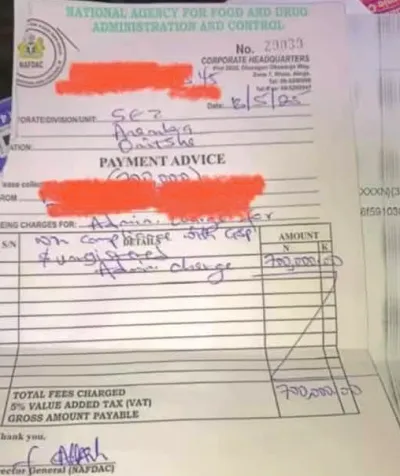
Key Details (NAFDAC Payment Advice):
-
Issuer: National Agency for Food and Drug Administration and Control (NAFDAC)
-
Form Title: Payment Advice
-
Date Issued: may be 6/5/2025
-
Office Location: SE Zone, Anambra, Onitsha
-
Amount Paid: ₦700,000.00
-
Reason for Charges: Listed as “Admin. fee + Transport + Comp. Defense other cost” (handwritten and vague)
-
VAT Listed: Yes, 5% VAT included
-
Signed By: Appears signed, presumably by a NAFDAC official (illegible signature but includes “Director General (NAFDAC)” designation)
Regulatory and legal framework
Under its establishing laws—Decree No. 15 of 1993, amended by Decree No. 19 of 1999 and consolidated as the NAFDAC Act Cap N.1 LFN 2004—NAFDAC has authority to:
- Regulate food, drugs, and other health-related products
- Impose documented inspection, registration, and penalty fees
However, the law does not empower NAFDAC to impose blanket reopening fines on entire markets or collect unofficial levies outside documented tariff structures. The S.I. 3 of 1994 Tariff Charges Regulations detail acceptable fees (e.g., for licensing, product registration, or inspection), but no provision exists for a ₦700,000 market reopening fee.
Questions over selective enforcement
Critics note that markets in Lagos and Abia States also faced NAFDAC operations without such fees, raising fears of selective enforcement and possible abuse of power. Traders say over 1,000 shop owners have already paid the alleged fee, while others remain locked out.
Call for Independent Investigation
With NAFDAC refusing to clarify the legal or financial basis for its actions and courts now involved, civil society groups and elected officials are calling for a federal-level independent inquiry.
“If this fee is legitimate, let the agency present its legal backing, revenue receipts, and exact criteria,” Senator Nwoye said. “If not, this is organized extortion, plain and simple.”
The controversy touches on deeper questions about regulatory accountability, due process, and the economic survival of small businesses in Nigeria.
NAFDAC has yet to provide documentation or detailed accounting of the goods seized or the fees collected. Until then, public trust in one of Nigeria’s most important health agencies remains in jeopardy.
