



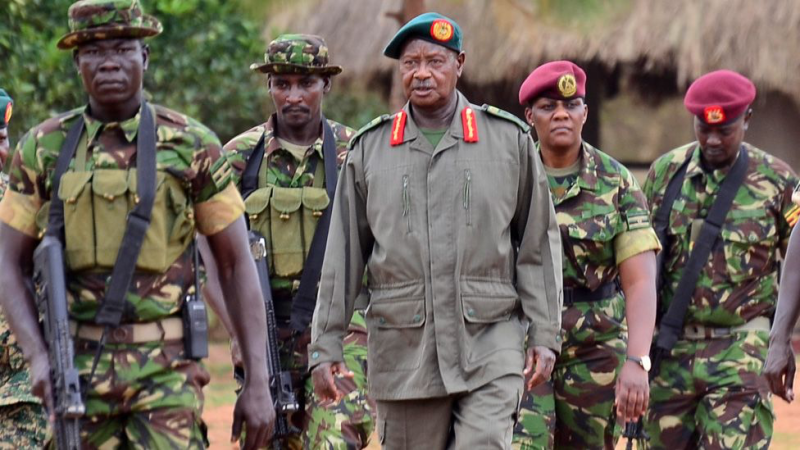
There is a photograph that still hangs in thousands of Ugandan homes, fading now at the edges but cherished nonetheless. It shows a younger Yoweri Museveni, rifle slung across his shoulder, surrounded by his guerrilla fighters in the bush. For those who lived through the terror of Idi Amin’s reign and the chaos that followed, this image represents something sacred: liberation.
Today, that same man is 81 years old and seeking a seventh term as president, extending a rule that has already lasted four decades. The election is scheduled for 15 January 2026, and the country he once rescued from the abyss now stands at a crossroads that feels less like a choice and more like a reckoning.
To understand what is at stake, you must first understand what Museveni meant to Uganda. When he marched into Kampala in 1986 after five years of guerrilla warfare, the country was a cemetery of broken dreams. Amin had murdered hundreds of thousands. Milton Obote’s second reign added more bodies to the pile. The economy was rubble. Institutions had collapsed. Fear was the only currency that retained its value.
Museveni changed that. The transformation was not immediate, but it was real. By the early 1990s, Uganda had become what development economists described as an African success story. The International Monetary Fund praised his liberalisation policies. Factories began to hum again. Roads were repaired. Children went to school without wondering if their teachers would be dragged away in the night.
Those who came of age in the 1990s and early 2000s learned about Museveni in tones reserved for founding fathers. He was the man who ended the killing. The man who brought stability when stability seemed like a fantasy. The man who, unlike his predecessors, appeared to care whether Ugandans lived or died.
The statistics tell part of this story, and they are not trivial. Uganda’s GDP has expanded nearly tenfold under his watch. Per capita income has quadrupled. More than 50,000 factories now operate across the country, employing over 823,000 people. The economy is projected to reach $245 billion in 2026, with growth rates that still attract the attention of development agencies.
In health, the gains have been extraordinary. HIV prevalence fell from 18.5 per cent in 1992 to 6.4 per cent by 2005, a decline that saved countless lives and became a model for the continent. The population has grown from 14 million to 46 million, reflecting not only high birth rates but the simple fact that Ugandans are living longer.
Education tells a similar story. Universal primary education in 1997 and universal secondary education in 2007 opened doors for millions of children who would otherwise have spent their lives illiterate. Enrolment surged from 3 million to over 8 million. Literacy rates climbed from 56 per cent to 78 per cent. These are not marginal improvements. They are the foundations of a nation.
The Human Development Index captures this progress in stark numbers. Uganda’s HDI stands at 0.582, an increase of roughly 70 per cent since 1990. Life expectancy has risen by more than 20 years. Average years of schooling have increased by nearly six years. For those who remember the Uganda of 1986, these figures feel close to miraculous.
But miracles carry a burden. They create expectations. And heroes, once crowned, rarely know when to step aside.
Somewhere along the way, the liberator became the institution. Constitutional amendments removed presidential term limits in 2005 and age limits in 2017. Each time, Museveni’s supporters insisted that Uganda still needed his steady hand, that alternatives were too risky, that stability mattered more than democratic rotation. Each time, a little more of the founding promise eroded.
Today, Freedom House rates Uganda as “Not Free,” with a score of just 34 out of 100. Press freedom has steadily deteriorated, with the country ranking around 125th out of 180 globally. Corruption has become endemic, with an estimated $2.4 billion lost annually to graft, according to watchdog and audit estimates. The police and finance sectors are particularly notorious, but the rot has spread deep into public institutions.
The inequality-adjusted Human Development Index tells a darker story than headline figures suggest. Uganda’s score drops to 0.400, meaning nearly a third of its development gains are effectively lost to inequality. The Gender Inequality Index places the country 141st out of 172. Youth unemployment officially ranges between 13 and 18 per cent, with underemployment far higher. In a country where more than 75 per cent of the population is under 30, this is not merely an economic problem. It is a ticking bomb.
The 2026 election campaign has laid these tensions bare. Museveni’s main challenger is Robert Kyagulanyi, known to millions as Bobi Wine, a former pop star turned opposition leader. At 43, he represents everything Museveni once was: young, energetic, and capable of speaking directly to a generation that has known only one president. His National Unity Platform draws crowds that routinely dwarf those of the ruling National Resistance Movement. His message is blunt and resonant: it is time for change.
The state’s response has been predictable and dispiriting. Hundreds of NUP supporters have been arrested. Live broadcasts of opposition events have been suspended. There are widespread fears of an internet shutdown to prevent mobilisation and independent result sharing, echoing the 2021 election when scores were killed in post-election violence. Bobi Wine has described the coming vote as “not an election, but war.”
This is not the legacy of a liberator. It is the posture of a leader who has forgotten why he took up arms in the first place.
What makes this moment especially poignant is that Museveni could still leave as a hero. Despite corruption, repression, and constitutional manipulation, many Ugandans continue to acknowledge what he achieved. Those in their forties and above, who once studied his guerrilla tactics in school and absorbed his role in regional peacekeeping, still carry a reservoir of goodwill.
But goodwill is finite. It shrinks with every arrested opposition supporter, every distorted election, every constitutional tweak designed to extend one man’s rule. The longer Museveni remains, the more his story shifts from liberation to domination, from nation-building to dynasty-building. His son, Muhoozi Kainerugaba, is already being positioned as a successor, turning what began as a revolution into something uncomfortably close to a monarchy.
There is dignity in knowing when to leave. Nelson Mandela understood this when he governed for one term and stepped aside. Julius Nyerere understood it when he retired and spent his final years as an elder statesman. Even Paul Kagame, despite his authoritarian tendencies, has invested heavily in institutions designed to outlast him.
Museveni has built much, but what he has built is increasingly fragile because it rests so heavily on his continued presence. The factories, roads, and schools can survive his departure. What may not survive is another decade of personalised rule, another contested election, another generation pushed toward the conclusion that violence is the only remaining language of change.
Bobi Wine has promised that if Museveni concedes peacefully, he will be protected. It is a generous offer and a historically informed one. Uganda knows the cost of violent regime change. The cycle of revenge nearly destroyed the country once. It could do so again.
But the offer carries an unspoken deadline. If Museveni clings to power through manipulation or force, if the military is deployed to decide the outcome, if the election becomes the “war” the opposition fears, then that protection evaporates. At that point, he ceases to be the man who saved Uganda and becomes the man Uganda must be saved from.
The polls are polarised and likely meaningless. Some predict a Museveni landslide with 77 per cent support. Others foresee a Bobi Wine victory that will be denied through fraud. The African Union and Western governments are watching, issuing the same carefully worded statements they released in 2021, aware that Uganda’s trajectory carries regional consequences.
What is undeniable is exhaustion. Forty years is a long time for any leader to govern. It is longer than most Ugandans have been alive. Debt is rising, inequality is widening, and the youth who should be the country’s greatest asset are instead its most frustrated constituency. The indicators point in the same direction: diminishing returns, eroding foundations, and the squandering of past gains for present ambition.
There is still time for a different choice. Museveni could announce that this will be his final term. He could supervise a genuine transition to competitive politics. He could use his authority to strengthen institutions rather than personalise them. He could, in effect, prove that what he claimed in 1986 was true: that he fought for Uganda, not for power.
Those schoolchildren of the 1990s, now in their forties, would celebrate such a decision. They would remember him as the man who saved their country twice, first from chaos, and then from himself. Their children, the ones filling Bobi Wine’s rallies today, might even come to appreciate what he achieved, freed from the resentment bred by watching an ageing leader refuse to let go.
If he chooses otherwise, if he rigs the vote, crushes dissent, or plunges the country back into violence, history will record a different verdict. It will remember a leader who stayed too long, who confused himself with the nation, and who turned a liberation movement into a vehicle for personal rule.
The photograph on the wall will remain, but its meaning will change. Not liberation, but warning. Even heroes can become tyrants when they do not know when to leave.
15 January 2026 is approaching. Uganda deserves better than a war. It deserves an election. And Yoweri Museveni, after forty years in power, still has a choice over how history will remember him.

