



An investigation into biometric failures, misinformation, and data sovereignty threats across the continent
Years after Kenya’s elections in 2017, Margaret from Nairobi still recalls the confusion that paralysed her. False information that spread via WhatsApp groups had persuaded her and thousands of other voters that polling stations had changed places, voting had been prolonged and results were being manipulated as votes were cast. “I didn’t even know what to believe any more,” says Ms. Ogeto, whose experience reflects that of millions of people across Africa, where technology is transforming democratic participation in ways that are both promising and perilous.
Across the continent, a technology-driven revolution is taking place, changing the way Africans vote, the way their votes are counted and the way that information — both true and false — can reach them during moments of enormous political importance. From multimillion-dollar biometric authentication systems to complex disinformation campaigns spreading through social media algorithms, technology has emerged as the latest battleground for African democracy.
The Biometric Promise and Its Perils
Up to 28 African countries have now deployed biometric technology for voter registration, with countries like Nigeria, Kenya, Ghana, Ivory Coast and Uganda also rolling out biometric systems for polling day authentication. The promise is seductive: biometric unique identifiers such as fingerprints or eye scans will not only prevent people from registering more than once, but they will root out voting fraud, leading to cleaner and more trustworthy elections.
Reality turned out to be more complicated.
In Kenya’s general election of 2017, the €37 million MorphoTablet system, developed by French firm Idemia, imploded spectacularly on polling day. Voters waiting in long lines as a series of authentication systems crashed, leading election officials to abandon them and return to manual procedures.
The failure was not only expensive, losing millions of dollars of taxpayer money, but also corroded confidence in electoral technology at the most critical time.
“The system was meant to be our protection against fraud — but it became the cause of suspicion,” recalls a Kenyan election official who lived through the chaos, noting that many Western observers blamed the failure of the electronic guardrails for the violence that ensued.
The Nigerian 2023 elections presented a chillingly similar resonance of technological promise running into the wall of harsh reality. Despite heavy investment in biometric verification systems to bolster electoral integrity, the country was plagued by widespread technical glitches unfolding as a disaster in waiting, similar to what happened to Kenya. Bad network connections meant voter authentication systems could not work so were subject to long delays, making the frustrated voters leave the polling stations.
Nigeria’s technological failure was also evident in the days after the election. As of February 28, 2023, a mere 46% of the result sheets had managed to be uploaded to the central server—a catastrophic failure that revealed how vulnerable digital electoral infrastructure really was. There have been reports of INEC officials refusing to upload results in places, feeding widespread allegations that the body was actively rigging, not just being woefully incompetent.
The parallel failures in Kenya and Nigeria show a disturbing pattern: African governments are spending millions on fancy biometric technology systems that then collapse under the weight of the actual election process, disenfranchising voters and undermining democracy.
Vote buying and fixing results — which are also issues biometrics cannot solve — were serious challenges in both countries, making clear that a technological solution cannot solve systemic electoral ones.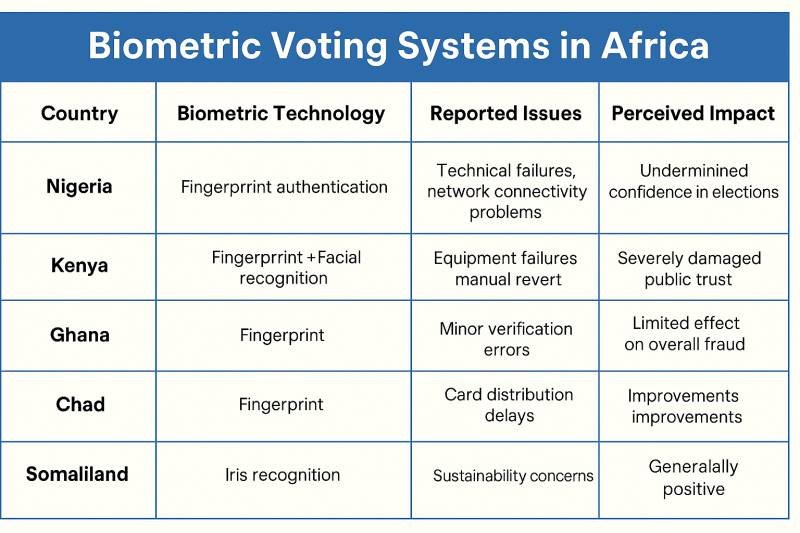
” Even in Ghana there have been since 2012 a sense of perspective has crept in. Biometric systems have reduced multiple registrations but seem to have only minor effect against other kinds of manipulation. It’s a technology that deals with symptoms, not systemic
Ghana’s rollout since 2012 gives a more nuanced view. Biometric systems cut down on multiple sign-ups, but studies show they don’t do much to stop other forms of cheating. The tech tackles the symptoms, not the root problems that allow people to mess with elections.
Even success stories have their downsides. Chad’s biometric setup, in place since 2007, made voters register more accurate for the 2016 presidential vote but ran into distribution delays in 2021. Somaliland set a record in 2017 as the first region to use iris scans, but people still wonder if it will last and if locals can handle the tech long-term.
The Data Privacy Dilemma
The biometric revolution has created a worrying reliance on foreign tech and know-how. Kenya and Nigeria depend on overseas companies to provide their voting systems, which raises big questions about who controls the data and how safe it is.
Adding biometric info creates what experts call “black boxes” – systems regular people can’t access and even local election staff often don’t understand. When Kenya’s system broke down in 2017, the country had to wait for Idemia’s tech team to fix it. This shows the dangers of handing over key parts of democracy to outsiders. What happens to free and fair elections when your vote goes into a computer you can’t see or challenge?
The establishment of an AI Division by Nigeria’s Independent National Electoral Commission (INEC) in May 2025 has intensified these debates. Groups like the Nigeria Labour Congress ask if the country’s electoral infrastructure can handle such technology, provide data security with transparency.
“We are building systems that voters do not understand, run by companies that are not accountable to the citizens, processing data they can not see,” says a Nigerian rights supporter who wanted to stay anonymous because talks about changing electoral reforms are very sensitive.
While nations like South Africa, Kenya, Nigeria, Ghana, and Zambia have made basic digital tech policies including data protection framework, how they are applied differs a lot. The gap between policy and practice leaves voter info at risk of misuse, especially where people limited knowledge about technology.
The Misinformation Machine
No tech challenge puts African democracy at greater risk than the growth of digital misinformation made worse by social media algorithms that aim to boost engagement instead of accuracy.
The 2017 elections in Kenya serve as a cautionary tale. Misinformation campaigns on social media platforms like WhatsApp and Facebook played a direct role in violence after the vote. False polls manipulated images, and inflammatory posts spread through chat groups often zeroing in on ethnic grievances and long-standing tensions. The implication was devastating—over 1,100 people died in election-related violence partly fuelled by fake news.
Uganda’s 2021 elections saw a coordinated disinformation campaigns across Facebook, Instagram, and X (formerly Twitter), with content designed to support the ruling party while undermining opposition candidates. The campaigns revealed how an overbearing governments can weaponise social media platforms against their own citizens.
Angola’s 2022 elections brought damaging hashtag campaigns to smear opposition candidates. This showed how disinformation machines keep changing across the continent. If lies can reach more people than truth, can elections still reflect the will of the people?
Algorithms play a key role in these threats. Social media sites like Facebook and X filter and suggest content based on user info often boosting inflammatory or divisive material. Political parties have figured out how to play these systems.
They hire consulting firms—like Cambridge Analytica during Kenya’s 2013 elections—to manipulate what algorithms suggest and how voters act. “These platforms aren’t neutral,” says a digital rights expert who tracks false info across Africa. “They’re built to grab attention,
The Human Cost
Behind the numbers and technical glitches are real stories of people risking their lives to take part in democracy. In Ghana, poll workers talk about the stress of using new tech without proper training, which slows things down and undermines voters confidence. Groups like Yiaga Africa in Nigeria have shown how many voters get frustrated when fingerprint scanners failed to work, especially in the rural areas where it’s hard to get technical help.
These experiences show a bigger picture across Africa where high-tech dreams often crash into real-world problems with poor internet lack of training, and resources. Voters end up stuck between systems meant to make democracy better but often just make it harder to vote.
Fighting Back: Strategies Survival
These hurdles notwithstanding, data shows that elections in Africa can survive and even thrive in the digital age—but only with strategic interventions addressing both technological and human factors.
Comprehensive digital education of the people turns out to be maybe the best way to fight misinformation. Teaching voters how to spot and verify information online looks promising, but it requires sustained investment and culturally appropriate approaches needs ongoing support. When voters learn basic digital and media skills, they can better handle online spaces increasingly polluted by deep fakes.
Fact-checkers like Dubawa in Nigeria played key role during the 2023 elections, debunking false narratives and providing verified information to voters. Organisations like that require support and protection to continue their essential work in the face of political pressure and resource constraints.
Keeping electoral processes transparent is essential for maintaining public trust. Electoral commissions must clearly communicate how they use technology, including algorithms and AI systems, while implementing robust data privacy and security policies. When voters understand how systems work, they’re more likely to trust electoral outcomes.
International cooperation becomes crucial given the cross-border nature of digital threats. Misinformation campaigns often originate outside target countries, requiring regional and global responses that individual nations cannot mount alone.
The Path Forward
Can African democracy to survive the very tools designed to safeguard it? The digital shift in African democracy remains a work in progress, with results still uncertain. Nations that put money into comprehensive strategies, combining technological solutions with human-centred safeguards, show more potential to maintaining democratic legitimacy.
To succeed, we must understand that tech can’t fix political issues on its own. Biometric systems can boost voter registration accuracy, but they can’t stop vote-buying or result tampering. Social media can improve political talk, but it can also spread dangerous misinformation. The answer lies in controlling these tools instead of letting them control us.
As Margaret from Nairobi saw during Kenya’s turbulent 2017 elections, democracy’s survival in this digital age depends not just on fancy math or fingerprint scanners, but on the people’s ability to make sense of a more complex information world. The stakes couldn’t be higher—the future of African democracy hangs by a thread measured not in computer data or body scans, but in the bond between governments and the people they serve.
The question isn’t whether technology will continue reshaping African elections, it will. Rather, it is: Can African societies use these strong tools while keeping the democratic values they’re meant to protect? The answer might shape the continent’s political path for years to come.
This investigation is based on documented cases and research from multiple sources across Africa, with particular focus on experiences in Nigeria, Kenya, Ghana, Uganda, Chad, Somaliland, and Angola. Names of some sources have been changed to protect their safety and security.
