



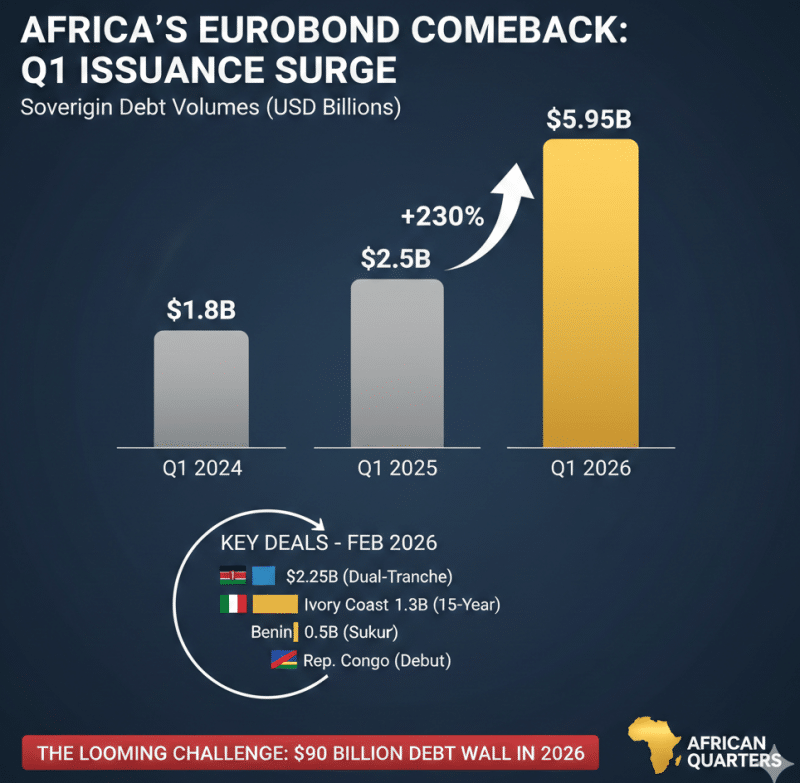
LAGOS / NAIROBI / LONDON, 21 February 2026: The monumental Africa Eurobond surge 2026 has officially thawed the “market freeze” that haunted continental treasuries for the better part of two years. In the strongest start to a financial year in over a decade, African sovereign borrowers have raised a staggering $5.95 billion in the opening seven weeks of 2026. According to Bloomberg data, this represents the highest issuance level since 2013 and a massive leap from the $1.8 billion raised during the same period last year. For the “Giant of Africa” and its neighbours, the message is clear: international investors are once again hungry for the high yields offered by frontier markets.
The “Early Bird” Strategy: Why Now?
The rush to the international capital markets is no accident of timing. African finance ministers are moving with predatory speed to lock in funding while a specific “window of opportunity” remains open. Global financial conditions have softened as the US Federal Reserve hints at a plateau in interest rates, and the average risk premium on African sovereign dollar bonds has narrowed to 329 basis points, the lowest level in eight years.
However, unlike the “infrastructure spree” years of the mid-2010s, the 2026 wave is defined by Proactive Liability Management. Rather than funding new deficits, governments are using fresh, relatively cheaper debt to “buy back” old, expensive debt that was issued during the high-inflation years of 2022 and 2023.
The Power Players of February 2026
Four nations have emerged as the architects of this comeback, each utilising distinct financial instruments to secure their fiscal future:
-
Kenya ($2.25 Billion): Nairobi executed a masterstroke on Thursday with a massive dual-tranche dollar bond. The National Treasury raised $900 million in seven-year notes (8.1% yield) and $1.35 billion in 12-year bonds (8.95%). These funds are being directly funnelled into an early Kenya Eurobond buyback February 2026 targeting portions of the 2028 and 2032 maturities. By “smoothing” the repayment curve, Kenya has successfully cooled fears of a liquidity crunch that had plagued the shilling just 12 months ago.
-
Ivory Coast ($1.3 Billion): Setting the regional benchmark, Abidjan secured a 15-year bond at a historic 5.39% yield. The order book was oversubscribed five times, with 270 institutional investors clamouring for a piece of one of the world’s fastest-growing economies.
-
Benin ($500 Million Sukuk): In a savvy pivot towards Islamic finance, Benin issued an international sovereign Sukuk at a 4.92% yield. This allowed the West African nation to tap into deep liquidity pools in the Gulf, diversifying its investor base away from traditional Western funds.
-
Republic of Congo ($700 Million): Proving that “stressed” issuers can still find takers, Brazzaville sold its nine-year debut at an 11.6% yield. While high, it is a significant improvement from the prohibitive 13.7% rates seen in late 2025.
The Pipeline: The DRC’s $750 Million Debut
While Kenya and Ivory Coast are veterans, all eyes are now on the Democratic Republic of Congo (DRC). Market sources indicate that Kinshasa is currently conducting a non-deal investor roadshow in London, preparing for a $750 million debut Eurobond in mid-March. As the world’s largest producer of cobalt and a critical copper hub, the DRC is betting that the global “Green Transition” will give it enough leverage to secure favourable terms despite its historically fragmented political environment.
The Looming “$90 Billion Debt Wall”
Despite the early-year euphoria, a shadow remains. S&P Global recently warned that African sovereigns face a $90 billion debt wall in 2026. Hard-currency principal repayments are now three times higher than they were in 2012.
Egypt alone accounts for roughly $27 billion of this total, followed by heavy maturities in Angola, South Africa, and Nigeria. The current surge is essentially a race against time. If global inflation or US interest rates spike unexpectedly, this window could slam shut, leaving those who have not yet refinanced out in the cold.

