



The AFCON 2025 quarter-finals marked the moment when the Africa Cup of Nations began to shed its early chaos and reveal its true contenders. On Thursday, Senegal and Morocco booked their places in the semi-finals, though they did so via sharply contrasting routes. Across two Moroccan cities, the tournament offered a study in how knockout football is decided: by control, composure, and just as often by collapse.
At the Ibn Batouta Stadium in Tangier, Senegal’s 1–0 victory over Mali was the very definition of a game won without beauty. The 2021 champions, now appearing in their third semi-final in four tournaments, progressed not through attacking fluency but by exploiting their opponents’ unravelling. Mali goalkeeper Djigui Diarra’s catastrophic mishandling of a routine back pass in the 27th minute gifted Iliman Ndiaye the simplest of finishes from close range, a moment of individual calamity that proved decisive in a match otherwise devoid of attacking quality.
What followed was a contest defined less by ambition than attrition. Mali’s problems deepened in first-half stoppage time when captain Yves Bissouma collected a second yellow card for a reckless challenge, reducing the Eagles to ten men for the entire second half. The dismissal, widely debated and viewed by some as harsh, nonetheless extinguished any realistic hope of a comeback. Combined with the goalkeeping error, it encapsulated a campaign that ended through avoidable mistakes rather than a lack of effort or belief.
Senegal controlled close to 60 per cent of possession but fashioned little beyond their fortunate breakthrough. Sadio Mané led with experience and authority, drawing fouls and slowing the game when required, while Kalidou Koulibaly marshalled a defence that was rarely tested by Mali’s sporadic counters. Under Aliou Cissé, the Lions of Teranga once again demonstrated a defining tournament trait: the capacity to grind out results when attacking rhythm deserts them. Yet the performance also raised a familiar concern — whether Senegal possess sufficient creativity to break down elite, well-organised opponents as the margins tighten further.
If Senegal survived, Morocco convinced.
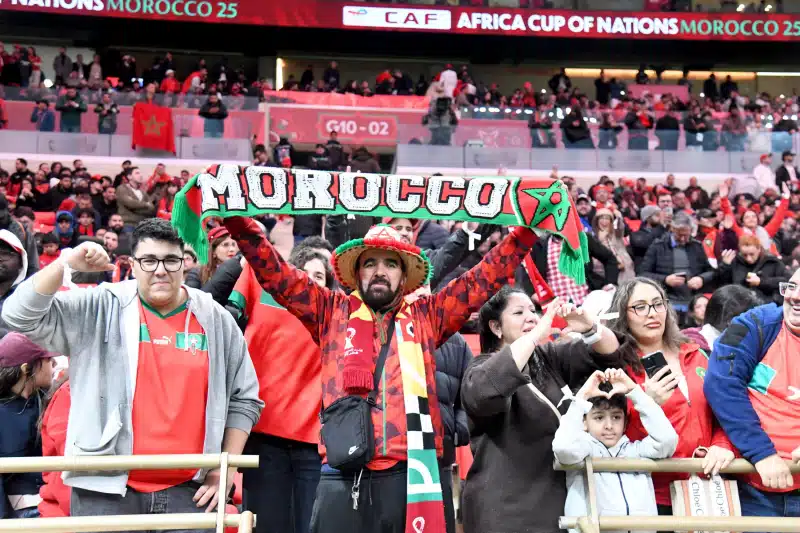
The evening fixture in Rabat delivered a stark contrast in both quality and intent. Morocco’s 2–0 dismantling of five-time champions Cameroon was executed with the composure and authority of a side increasingly comfortable with expectation. Playing before a raucous home crowd at the Prince Moulay Abdellah Stadium, the Atlas Lions produced a display that suggested a nation ready to end its 49-year wait for continental glory.
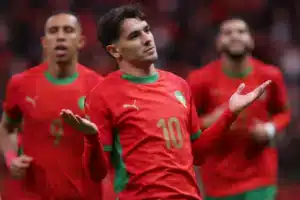
Once again, Brahim Díaz was the central figure. The Real Madrid playmaker extended his remarkable scoring streak with his fifth goal in as many matches, a calm first-half finish that reinforced his status as the tournament’s standout performer. His movement between the lines and composure under pressure have turned Morocco from contenders into genuine favourites.
The contest was settled in the 74th minute when Ismael Saibari struck powerfully from distance, a goal that reflected Morocco’s growing confidence and Cameroon’s fading resistance.
Morocco’s dominance was not merely aesthetic. Controlling 65 per cent of possession, they dictated tempo through compact midfield spacing and aggressive full-back positioning, with Achraf Hakimi and Noussair Mazraoui stretching Cameroon horizontally and pinning them deep. Cameroon, under Rigobert Song, struggled to establish any sustained rhythm. Patrick Mbeumo threatened sporadically, but the hosts’ defensive structure absorbed pressure with ease and limited transitions before they could develop.
Controversy briefly flared when a potential penalty for Cameroon was waved away, sparking frustration among the travelling support and on social media. By full time, however, such grievances felt secondary. Morocco were superior in every phase. Advancing to their first AFCON semi-final since 2004, Walid Regragui’s side now look tactically mature, emotionally composed, and fully aligned with the demands of tournament football. The dream of a first title since 1976 no longer feels distant, it feels attainable.
Friday’s remaining quarter-finals promise to test those narratives further.
Algeria face Nigeria in Marrakech at 4pm local time in a clash steeped in history and tension. The 2019 champions arrive with a defence that has conceded just once all tournament, marshalled by experience and discipline, while Nigeria counter with attacking firepower led by Victor Osimhen and Ademola Lookman, the latter having tormented defences throughout the competition.
The sides are closely matched across 22 previous meetings, with Nigeria holding a small advantage. There is added intrigue from their 2019 semi-final meeting, when Algeria eliminated Nigeria, a setback the Super Eagles later avenged in qualifying. Tactically, the contest is likely to be decided in midfield, with Algeria expected to defend deep and counter against Nigeria’s more open approach. Osimhen’s fitness remains a talking point after carrying a knock, though he is expected to start.
Nigeria’s attacking depth gives them a marginal advantage, particularly if they can expose any fatigue in Algeria’s ageing backline. A narrow 2–1 victory for the Super Eagles feels plausible, though Algeria’s defensive resilience and big-game experience suggest extra time or even penalties, cannot be ruled out.
The evening encounter in Agadir pits Egypt against Ivory Coast in a rematch of the 2021 final. Egypt, record seven-time champions, remain unbeaten in the tournament, with Mohamed Salah scoring in every match so far. Much of their ambition rests on his ability to unlock an Ivorian defence built for physicality and transition. Defending champions Ivory Coast bring their own threats, with Sébastien Haller and Franck Kessié anchoring a side that thrives on counter-attacks and set pieces.
Egypt will look to dominate possession, averaging 55 per cent thus far, building patiently through midfield. Ivory Coast, under Emerse Faé, are content to absorb pressure before striking, an approach that has served them well. Evan Ndicka faces the unenviable task of limiting Salah, while Egypt must cope without the injured Trezeguet. The historical record favours Egypt, but recent form has tilted towards the Elephants.
Another tight contest is expected. The match could finish level after 90 minutes, with Ivory Coast’s experience in high-pressure shootouts giving them a potential edge.
As the semi-final lineup begins to take shape, AFCON 2025 is revealing a familiar truth. In the latter stages of this tournament, spectacle often gives way to control, and ambition is measured not by dominance but by decision-making under pressure. Senegal and Morocco passed that test in different ways. The question now is whether Nigeria or Egypt can do the same or whether AFCON’s capacity for upheaval still has one more twist to deliver.

