



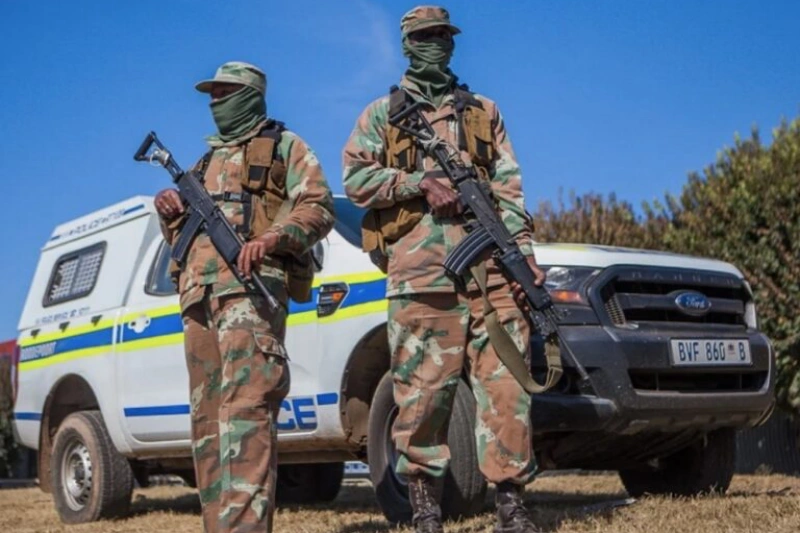

The announcement, initially delivered during his 10th State of the Nation Address and reaffirmed during Armed Forces Day commemorations in Thohoyandou, Limpopo, frames the decision as a measured response to an alarming escalation in organised criminal activity. This latest SANDF Deployment 2026 will see soldiers stationed primarily in the Western Cape, Gauteng, and the Eastern Cape – provinces that continue to record the most volatile levels of violent crime in the country.
A Response to Escalating Organised Crime
Government officials point first to the rapid expansion of illegal mining syndicates – commonly known as “zama zama”networks – as a central cause of the current instability. These groups operate in abandoned shafts and disused gold mines, extracting resources through supply chains that stretch far beyond South Africa’s borders.
Gauteng Premier Panyaza Lesufi recently highlighted the severity of the crisis, noting that in early 2026, over 600 families were forced to flee the Sporong informal settlement on the West Rand due to violence linked to these mining syndicates. The SANDF Deployment 2026 is specifically tasked with stamping out what Lesufi described as a “reign of terror.” Security sources say the problem has evolved into a heavily armed enterprise where rival groups clash underground with high-calibre weaponry, while turf battles frequently spill into nearby residential communities.
The “Shadow of the Bullet” on the Cape Flats
Gang violence has similarly intensified in communities such as the Cape Flats. Local activists speak of a pattern that feels painfully familiar: a shooting, retaliation, then a brief lull before another outbreak. Families report that children are kept indoors after school because stray bullets have become an everyday fear.
President Ramaphosa addressed this directly during his speech in Limpopo, stating that the SANDF Deployment 2026 is intended as a “shield for the vulnerable,” so that children in Nyanga, Eldorado Park, or New Brighton can walk to school without fear.
Statistical Progress vs. Felt Reality
This military intervention comes at a paradoxical moment for South African law enforcement. According to the latest crime statistics for the third quarter of the 2025/26 financial year, South Africa recorded an 8.7% decrease in murdersnationwide. Acting Police Minister Professor Firoz Cachalia noted that while 6,381 murders were recorded – 602 fewer than the previous year – the figures remain “unacceptably high.”
While provinces like Gauteng saw double-digit reductions, the Western and Eastern Capes saw much smaller decreases. For the average citizen, these statistical declines do not always translate into a felt sense of safety, particularly as extortion rackets targeting small businesses continue to rise in township areas.
Political Backing and Parliamentary Caution
The main opposition party, the Democratic Alliance (DA), has expressed conditional support for the SANDF Deployment 2026, describing it as a necessary short-term stabilisation measure. However, they have been quick to point out that “stabilisation is not a strategy,” arguing that the army cannot replace the investigative functions of the SAPS or the Hawks.
The Parliamentary Portfolio Committee on Defence issued a sharp note of caution this week. Committee members emphasised that while a murder rate of 26,000 to 30,000 people per year is a national crisis, the army is not a long-term answer. Academics from Stellenbosch University have further warned that domestic military deployments risk becoming politicised and could shift focus away from the army’s core mandate of protecting national sovereignty.
Operation Prosper: The Framework and Its Limits
This intervention falls under “Operation Prosper”, a security framework where SANDF personnel provide logistical and patrol support while leaving primary law enforcement power to the police. Defence officials stated that the SANDF Deployment 2026 will be informed by lessons learned from the 2019 deployment, which civil society groups like the Cape Crime Crisis Coalition argue had little sustained impact on areas like Mitchells Plain.
Security analysts note that South Africa’s Constitution permits such deployments when public order is seriously threatened. However, the long-term efficacy remains under scrutiny. Acting Police Minister Cachalia has instructed the National Commissioner to strengthen Anti-Gang Units to ensure that once the military withdraws, the police are capable of maintaining the “operational space” created by the troops.
The Economic Stakes of the Deployment
Business heavyweights aren’t exactly popping champagne just yet, though the general mood is one of guarded relief. The consensus in boardroom circles is that rampant crime has become a “silent tax” on the working class and a massive red flag for anyone looking to invest. A huge part of the SANDF Deployment 2026 isn’t just about street patrols; it’s an urgent attempt to fortify the country’s crumbling critical infrastructure.
For far too long, Eskom’s power plants and Transnet’s rail lines have been easy targets for professional cable thieves and well-funded saboteurs. By putting boots on the ground at these essential sites, the National Treasury is essentially betting that a drop in disruptions will pay for the deployment itself. If this security clampdown actually works, it might provide the breathing room needed to hit that 1.5% GDP growth target for the 2026/27 cycle. But there is a catch – economists are already questioning how long the fiscus can sustain an army in the streets before the costs start to outweigh the boost in investor confidence.
A Defining Moment for the Republic
The sight of fatigues on suburban street corners and township avenues forces a difficult conversation about the state of the nation. It raises a fundamental question that any constitutional democracy must eventually face: where do we draw the line between urgent safety needs and the principle that policing should be a civilian-led endeavour?
The SANDF Deployment 2026 is a clear signal that the state is reaching for its most powerful lever to restore order in high-risk zones. Yet, history suggests that boots on the ground offer a temporary reprieve rather than a permanent cure. The true test of this intervention won’t be found in the number of roadblocks established today, but in the durability of the institutional reforms that must follow. Specifically, the nation is watching to see whether the state finally fixes the backlogs in forensic labs and detective training that have allowed organised crime to flourish for so long.
Source: South African Government News Agency (SAnews.gov.za)


