



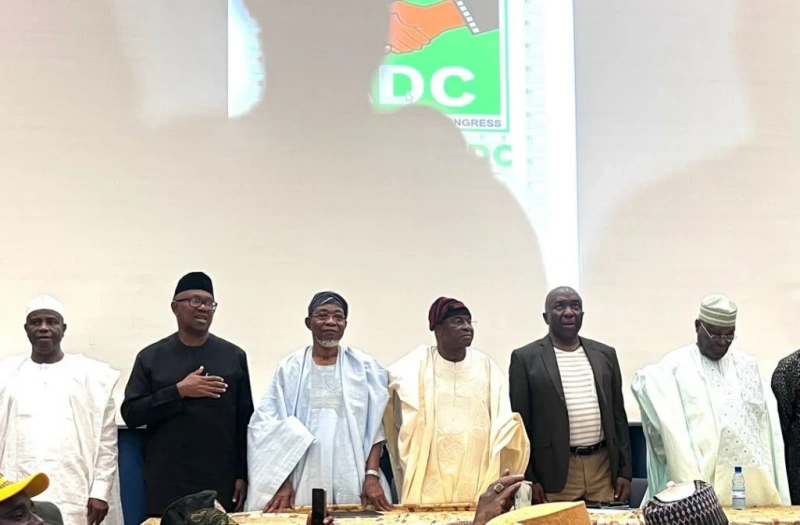

ABUJA, 26 February 2026 — Nigeria’s political temperature rose sharply on Wednesday as three prominent opposition figures; Atiku Abubakar, Peter Obi, and Rotimi Amaechi, convened what aides described as a “strategic mega-meeting” at the Transcorp Hilton Abuja.
After five hours of closed-door deliberations, the trio announced the formation of a coordinated opposition platform, styled an ‘Atiku, Obi, Amaechi United Front’, aimed at challenging aspects of the newly assented 2026 Electoral Act.
In a joint communiqué read by Obi, the leaders expressed concern that elements of the legislation could significantly reshape Nigeria’s electoral framework. They argued that certain provisions may carry implications for party competition and internal democracy if not carefully implemented.
The Core Dispute: Section 84 and the Primary Election Framework
At the centre of the controversy is Section 84 of the 2026 Electoral Act, which limits political parties to two recognised methods of candidate selection: Direct Primaries and Consensus.
The legislation removes the Indirect Primary system, commonly referred to as the delegate model, which has historically been adopted by several major Nigerian parties due to its structured format and comparatively lower logistical demands.
Opposition leaders contend that mandating direct primaries nationwide may impose significant financial and organisational pressures on parties, particularly those without extensive state-level structures.
“This is legislative overreach dressed as reform,” Obi stated. “Forcing nationwide direct primaries creates enormous cost implications, while consensus provisions can easily be manipulated by dominant interests.”
While stopping short of alleging constitutional invalidity, the leaders indicated that the changes could alter internal party processes in ways that may influence the political landscape ahead of 2027.
A Strategic Realignment Ahead of 2027
The joint appearance of the three politicians drew considerable attention across the political spectrum.
Atiku Abubakar, former Vice President and a prominent figure within the Peoples Democratic Party, remains one of the most established actors in Nigeria’s opposition space.
Peter Obi, former presidential candidate of the Labour Party, continues to attract notable support among younger and urban voters, particularly through networks associated with the Obidient movement.
Rotimi Amaechi, a former governor and cabinet minister affiliated with the All Progressives Congress, has previously held influential roles within the ruling party’s national structure.
Amaechi has not publicly announced any change in party affiliation. However, his participation in the meeting has generated discussion within political circles, given his longstanding association with the APC.
Some analysts view the emerging collaboration as a strategic response to developments observed during the 2023 general election, when multiple opposition candidacies split votes across several key states. In Nigeria’s first-past-the-post presidential system, fragmentation can materially affect electoral outcomes.
Key Demands Announced
The “United Front” outlined three immediate steps:
1. Legal Challenge
A coordinated team of Senior Advocates of Nigeria is being assembled to examine potential constitutional grounds for challenging aspects of the Act at the Supreme Court.
2. Legislative Reconsideration
A formal petition is expected to be submitted to the National Assembly seeking reconsideration of the removal of the Indirect Primary option before the third quarter of 2026.
3. National Voter Awareness Campaign
The coalition plans to launch a nationwide civic education initiative aimed at explaining the practical implications of the revised primary framework to party members and voters.
The leaders framed their position as a defence of procedural safeguards within Nigeria’s democratic system rather than as partisan opposition.
Presidency Pushes Back
In a late-evening response, the Presidency described the meeting as “political theatrics” and maintained that the 2026 Electoral Act strengthens internal democracy by empowering ordinary party members through direct participation.
Government officials argue that direct primaries can reduce elite dominance within parties, broaden inclusion and align Nigeria’s internal party processes with participatory democratic practices.
Some political observers, however, note that practical implementation challenges could arise, particularly for parties with limited organisational infrastructure.
What This Means for 2027
Debates over primary election mechanisms may appear procedural, but their implications are strategic.
Primary systems determine which candidates ultimately appear on the ballot. In a political environment where internal party contests often shape national outcomes, the structure of candidate selection plays a decisive role in electoral positioning.
Whether the courts intervene or the National Assembly reopens deliberations, one point is evident: discussions surrounding the 2027 general election have begun to take clearer shape.
For now, the joint appearance of three prominent political figures signals an effort to explore coordinated engagement rather than parallel competition as the next electoral cycle approaches.


