



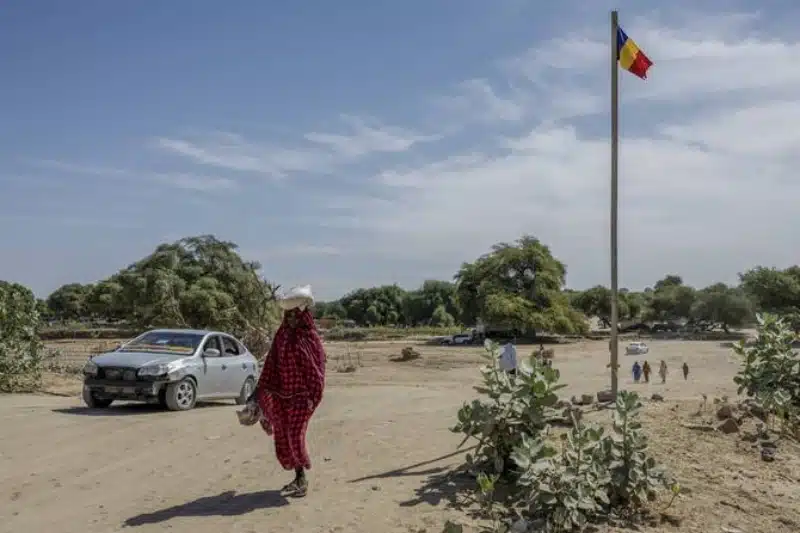

The Chad Sudan Border Closure has fundamentally shifted the geopolitical landscape of Central Africa this Monday afternoon. The move by N’Djamena to sever its land link with Sudan is a decisive escalation that transcends a standard diplomatic spat; it is a direct and protective response to violent cross-border incursions over the weekend. These attacks claimed the lives of at least five Chadian security personnel and three civilians in the border town of Tiné.
Some reports from the region suggest the death toll among Chadian forces could be higher following a surprise assault by the Rapid Support Forces (RSF), marking one of the most serious violations of Chadian sovereignty since the Sudanese civil war began in April 2023.
The gravity of this situation lies in its timing and the potential for a regional domino effect. As the internal Sudanese conflict continues to bleed across its frontiers, the Chadian government, through Communications Minister Mahamat Gassim Cherif, has signalled that this “until further notice” closure is a non-negotiable step to preserve national stability and prevent further infiltration by armed factions.
From Containment to Direct Exposure
For much of the past three years, Chad has tried to manage the fallout from Sudan’s internal conflict without becoming directly entangled in it. Fighting between the Sudanese Armed Forces and the paramilitary Rapid Support Forces (RSF) has devastated Darfur and destabilised parts of the country since April 2023. N’Djamena’s approach largely centred on humanitarian coordination and cautious diplomacy.
The violence in Tiné shifted that calculation. By sealing the frontier “until further notice”, Chad signalled that the conflict is no longer happening at a distance. It has crossed into Chadian territory.
The Chad–Sudan border runs for roughly 1,400 kilometres across desert and scrubland that has long been difficult to monitor. Traders, pastoralists and families routinely move across it. Armed groups have also exploited its porosity over the years. What makes this moment different is the formal recognition by Chadian authorities that cross-border violence has crossed a threshold.
Closing the border is both a defensive act and a political message. It reinforces territorial control at a time when state authority across parts of the Sahel is under sustained strain.
Humanitarian Pressure at a Breaking Point
Eastern Chad hosts close to one million Sudanese refugees who fled violence in Darfur and neighbouring regions. Camps near Adré and other eastern towns were already operating under severe pressure before the latest escalation. Access to water, food and medical services remains stretched.
A sealed border complicates already fragile logistics. Humanitarian corridors that rely on cross-border coordination face delays and rerouting. Aid agencies must balance urgent civilian needs with evolving security constraints. Although the Chadian government has framed the measure as security-driven rather than anti-refugee, tighter controls inevitably affect the movement of people and supplies.
If fighting intensifies inside Sudan and displacement increases, Chad may find itself managing a growing humanitarian burden while simultaneously reinforcing its eastern frontier. That dual pressure could test both administrative capacity and international support mechanisms.
Economic Fallout in Border Communities
The closure also carries immediate economic consequences. The Chad–Sudan frontier functions as a commercial lifeline for many communities. Informal trade in livestock, grain and fuel links markets in western Sudan to eastern Chad. In towns such as Abéché and Tiné, livelihoods depend on these cross-border exchanges.
An abrupt shutdown disrupts those networks almost overnight. Traders face losses. Supply chains tighten. In landlocked economies where market flexibility is limited, even temporary interruptions can push up the price of staple goods. For households already dealing with inflation and climate-related shocks, the impact is felt quickly.
Border economies in the Sahel often operate beyond formal customs systems. When those routes are blocked, the shock does not remain local; it filters into urban markets and rural households alike.
A Security Anchor Under Strain
Chad has long been regarded by regional and Western partners as a central security actor in the Sahel. Its military has participated in counter-insurgency operations and, despite domestic political transitions, has maintained a degree of institutional continuity.
Reinforcing the eastern frontier, however, requires trade-offs. Military deployments are finite. Prioritising one border can limit flexibility elsewhere. Armed groups operating across the wider Sahel have historically taken advantage of moments when state forces are redeployed or overstretched.
Diplomatically, relations between N’Djamena and Khartoum are entering a more fragile phase. Public statements from Chadian officials emphasise sovereignty and the right to defend territorial integrity. Even without direct confrontation, the language reflects a hardening stance.
A Border as Policy
In volatile regions, borders are more than geographic markers; they are instruments of state policy. By closing its frontier with Sudan, Chad has drawn a firmer line between internal stability and external conflict.
The decision reflects a broader reality across the Sahel. Conflicts are no longer neatly contained within national boundaries. Armed movements, displacement flows and economic networks cut across maps drawn in distant capitals.
Chad’s action does not end Sudan’s war. It does, however, underscore a shift in regional thinking: neighbouring states are less willing to absorb the consequences of a conflict that shows little sign of resolution.
The closure of a desert frontier post may appear geographically limited. Strategically, it signals that the war in Sudan is reshaping security calculations well beyond its own borders, with implications that reach across the Sahel belt.


