



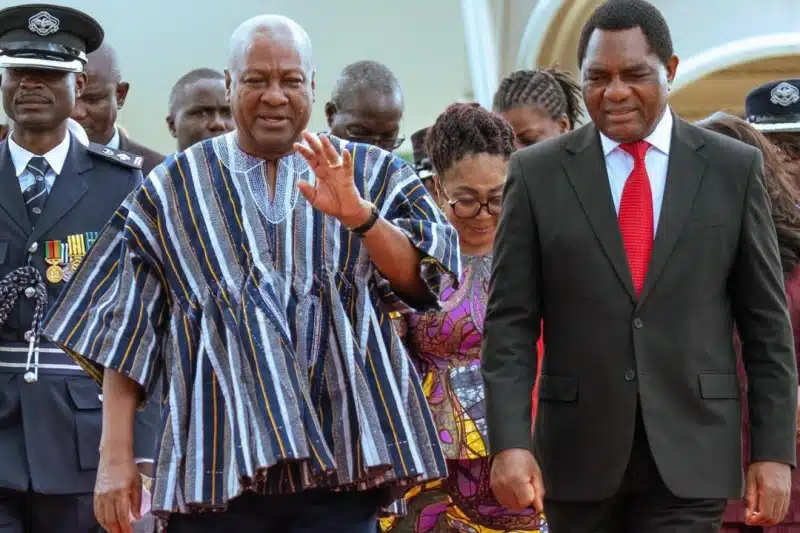

What started as fashion banter has evolved into cultural policy, and potentially, a revival of Ghana’s northern textile economy.
The Spark: The “Blouse” Comment That Went Viral
The controversy began during President John Dramani Mahama’s state visit to Lusaka in early February 2026. Stepping off his aircraft at Kenneth Kaunda International Airport, he wore a traditional Fugu, known locally as Batakari, a handwoven smock that originates from Northern Ghana.
While the attire is widely regarded in West Africa as a symbol of authority and heritage, some Zambian social media influencers mockingly described it as a “blouse,” referencing its loose silhouette and flared hem.
The remark quickly went viral.
Ghana’s Digital “Clapback”
The reaction across X and Instagram was immediate and coordinated.
Ghanaians responded not merely with memes, but with history. Timelines filled with archival images and commentary noting that Fugu was worn by Ghana’s founding father, Kwame Nkrumah, during the country’s 1957 independence celebrations. What critics dismissed as a “blouse” was, supporters argued, a garment deeply woven into Ghana’s political identity, symbolising dignity, resistance, and postcolonial pride.
Public figures amplified the message. Ghanaian digital creator Wode Maya and musician Wiyaala shared photographs in intricately embroidered Fugus, reframing the garment as both heritage and high fashion.
The online momentum soon drew diplomatic attention. Rather than allow the banter to harden into friction, Zambian President Hakainde Hichilema publicly praised the craftsmanship of the smock and announced plans to commission custom Fugus from Ghana for himself and members of his cabinet.
What began as mockery evolved into endorsement.
The Craft Behind the Cloth
Beyond symbolism, Fugu is the product of a centuries-old weaving tradition rooted among the Dagomba and other Mole-Dagbani ethnic groups of Northern Ghana, including the Mamprusi and Frafra communities.
The fabric is crafted using narrow-strip loom weaving, a technique passed down through generations. Cotton threads are spun and stretched across wooden looms, then woven into long strips typically four to five inches wide. These strips are stitched together to form broader panels before being tailored into the flowing smock.
Historically dyed with pigments derived from bark, roots, and indigo plants, the cloth retains its distinctive earthy palette, even as modern artisans incorporate brighter dyes for contemporary appeal. The embroidery, sometimes geometric, sometimes symbolic, is painstakingly hand-stitched and can take days or even weeks to complete for ceremonial pieces.
In communities around Tamale, Bolgatanga, Wa, and Yendi, weaving is both livelihood and lineage. Techniques are often passed through families, while women increasingly dominate tailoring, finishing, and commercial design adaptation.
From Banter to Policy
Recognizing the surge in global attention, Ghana’s Ministry of Tourism, Culture, and Creative Arts moved quickly. Led by Minister Abla Dzifa Gomashie, the Ministry issued a formal declaration on February 10:
“To affirm our identity and project Ghana’s heritage with pride, the government encourages all citizens, both at home and in the diaspora, to dedicate every Wednesday to the wearing of the Fugu.”
In less than a week, a social media roast had transformed into national branding.
The Economic Calculation
The move carries clear economic intent.
Ghana’s traditional textile and garment sector, which includes kente, Fugu, and other indigenous fabrics, employs tens of thousands of artisans across weaving, dyeing, tailoring, and embroidery. Industry observers estimate that the broader cultural textile value chain contributes hundreds of millions of cedis annually to local economies, particularly in the Northern, Upper East, and Upper West regions.
By institutionalizing “Fugu Day,” the government aims to:
-
Increase domestic demand for handwoven cotton strips
-
Stabilize income for rural weaving households
-
Create urban tailoring jobs as corporate Ghana embraces weekly traditional wear
-
Position Fugu as a premium African fashion export across Southern and Eastern Africa
If even 5–10 percent of Ghana’s formal workforce adopts weekly Fugu purchases or rotation, analysts suggest the multiplier effect could significantly expand weaving capacity within a year.
Culture, in this case, doubles as industrial policy.
Voices from the Loom
In Tamale, 54-year-old master weaver Ibrahim Alhassan described the moment as “unexpected but powerful.”
“For years, young people thought weaving was old-fashioned. Now they see the President wearing it, other countries talking about it. My apprentices are proud again.”
In Bolgatanga, tailor and embroiderer Mariama Atanga said orders began increasing shortly after the viral debate.
“People are calling asking for new designs before Wednesday. Even customers in Accra want custom pieces. This is good for us.”
For many artisans, the announcement represents not just pride, but income stability in regions that have historically faced higher unemployment and limited industrial investment.
The First “Fugu Wednesday” – February 11, 2026
The debut was both symbolic and visible. From Parliament House to corporate boardrooms in Accra, Western suits gave way to striped northern textiles. Civil servants, media personalities, and students participated.
President Mahama later joked online that he had become the “Chief Marketing Officer” for Ghanaian weavers.
A digital roast had stitched together national pride, diplomacy, and economic ambition.


