



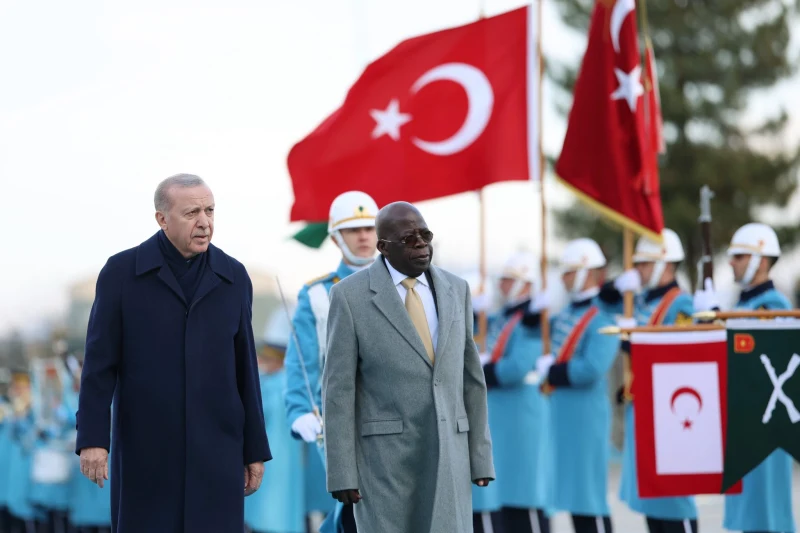

The televised stumble was brief, almost dismissible. President Bola Ahmed Tinubu, walking alongside Turkish President Recep Tayyip Erdoğan during a ceremonial parade in Ankara on Tuesday, lost his footing and fell. Within moments, security personnel helped him upright. The ceremony continued. The Nigerian Presidency issued its familiar refrain: a poorly laid carpet, nothing to see here, the president is “hale and hearty.”
But the Turkey incident was merely the latest public manifestation of what close observers of Nigerian politics have long suspected. At 73 years old, or possibly older according to some accounts, Tinubu’s hidden health crisis has become an open secret shrouded in official denial. What makes this fall significant is not the fall itself, but what it represents: a president whose health remains one of Nigeria’s most closely guarded state secrets.
The pattern is unmistakable. In March 2021, while campaigning as a presidential aspirant, Tinubu stumbled over his own foot at an event in Kaduna. Video footage circulated widely. Five months later, he underwent knee surgery in London, appearing on crutches as he departed Nigeria. Then came June 2024, when he tripped and fell while boarding a parade vehicle during Democracy Day celebrations in Abuja. Each time, the Presidency offered reassurances. Each time, public concern deepened.
What the public cannot see is perhaps more telling than what it can. Tinubu’s medical records remain locked away, protected by privacy laws that, while legally sound, leave Nigerians governing in the dark about the health of their leader. There are no publicly available documents, no transparent health assessments, nothing beyond official statements that invariably insist all is well.
The speculation, however, refuses to stay silent. Throughout his 2023 presidential campaign, Tinubu displayed what many described as a shuffling gait, slurred speech in certain appearances, and an evident need for physical support. His frequent medical trips abroad became a subject of national conversation. Reports placed him in France repeatedly between 2023 and 2025 for what officials termed “routine check-ups” or “private visits.” In August 2025, claims emerged that he was bedridden in Abuja, missing key governmental functions. The Presidency dismissed these as “baseless rumours.”
Most recently, Sahara Reporters suggested that Tinubu’s visit to Saint Lucia in 2025 served as cover for discreet medical consultations, allegedly arranged through the influence of close associate Gilbert Chagoury. The Presidency countered that the trip was purely diplomatic. The public was left, as always, to read between carefully crafted lines.
Public interpretations now range widely, from concerns about mobility linked to past surgeries to questions raised by observed tremors and speech patterns. None of these interpretations can be independently verified, and the Presidency has provided no medical disclosure that would allow the public to assess them. In the absence of transparency, conjecture thrives.
Medical privacy is a fundamental right, even for presidents. But there exists an unavoidable tension between personal privacy and public accountability when the person in question holds the highest office in Africa’s most populous nation. Nigerians remember all too well the presidency of Umaru Musa Yar’Adua, who governed while gravely ill and died in office in 2010, leaving the country in constitutional limbo. They also recall Muhammadu Buhari’s numerous medical trips to London, during which he spent extended periods away from the country while critical decisions were deferred.
The Turkey fall matters not because it happened, but because it happened in the open. Away from the controlled environments of Aso Rock, away from the careful choreography of official events, the camera captured what palace handlers cannot always prevent. It was a moment of unscripted reality in a presidency that has mastered the art of managed appearances.
What remains unknown dwarfs what is known. Is Tinubu managing age-related decline, as many suspect? Do his frequent trips abroad suggest treatment for undisclosed chronic conditions? These questions persist not because Nigerians are predisposed to cynicism, but because history has taught them the cost of silence.
Tinubu’s situation is not unique on the African continent. He joins a troubling cohort of elderly leaders who cling to power despite visible frailty. Paul Biya of Cameroon, 93, has ruled since 1982 and is rarely seen in public. Teodoro Obiang Nguema, 84, has governed since 1979. Uganda’s Yoweri Museveni, 82, has been in power since 1986. Zimbabwe’s Emmerson Mnangagwa, 84, and the Republic of Congo’s Denis Sassou Nguesso, 83, complete this gerontocracy.
These leaders share more than advanced age. They govern within political systems where authority has become highly personalised, and where leadership succession is often approached with caution rather than treated as a routine democratic transition. Extended tenures have become a defining feature in several such systems, contributing to prolonged uncertainty about renewal and continuity at the top of government.
For Nigeria, the implications are profound. The country faces enormous challenges: a collapsing national grid, soaring inflation, widespread insecurity, and a deepening youth unemployment crisis. These problems demand vigorous, focused leadership. Instead, the nation watches its president stumble, literally and figuratively, while official spokespeople insist that all is well.
Calls for greater transparency have grown louder with each public incident of this nature. In 2022, ahead of Tinubu’s election, the Arewa Consultative Forum urged that anyone with credible evidence of a candidate’s unfitness for office should speak out, citing Nigeria’s difficult experiences with leaders whose health conditions were shielded from public scrutiny. That call went unheeded. The evidence, such as it is, remains sealed behind medical confidentiality and official obfuscation.
What Nigerians are left with is a presidency defined as much by what is hidden as by what is revealed. They see the stumbles, the absences, the foreign medical trips. They hear the denials, the reassurances, the explanations about faulty carpets and minor mishaps. They know their president is 73, perhaps older. They suspect he is unwell. They cannot prove it.
The Turkey incident will fade from the news cycle, as previous incidents have. The Presidency will continue to dismiss health concerns. Tinubu will continue to govern, supported by the machinery of state and the apparatus of power. But the question remains unanswered, hanging over Nigerian democracy like a shroud: what is the true state of the president’s health, and why must it remain a secret?
In the absence of transparency, speculation fills the void. In the absence of accountability, trust erodes. And in the absence of an honest national conversation about presidential fitness and succession, Nigeria stumbles forward, much like its president, with no assurance that the next fall will not be one from which the system itself cannot recover.


