



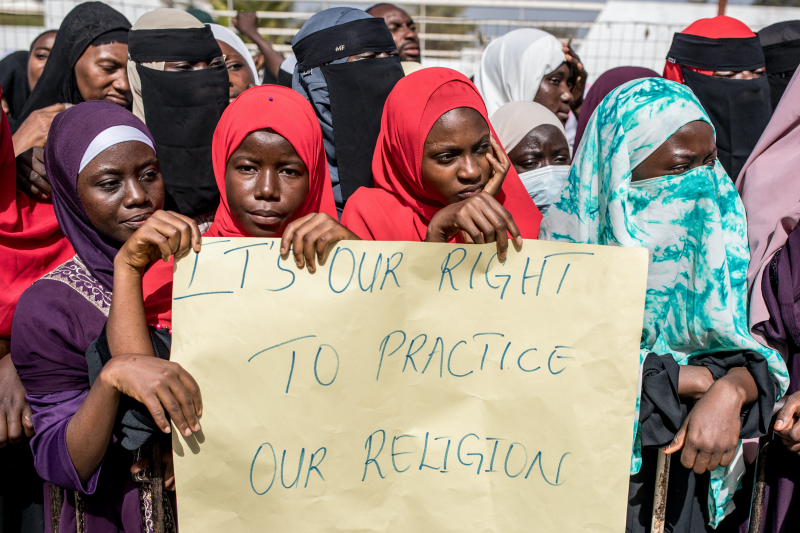

In courtrooms in Banjul and in villages hundreds of kilometres away, a profound national argument is unfolding around the FGM ban in The Gambia, one that cuts across religion, law, gender, and political identity. At its centre is female genital mutilation (FGM), a practice outlawed since 2015 but now the subject of a determined legal effort to overturn that prohibition.
The challenge before the Supreme Court of The Gambia, which began hearings in December 2025 and resumed this month, has exposed how fragile consensus around women’s rights remains, even under democratic rule. It has also reopened questions many Gambians believed had already been settled: who defines culture, how far religious freedom extends, and whether the state has the authority to criminalise long-standing practices when they conflict with public health and child protection.
No ruling has yet been delivered. But the arguments heard so far reveal a country wrestling openly with itself.
A Ban Born Under Dictatorship, Challenged Under Democracy
FGM was criminalised in December 2015 through the Women’s (Amendment) Act, passed under former president Yahya Jammeh. The law imposed prison sentences and fines on anyone who performed, aided, or abetted the practice, with life imprisonment if it resulted in death.
Although the ban aligned The Gambia with international conventions such as CEDAW and the Maputo Protocol, some critics have argued that its passage under an authoritarian government weakened its legitimacy. Under Jammeh, whose rule was later associated with repression, enforced disappearances, and torture, laws enacted during that period have since been questioned by sections of the public as externally driven rather than democratically debated.
After Jammeh’s removal in 2017, the new democratic government under Adama Barrow initially left the law untouched. But enforcement was minimal. For nearly eight years, no prosecutions occurred, and FGM continued largely underground.
That changed in 2023.
The Conviction That Reignited a National Debate
In August 2023, three women were convicted for subjecting eight children to female genital mutilation in Niani District, the first case to result in convictions since the practice was criminalised in 2015. Rather than deterring the practice, the case triggered an immediate backlash.
Religious leaders condemned the convictions, rallies were organised, and a fatwa issued by the Supreme Islamic Council framed FGM—described as “female circumcision”—as a virtue of Islam. The argument was clear: the state had criminalised a religiously sanctioned practice and violated constitutional protections.
The backlash soon moved into Parliament. In March 2024, a bill seeking to repeal the FGM ban was introduced. Although it passed second reading, the proposal was rejected in July 2024 following committee hearings and public consultations, with lawmakers voting 34–19 to retain the prohibition.
Within weeks, the battle shifted from Parliament to the courts.
The Supreme Court Challenge
The current case was filed by a coalition led by Almameh Gibba, an independent member of parliament, alongside religious and civic organisations.
Their argument rests on two provisions of the Gambian Constitution: Section 25, which guarantees freedom of religion, and Section 32, which protects the right to culture.
According to the plaintiffs, the FGM ban unlawfully interferes with religious practice and cultural expression. They argue that the law makes no meaningful distinction between harmful forms of FGM and what they describe as a minor, non-injurious religious procedure.
Hearings began in December 2025 before a five-member panel and resumed in January 2026. The proceedings have been held in open court and have attracted domestic and international media coverage, as well as attention from human rights organisations.
Testimonies That Reframe the Practice
Witnesses called by the plaintiffs characterised female genital mutilation as benign, voluntary, and beneficial.
Among them is Imam Abdoulie Fatty, a prominent cleric who told the court that what is practiced in many Gambian communities is not mutilation but a religiously recommended act. He cited Islamic texts to argue that the procedure is meant to promote cleanliness and modesty, and distinguished what he called “acceptable” forms from more severe types condemned by Islam.
Another witness, a former practitioner, described carrying out the procedure on infants and young girls using sterilised razor blades, insisting she had never witnessed serious complications. She framed the practice as a cultural rite linked to moral upbringing and social respectability.
Under cross-examination, witnesses acknowledged that children do not consent to the procedure and that it is typically carried out at a very young age. Still, they maintained that harm arises only from improper execution—not from the practice itself.
Medical and public health authorities, outside the court proceedings, cite evidence linking the practice to a range of health risks.
Health Risks and the Human Cost
According to UNICEF, approximately 73 percent of women aged 15 to 49 in The Gambia have undergone female genital mutilation, with higher prevalence reported in rural areas. UNICEF reports that the practice remains widespread among women and girls.
The World Health Organization considers the practice to be harmful and advises against it on public health grounds.
In 2025, health authorities and civil society organisations reported two infant deaths linked to bleeding following the procedure.
Women’s rights organisations and health professionals have cited such cases in public statements and advocacy efforts related to the ongoing legal and policy debate.
Religion, Identity, and Resistance to “Western Influence”
Support for repeal has been expressed by religious leaders and community members in conservative settings, where the practice is discussed in relation to religious observance and cultural identity.
During public debates and advocacy efforts, proponents of repeal have described the FGM ban as externally influenced, citing The Gambia’s dependence on foreign aid and the involvement of international organisations in anti-FGM programmes.
Supporters have also used social media platforms to circulate these arguments and to engage audiences beyond formal religious gatherings. Videos, sermons, and WhatsApp messages frame the issue as a defence of sovereignty against external moral imposition.
For critics, this framing ignores the voices of survivors and conflates cultural autonomy with practices that primarily affect girls who have no capacity to choose.
Civil Society Pushback and International Pressure
Women-led organisations have emerged as the most consistent defenders of the ban. Groups such as GAMCOTRAP and FAWEGAM have documented health impacts, supported survivors, and engaged lawmakers during the parliamentary debate.
They are supported by international partners and agencies, including UN programmes focused on eliminating harmful practices by 2030 under the Sustainable Development Goals. Human rights organisations have warned that repealing the ban would violate The Gambia’s international obligations and could encourage similar reversals elsewhere in West Africa.
A recent regional court ruling against another West African state for failing to protect girls from FGM has added weight to those concerns.
What Is at Stake
The Supreme Court’s eventual ruling will carry implications beyond the immediate case.
The law remains in force while the court considers the challenge. Legal analysts and civil society groups note that enforcement of the ban has historically been uneven, regardless of the outcome.
The court has reserved its decision.
The outcome will determine whether the 2015 prohibition on female genital mutilation remains in force or is struck down.


