




Five months into his second term, Mahama is steering Ghana through an economic recovery marked by measured reforms, cautious public optimism, and pressure to deliver real change.
When President John Dramani Mahama returned to power on January 7, 2025, he inherited a broken economy in need of urgent reform. The Ghana economic recovery became a defining theme of his second term, following years of inflation, sovereign debt default, and public discontent after the Akufo-Addo administration. Five months into Mahama’s return, early signs suggest a structured, though cautious, path forward.
Inside Mahama’s Ghana Economic Recovery Strategy
At the heart of Mahama’s vision is the Eight-Pillar Recovery Plan, introduced in May 2025. It focuses on macroeconomic stabilisation, industrial transformation, and governance reforms—drawing lessons from Mahama’s 2012–2017 presidency and the Akufo-Addo years.
Launched in June 2025, the National Industrialisation Drive aims to pivot Ghana away from gold, cocoa, and oil toward agro-processing and light manufacturing. This diversification underpins the Ghana economic recovery, signalling a shift toward long-term value creation.
The ambitious 24-hour economy initiative, encouraging round-the-clock operations, has sparked debate but also hope for expanded employment opportunities and increased productivity.
Economic Indicators in Ghana’s Recovery: Gains & Risks
The World Bank projects 4.3% GDP growth for Ghana in 2025. While an improvement, structural challenges remain. Inflation, which peaked at 54.1% in December 2022, dropped to 23.0% by November 2024. Yet $2.5 billion in power sector arrears and high youth unemployment threaten sustained growth.
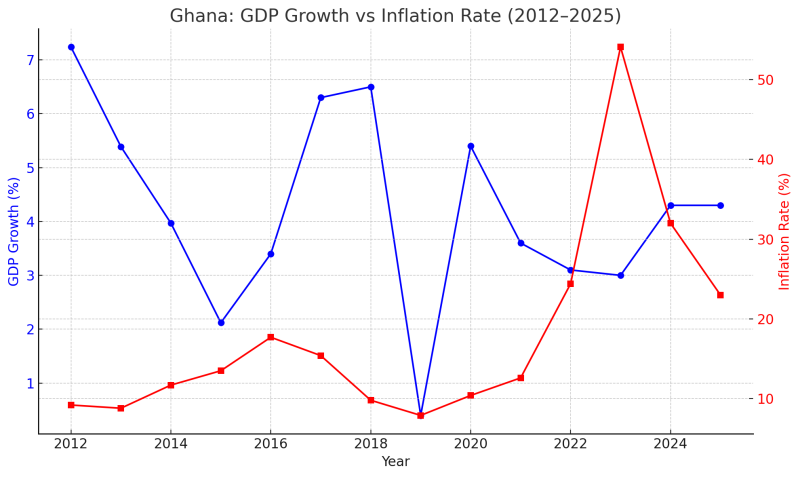
Programs like “One Million Coders” aim to address joblessness, while fiscal discipline efforts form part of the broader Ghana economic recovery plan.
Currency Confidence: A Small but Important Win
In a sign of improved economic management, the Ghana cedi appreciated by 0.17% against the US dollar between June 2024 and June 2025. Currency stabilisation is key to sustaining the Ghana economic recovery and restoring investor confidence.
Ghana in West Africa: Competitive but Constrained
Regionally, Ghana’s projected growth is solid but lags leaders like Senegal (10.6%) and Côte d’Ivoire (6.2%). While Ghana benefits from an advanced industrial base and reform-minded governance, inflation and debt burdens weigh it down.
Looking Back to Look Forward
Mahama’s current strategy reflects lessons from his past term—marked by the “dumsor” power crisis and declining growth—and from Akufo-Addo’s failed economic stewardship that culminated in the 2022 sovereign debt default.
Now, working within a $3 billion IMF program, Mahama appears more cautious and reform-oriented, aligning fiscal restraint with industrial development for a sustainable Ghana economic recovery.
Ghanaians Speak: Hopeful, but Hardened
Public sentiment is cautiously optimistic. On X (formerly Twitter), users like @AnnanPerry praised Mahama’s performance at the Africa Business Forum. @scottbolshevik welcomed the energy debt repayment plan. Others like @LouieXiii131 continue to call for institutional audits—underscoring ongoing concerns about transparency.
Citizens want progress they can feel—affordable food, jobs, and electricity. They will judge the Ghana economic recovery based on lived experience, not press releases.
Experts and the Everyday
While institutions like the ISS predict Ghana could achieve 9% growth by 2043 with proper reforms, citizens remain grounded in the present. Their concerns are immediate: wages, bills, and daily survival.
Conclusion: Will Ghana’s Economic Recovery Hold?
Five months into his presidency, Mahama has charted a more structured course. His second term reflects both maturity and constraint. But the success of the Ghana economic recovery will hinge on sustained delivery—not strategy alone.
For now, Mahama has bought time. But Ghanaians are watching—carefully.

