




Story by Joshua Moracha(Zambia) and Mercie Wamoyi(Kenya)
In the shadow of mineral wealth, a crisis unfolds. Zambia’s Copperbelt—once the crown jewel of the nation’s economy—harbours a devastating secret: widespread hunger and malnutrition that has reached alarming proportions. While copper exports generate millions in revenue, children go to bed hungry, and farmers watch helplessly as their once-fertile lands turn barren.
Since Zambia’s post-independence economic model emphasised copper exports as the backbone of national growth, agriculture in regions like the Copperbelt received little sustained investment. Over decades, this imbalance deepened rural poverty and left communities vulnerable to market and environmental shocks.
Colonial powers established the mining industry in the 1920s and 1930s, but even after independence in 1964, successive governments continued to prioritise mineral extraction over agricultural development.
The nationalisation of mines in the 1970s briefly promised local control, but structural adjustment programs in the 1980s and 1990s forced privatisation, handing control back to multinational corporations with little accountability. As mining companies exploited the region’s rich copper deposits, traditional farming knowledge and agricultural infrastructure deteriorated. What was once intended to be the economic engine lifting the nation became a curse for rural communities whose food systems were systematically neglected.
From breadbasket to barren
“Farmers affected by the mining pollution in Mwambashi and Chambeshi areas will NOT be able to plant any crops this year due to the damage caused to the soil by the acid pollution,” declares Elisha Matambo, Copperbelt Province Minister, in a stark 2025 statement that reveals the true cost of unchecked industrial activity.
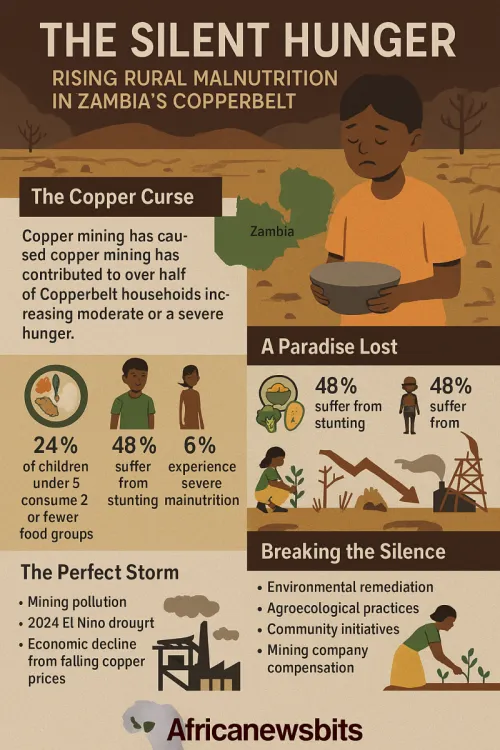
The irony is painful—a region rich in natural resources has become impoverished in its most basic need: food. Over half of Copperbelt households now face moderate to severe hunger. The statistics are heartbreaking: 24% of children under five consume only two or fewer food groups daily, 48% suffer from stunting, 25% are underweight, and 6% experience severe malnutrition. Behind each percentage point are real children, with dreams and potential being stunted alongside their bodies.
The perfect storm
This crisis didn’t happen overnight. It’s the result of a perfect storm of factors that have converged over decades:
Mining operations, primarily run by multinational corporations like Glencore and First Quantum Minerals, have poisoned the land with acid runoff and heavy metals, turning once-productive farms into toxic wastelands. These companies have extracted billions in profit while environmental regulations remain weakly enforced and rehabilitation efforts minimal.
When global copper prices fluctuate—as they did dramatically during the 2008 financial crisis and again in the early 2020s—these companies slash local employment while maintaining executive bonuses, leaving Zambian communities to bear the economic cost.
The 2024 El Niño drought—the worst in 60 years—destroyed nearly half of Zambia’s maize crop, leaving 6 million people food insecure. Economic decline from falling copper prices has driven unemployment to 45% and poverty to 75% in the region. Agricultural policies have prioritised export crops over feeding local communities, and smallholder farmers have been left without support.
As copper mines dig deeper into the earth, they simultaneously dig deeper into the region’s future, extracting not just minerals but the very possibility of food sovereignty.
Voices from the ground
The story of the Copperbelt cannot be told without amplifying the voices of those who live its reality every day.
In Kalulushi District, smallholder farmers are speaking out against the government’s Farm Input Subsidy Programme (FISP), which has promoted synthetic fertilisers at the expense of soil health. “These chemicals are destroying our land,” these farmers lament, advocating instead for agro-ecology practices like organic composting and crop diversification to restore their soil’s vitality.
Their concerns echo across the region, where generations of agricultural wisdom are being lost to short-term industrial gain. But amid the despair, there are also stories of resilience and innovation.
Take Emeldah, a single mother and farmer from Monze District. Though not from the Copperbelt, her experience resonates with challenges faced across rural Zambia. “I have white and orange corn, cowpeas, groundnuts, and sunflowers,” she proudly shares, having diversified her crops through a WFP-supported farmers’ club. She’s even started a business selling cowpea sausages and soybean cakes, with dreams of opening a restaurant.
Emeldah’s story highlights what’s possible when farmers receive the right support and training—a vision that remains elusive for most Copperbelt residents.
Women and youth: Bearing the burden, leading the change
The malnutrition crisis weighs heaviest on the Copperbelt’s most vulnerable. Pregnant women and nursing mothers struggle to obtain essential nutrients, leading to a devastating cycle of maternal anaemia, low birth weights, and compromised development for infants.
Local midwives report seeing women so malnourished they cannot produce sufficient breast milk, while adolescent girls often drop out of school when hunger makes concentration impossible or when they must help their families search for food.
Yet women and youth are also at the forefront of resistance and innovation. In Kitwe, 24-year-old Mutale leads a collective of young farmers reclaiming abandoned urban plots for vegetable production. She said:
“The mining companies took our parents’ jobs and poisoned our soil, but we refuse to inherit hunger. We’re building a new relationship with the land.”
Her group uses social media to share farming techniques adapted to contaminated soils and connects with youth across the continent facing similar challenges.
Beyond rural: Urban food deserts in mining towns
The hunger crisis stretches beyond rural areas into the Copperbelt’s urban centres. In mining towns like Chingola and Mufulira, laid-off miners and their families face skyrocketing food prices in markets dominated by imported goods. A loaf of bread can cost three times what it does in Lusaka, while fresh vegetables are scarce and expensive. Urban residents often spend over 70% of their income on food, yet still cannot afford nutritionally adequate diets.
“I worked in the mines for fifteen years, and now I can’t feed my family,” says Joseph, a former miner in Kitwe. “The supermarkets are for the mining executives, not for us.” Many urban families now rely on informal food markets where quality and safety are concerns, or they send children back to rural villages during school holidays—straining already food-insecure rural households.
The way forward
The solutions to the Copperbelt’s malnutrition crisis are as complex as its causes, but they begin with listening to local voices.
Sibi Lawson-Marriott of the World Food Programme emphasises the importance of supporting local producers:
“When WFP distributes cash transfer of a million dollars in a small refugee settlement, for example, that’s a huge market opportunity. And if we can support local producers to take advantage of that—that’s a systems action.”
This systems approach is crucial. One-off food aid won’t solve the deeper issues. What’s needed is a comprehensive strategy that addresses environmental remediation, agricultural policy reform, community empowerment, and climate resilience.
Minister Matambo’s call for mining companies to compensate farmers and remediate damaged land must be heeded. The farmers advocating for agro-ecological practices deserve policy support. Community-led initiatives like seed banks, urban agriculture cooperatives, and land restoration projects need resources to scale.
Breaking the silence
The hunger in Zambia’s Copperbelt has been silent for too long—overshadowed by copper production figures and export earnings. It’s time to break this silence.
When a region that powers a nation’s economy cannot feed its children, something is fundamentally broken. When farmers can no longer plant crops in soil ravaged by the very industry that was supposed to bring prosperity, something is desperately wrong.
The crisis in the Copperbelt isn’t just about food—it’s about justice. It’s about recognising that true wealth isn’t measured in copper tons, but in healthy children, thriving communities, and sustainable livelihoods.
As one Kalulushi farmer puts it, “Our soil is our future. If we can heal the land, we can heal ourselves.” In these words lies both the challenge and the hope for Zambia’s Copperbelt—a region where hunger must no longer remain silent, and where prosperity must be redefined to include the fundamental right to nutritious food for all.
The time for action is now. The voices from the ground are speaking. The question is: are we listening?

