



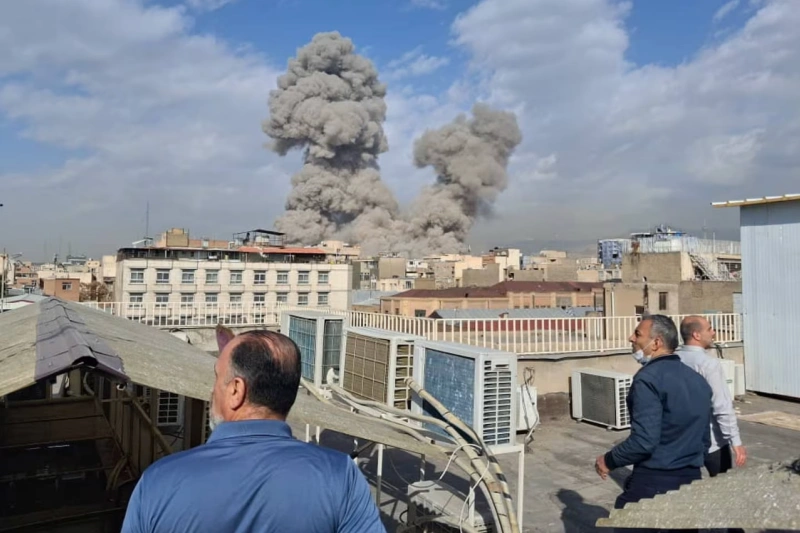
When the first explosions were reported in Tehran just before midday on 28 February 2026, the tremors were not only felt in the Middle East. Within hours of the massive US-Israeli Strikes on Iran, the African Union (AU) issued an urgent appeal for de-escalation, warning that an expanding conflict could have “catastrophic” consequences for African economies already stretched to their limits.
The military action, codenamed “Operation Roaring Lion,” marks a terrifying shift in global security. For AU Commission Chairperson Mahamoud Ali Youssouf, the priority is no longer just diplomacy – it is preventing a total economic collapse across the Global South.
The Foundations: A Regime Pushed to the Brink
The decision by Washington and Tel Aviv to launch kinetic strikes did not occur in a vacuum; it was the inevitable explosion following a winter of internal decay within the Islamic Republic. By early 2026, the Iranian state was already buckling under the weight of the “Rial Rebellion.” What began as a series of strikes over bread prices quickly morphed into a national uprising against the clerical establishment.
On 8 January 2026, the world watched in horror as the IRGC carried out a brutal crackdown in Tehran. While the regime attempted to shroud the violence behind a near-total internet blackout, survivor accounts and smuggled footage suggested a death toll exceeding 1,800 people in a single night of carnage. This internal instability directly bled into the nuclear arena. Indirect talks in Geneva, mediated by Oman, reached a final, bitter impasse on 27 February. When Iran refused to ship its enriched uranium stockpiles out of the country – calling it a “sovereign red line” – the diplomatic road hit a dead end.
The resulting US-Israeli Strikes on Iran have targeted more than just military silos; they have struck the very heart of the state’s command structure, including the presidential palace. While the US calls this a “liberation of the Iranian people,” the African Union sees it as the opening of a Pandora’s Box that could swallow the fragile progress of the African continent.
Why African Leaders Are Worried
The fear in Addis Ababa is that Africa is the “unseen victim” of Middle Eastern volatility. The US-Israeli Strikes on Iran have immediately threatened three vital pillars of African stability: energy security, the cost of food, and the safety of maritime trade corridors.
Energy: The Price of Distance
The Strait of Hormuz carries roughly 20% of the world’s oil. With Iran threatening to retaliate against US interests in the Gulf, fuel-importing nations like Kenya and Ethiopia are bracing for transport and electricity costs to surge. Even as a producer, South Africa is deeply vulnerable; heavily reliant on imported refined products, the country could see record-breaking pump prices within days. Shipping companies have already begun rerouting vessels around the Cape of Good Hope, a diversion that adds ten days to travel and massive insurance premiums to every container landing in an African port.
Nigeria: A Windfall with a Sting
For Nigeria, the US-Israeli Strikes on Iran present a paradox. While the 2026 budget was based on a conservative $64.85 oil price, crude is now screaming toward $100. However, because Nigeria still imports most of its petrol, analysts warn that prices at the pump could soon hit N1,000 per litre. This psychologically significant threshold threatens to spark domestic unrest. Consequently, security patrols in the Niger Delta have been ramped up to prevent local syndicates from exploiting the global chaos to tap into high-value pipelines.
Egypt: The Suez Canal and the “Revenue Gap”
For Egypt, the fear is centred on the Suez Canal. If the Red Sea becomes a “No-Go Zone” due to Iranian proxy retaliation or Houthi escalations, the canal – Egypt’s primary source of foreign currency – will see its revenue vanish. A sustained rerouting of global shipping would starve the Egyptian fiscus of billions of dollars, precisely when it needs those funds to buffer against rising wheat and energy import costs.
The “Forgotten Crises” and the Sudan Link
A major concern raised by AU officials is that a full-scale war in the Middle East will suck the oxygen out of the room for Africa’s own wars. Currently, the civil war in Sudan and the insurgencies in the Sahel are at a critical juncture. There is a deep-seated fear that as global powers fixate on Tehran, the humanitarian funding and diplomatic pressure required to end the suffering in Khartoum and Goma will simply dry up.
“The world only has so much bandwidth for tragedy,” noted one senior AU advisor. When the Middle East burns, Africa is pushed to the back of the queue.” Furthermore, there are growing concerns that Iran’s regional proxies could seek to activate “sleeper” networks in North and West Africa to strike at Western interests, effectively bringing a Middle Eastern war to African soil.
A Diplomatic Plea for Survival
The AU’s call for “cooler heads to prevail” is a pragmatic plea for time. As Chairperson Youssouf noted, Africa is the collateral damage of a world on fire. The continent cannot influence the trajectory of the US-Israeli Strikes on Iran, but it will almost certainly be the one to pay the bill in the form of hyperinflation, food scarcity, and social unrest.
By demanding an immediate return to the negotiating table, the AU is not siding with Tehran; it is siding with the millions of Africans whose livelihoods depend on stable markets and open shipping lanes. In 2026, in a hyper-connected global economy, there is no such thing as a “local” war.

