



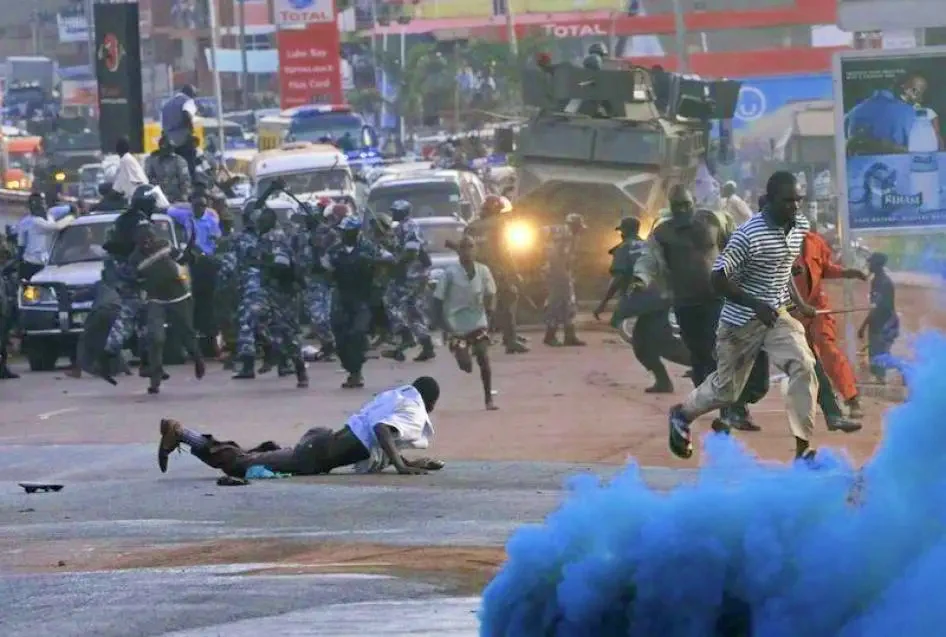
Uganda post-election violence has plunged the country into one of its most volatile moments in decades. The acrid smell of tear gas still hung over Kampala’s streets as dawn broke on 17 January, revealing a city transformed into an armed camp. Military helicopters circled overhead while armoured vehicles blocked major intersections, their crews watchful for any sign of the protests that President Yoweri Museveni had warned would be met with force.
The violence that erupted following Uganda’s disputed presidential election has left at least a dozen people dead, according to opposition figures and local rights monitors, hundreds detained, and the nation’s main opposition leader missing after being forcibly removed from his home by soldiers. What began as a tense election day on 15 January descended into bloodshed as the Electoral Commission began releasing results showing Museveni with a commanding lead that opposition supporters immediately denounced as fraudulent.
The latest provisional tallies showed the 81-year-old president securing 73.7 per cent of the vote, with his main challenger, the musician-turned-politician Robert Kyagulanyi, known as Bobi Wine, trailing at 22.7 per cent. These figures emerged from a vote conducted under an internet blackout, with widespread reports of technical failures and allegations of systematic fraud.
The deadliest violence occurred in the early hours of 16 January in Butambala, a town 55 kilometres southwest of Kampala. The details remain contested, caught between sharply conflicting accounts from police and opposition figures. What is not disputed is that at least ten people died there, though the circumstances surrounding their deaths remain contested.
Muwanga Kivumbi, a National Unity Platform MP representing Butambala, said security forces stormed his home at approximately 3am, firing tear gas before opening fire with live ammunition. “They killed ten people inside my house,” Kivumbi told reporters, his voice breaking with emotion. “There were people inside the garage who were waiting for the results to celebrate my victory. They broke the front door and began shooting inside the garage. It was a massacre.” Opposition leaders say an independent investigation is needed to establish the full facts.
His wife, Zahara Nampewo, a law professor, provided a harrowing account of the raid. She described how those sheltering in the garage were trapped when security forces fired through the door. “After killing them, the military continued firing,” Kivumbi added. “And they ensured that they removed all the evidence of the dead. You only have a pool of blood that is left here.”
The police narrative painted an entirely different picture. Local spokesperson Lydia Tumushabe claimed that machete-wielding opposition supporters had attacked a police station and vote-tallying centre, forcing officers to respond in self-defence. She said 25 people were arrested and charged with malicious damage to property, with “an unspecified number put out of action.” The stark divergence between these accounts reflects the deep mistrust that has poisoned Uganda’s political atmosphere.
In Kampala itself, protesters took to the streets as news of Museveni’s lead spread. Young men lit fires along roadsides while crowds charged through tear gas clouds as police deployed water cannons to disperse them and extinguish the flames. The scenes echoed the violence of 2021, when at least 54 people died in election-related unrest and thousands were detained.
The most dramatic development came late on 16 January, when an army helicopter descended onto Wine’s compound in the Magere suburb of Kampala. According to his National Unity Platform party, soldiers forcibly removed the 43-year-old opposition leader and flew him to a destination that authorities had not publicly disclosed by the time of reporting. His wife, Barbie Kyagulanyi, described a terrifying siege in a phone call to local media.
“Men are attempting to get into the house,” she said, her voice tight with fear. “They started by removing our cameras, then they brought ladders on the sides, and they have taken out our electricity. They have put a loudspeaker outside, and they have a helicopter above. They have us surrounded, and they have chained our gates.”
The party also alleged that Wine’s personal security team was violently assaulted during the operation, and that his gateman was shot dead, though authorities have denied this claim. Police spokesperson Kituuma Rusoke called the reports “untrue and unfounded,” but offered no explanation for Wine’s whereabouts. The internet blackout has made verifying the opposition leader’s location virtually impossible.
This was not the first time authorities had confined Wine to his residence. After the 2021 election, security forces held him under house arrest for several days, a pattern that human rights groups have condemned as part of a broader strategy to neutralise opposition.
The election itself was conducted under extraordinary restrictions. On 13 January, two days before voting began, the Uganda Communications Commission suspended mobile internet services, citing the need to prevent “misinformation, electoral fraud and incitement to violence.” The blackout remained in force throughout the voting and counting process, leaving citizens unable to share information or verify the Electoral Commission’s claims.
Voting was plagued by delays, with some polling stations opening up to four hours late due to what the commission termed “technical glitches.” Biometric identification kits failed across the country, forcing election officials to resort to paper registers. Opposition parties alleged this was deliberate, designed to facilitate fraud, particularly in areas where they enjoyed strong support.
Wine had accused the government of “massive ballot stuffing” throughout election day, claiming that over 20,000 polling stations reported results despite no voting having occurred due to security interference. His party reported that hundreds of polling agents and supervisors were abducted or chased from stations, leaving the count vulnerable to manipulation.
The campaign leading up to the vote had been marked by systematic violence against opposition supporters. Security forces repeatedly fired tear gas and bullets at Wine’s rallies, killing at least two people and arresting hundreds. In December, Wine and his supporters were attacked and beaten by security forces while campaigning in Gulu. The UN Human Rights Office warned that the election was taking place in an atmosphere of “widespread repression and intimidation.”
In his New Year’s Eve address, Museveni had recommended that security forces use more tear gas to break up what he called “the criminal opposition,” defending such tactics by saying “it doesn’t kill.” His son, General Muhoozi Kainerugaba, the country’s top military commander and widely seen as his father’s heir, had publicly claimed on social media to have personally tortured Wine’s chief bodyguard after he was abducted.
The Electoral Commission was expected to announce final results by 5pm local time on 17 January, though many Ugandans feared the declaration would trigger fresh violence. International observers and human rights groups had already raised serious concerns about the process. The United States had declared the 2021 election neither free nor fair, a verdict many expected would be repeated.
For Museveni, who seized power in 1986 after leading a guerrilla war, the election represented an opportunity to extend his grip on Uganda into a fifth decade. He removed constitutional term limits in 2005 and age limits in 2017, systematically dismantling the constraints that might have forced his retirement. In a bitter irony, he once wrote that “the problem of Africa in general, and Uganda in particular, is not the people but leaders who want to overstay in power.” Those words, penned in the year he took office, now haunt his legacy.
Wine represented the frustration of Uganda’s youth, who make up the overwhelming majority of the country’s 50 million people. Most Ugandans under 40 have known no other president. The former pop star, who earned the nickname “Ghetto President” for his upbringing in Kampala’s impoverished neighbourhoods, had promised sweeping reforms to tackle corruption and end what he characterised as “family rule.”
The violence in Uganda unfolded against a backdrop of regional instability. Tanzania’s October 2025 election had been followed by unprecedented levels of abductions, arrests and killings of opposition supporters, contradicting official results that credited the incumbent with 98 per cent of the vote. Kenya has witnessed deadly anti-government demonstrations in recent years. The pattern suggested a tightening of authoritarian control across East Africa.
Uganda’s strategic importance amplifies international concern about the election. The country shelters nearly two million refugees, the most in Africa, and provides troops for regional military operations. Museveni has maintained favourable relations with Western countries, recently agreeing to accept migrants rejected by the United States. He has also facilitated the entry of French and Chinese companies to begin oil drilling, with production set to start later in 2026.
Wine had vowed to review these oil contracts if elected, telling journalists that “any part in those agreements that does not favour Ugandans will definitely be revised.” Such pledges, combined with his popularity among the young and urban poor, made him a threat that Museveni’s security apparatus appeared determined to neutralise by any means necessary.
As Kampala awaited the final results, the internet blackout continued to choke the flow of information. Journalists struggled to verify claims and counterclaims. Families searched desperately for loved ones who had been arrested or had simply vanished. The full death toll remained unknown, with opposition sources suggesting it could be significantly higher than official figures acknowledged.
In the Butambala compound where the killings occurred, pools of blood dried on concrete floors. Families prepared to bury their dead, knowing that justice for the deaths would likely never come. Uganda has never witnessed a peaceful transfer of presidential power at the national level since independence from British colonial rule six decades ago. This election, conducted amid violence, fraud allegations and the disappearance of the main opposition candidate, suggested that grim pattern would continue.
The question haunting Uganda was not whether Museveni would be declared the winner, but whether the country could avoid descending into sustained unrest once that result was announced. With security forces deployed across major cities, opposition leaders detained or missing, and the internet still dark, the stage was set for further confrontation.

