



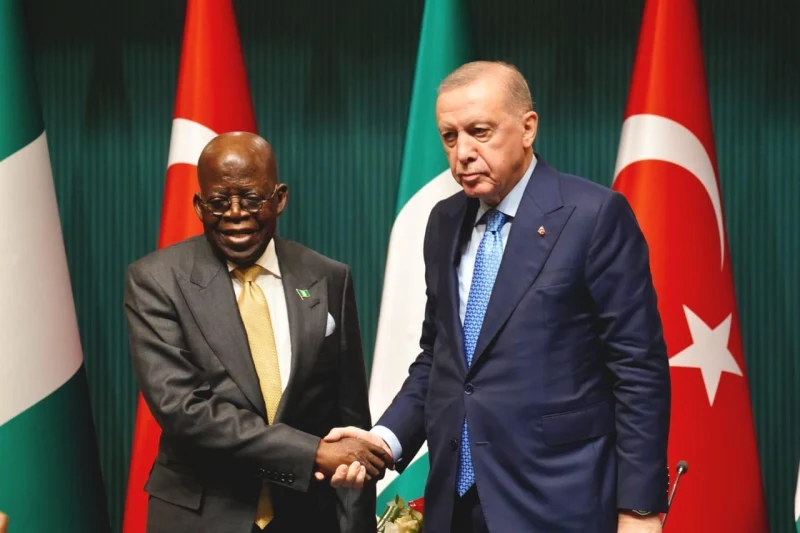
Nigeria-Turkey agreements were signed during President Bola Tinubu’s recent visit to Turkey, with officials from both countries concluding nine deals covering defence, trade, education, media cooperation, and social development. The visit briefly drew public attention after President Tinubu stumbled during the reception in Ankara, prompting online concern about his health.
Documents released by both sides show that most of the agreements are memoranda of understanding rather than binding commitments. Some build on existing cooperation, while others point to work that would follow.
One of the agreements focuses on Nigeria’s diaspora, which remains a major source of foreign inflows through remittances estimated at more than 20 billion dollars in 2025. According to officials familiar with the talks, the agreement is intended to improve coordination around remittance flows and skills transfer, drawing on Turkey’s experience engaging its citizens abroad. The framework is largely consultative, and details on funding or incentives are limited. Analysts say its impact will depend on whether it leads to concrete programmes that Nigerians living overseas can access.
Security cooperation featured prominently during the visit. Nigeria has in recent years purchased drones and ATAK T129 helicopters from Turkey, and the new agreement expands cooperation to include training, intelligence sharing, and defence industry collaboration. With insurgency, banditry, and violent crime affecting several parts of the country, officials see the partnership as a way to strengthen operational capacity. Security experts say past experience shows that equipment alone does not resolve Nigeria’s security challenges.
Economic cooperation is anchored on the creation of a joint economic commission, which both sides say will oversee efforts to expand trade and investment. Officials have spoken publicly about increasing bilateral trade from roughly 688 million dollars to 5 billion dollars annually. Turkish companies already operate in Nigeria, particularly in construction and infrastructure, and are often cited for their speed of execution. Business groups say reaching the trade target will depend largely on changes at home, particularly around policy stability, access to foreign exchange, and clearer regulations.
Another agreement focuses on halal certification, which officials say could help Nigerian producers meet requirements in some export markets, particularly in Muslim-majority countries. Agriculture officials say this could support exporters seeking access to new markets. In Nigeria’s religiously diverse society, the agreement has attracted attention beyond trade circles. Similar initiatives in the past have sparked debate, according to observers.
Education cooperation appears in several of the agreements. At the tertiary level, plans include university exchanges, scholarships, and joint academic programmes. Officials say the initiatives are meant to address long-standing problems in Nigeria’s higher education system, including underfunding and frequent disruptions. The agreements also extend to curriculum development and teacher training at the basic education level. Analysts say funding and coordination across levels of government will be key.
The agreements also include cooperation in media and broadcasting, with a focus on training, content exchange, and professional development for journalists. Supporters say the aim is to strengthen skills in a rapidly changing media landscape. The partnership has drawn attention amid ongoing international debates about media freedom in Turkey under Recep Tayyip Erdoğan, highlighting the importance of how such cooperation is implemented locally.
Other agreements signed during the visit relate to diplomatic training and social development, including women’s empowerment, youth initiatives, health, and social welfare. Officials describe these as frameworks for future collaboration rather than detailed programmes. Their scope and impact will depend on how follow-up projects are designed and funded.
Overall, the agreements point to Nigeria’s effort to widen its diplomatic and economic ties as some traditional partnerships come under strain. Turkey has presented itself as a partner in areas such as security, investment, and technical cooperation. Many of the commitments announced during the visit are broad and will depend on what follows.
For Nigeria, the agreements represent a familiar test. Similar partnerships in the past have raised expectations, with results depending largely on what happens at home. As officials return from Ankara, attention is expected to turn to implementation.

