



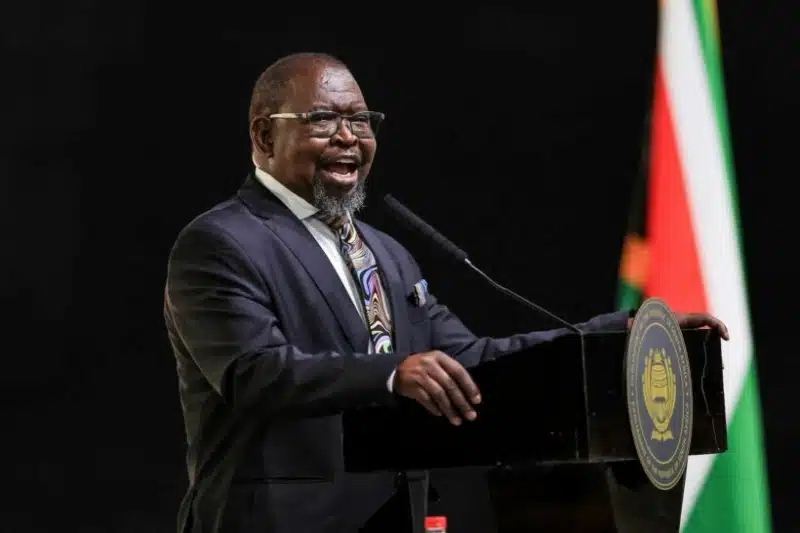
PRETORIA – South Africa’s 2026 fiscal framework, delivered by Finance Minister Enoch Godongwana, lands at a politically sensitive moment. Economic growth remains weak, debt-servicing costs are elevated, and social pressures are mounting.
Against that backdrop, Treasury has chosen a familiar but controversial tool: it has once declined to adjust personal income tax brackets for inflation in SA Budget 2026.
This is the third consecutive year of so-called bracket creep. And while it avoids the optics of an explicit tax hike, its effect is functionally similar.
For millions of working South Africans, the result will be subtle but real.
The Tax Trap: Bracket Creep as a Revenue Strategy
Bracket creep occurs when tax thresholds remain static while wages rise nominally in response to inflation. Workers appear to earn more, but a greater share of their income is taxed at higher marginal rates.
Treasury projects that this decision will generate approximately R16.4 billion in additional revenue.
What It Means in Practice
A professional receiving a 5 percent cost-of-living increase may find that the additional income is taxed at a higher marginal rate than before.
The arithmetic is straightforward:
-
If thresholds are frozen, part of that increase could shift from a 26 percent band to a 31 percent band.
-
The result is reduced real take-home growth.
In real terms, inflation erodes purchasing power. In fiscal terms, bracket creep quietly strengthens state revenue without Parliament voting for higher headline rates.
Economists describe this as a “passive consolidation tool.” Treasury avoids politically volatile measures such as increasing VAT, while still narrowing the deficit.
Yet the distributional question lingers: the middle class, already under pressure from rising living costs and stagnant service delivery, bears a disproportionate share of fiscal stabilisation.
Social Grants: Extending the R370 Lifeline
If the middle class absorbs the squeeze, the country’s most vulnerable receive continuity.
The Social Relief of Distress (SRD) grant, first introduced during the pandemic, will be extended for another 12 months until 31 March 2027.
The Numbers
-
Monthly payment: R370
-
Beneficiaries: Approximately 8 million people
-
Duration: Extended through March 2027
However, this extension comes with structural reform. By April 2027, the SRD is scheduled to transition into a new “Job-Seeker Support” framework.
The Minister indicated that the future model will link cash transfers to job-search activity and skills development participation. The objective is to shift from emergency relief toward labour market activation.
This reflects a broader policy debate: whether South Africa can afford a permanent basic income grant in its current fiscal position, or whether support must be conditional and employment-linked.
Carbon Tax Escalation and Industrial Impact
More consequential than routine excise adjustments is the escalation of the carbon tax under Phase 2 implementation.
Phase 2 Carbon Tax
-
Previous rate: R236 per tonne
-
New rate: R308 per tonne
-
Increase: 30.5 percent
The tax applies primarily to large industrial emitters in energy-intensive sectors. While the policy objective is emissions reduction and alignment with climate commitments, analysts note that compliance costs may, over time, be incorporated into production pricing structures.
The extent of any pass-through to electricity tariffs, transport costs or manufactured goods will depend on sector-specific absorption capacity, regulatory decisions and prevailing market conditions. In a low-growth environment, however, cost adjustments tend to have broader multiplier effects across supply chains.
Infrastructure as the Counterbalance
To balance revenue-side tightening, Treasury has positioned infrastructure investment as a medium-term growth lever.
A R940 billion infrastructure pipeline remains central to the strategy, targeting logistics reform, water system rehabilitation and municipal energy networks.
In addition, a R54 billion performance-based grant framework has been introduced to incentivise measurable improvements in municipal service delivery outcomes.
The policy logic is straightforward: fiscal consolidation is paired with capital expenditure aimed at improving productivity and unlocking private-sector participation.
Implementation remains the critical variable. Historical infrastructure backlogs and governance constraints suggest that the effectiveness of this allocation will depend heavily on project management capacity and institutional coordination.
Institutional Reinforcement: SARS Capacity Expansion
The South African Revenue Service (SARS) will receive an additional R7.5 billion to strengthen compliance enforcement, including expanded data analytics and AI-assisted audit systems.
Treasury’s stated objective is to broaden the effective tax base and improve collection efficiency rather than introduce new headline tax increases.
Should enforcement gains materialise, reliance on indirect revenue measures such as bracket creep could ease in future cycles. Absent measurable improvements, however, the fiscal burden is likely to remain concentrated among formally employed taxpayers.
Winners and Losers of SA Budget 2026
Winners
-
SRD beneficiaries retaining the R370 grant for another year
-
High-performing municipalities eligible for the R54 billion incentive framework
-
SARS, with expanded enforcement funding
Losers
-
Middle-income earners affected by continued bracket creep
-
Heavy industry facing higher carbon compliance costs
-
Motorists absorbing projected fuel levy adjustments
The Broader Fiscal Question
South Africa’s debt-to-GDP ratio remains elevated, and debt-service costs compete directly with social and capital spending.
Treasury’s 2026 strategy can be summarised as follows:
-
Avoid politically explosive tax hikes
-
Preserve social stability through grant continuity
-
Tighten enforcement to improve compliance
The risk is cumulative fatigue among formal taxpayers. The opportunity lies in whether infrastructure reform and labour-market activation can broaden the base of economic participation.
Ultimately, SA Budget 2026 reflects a state attempting to balance two imperatives: fiscal consolidation and social protection.
Whether that balance proves sustainable will depend less on the arithmetic of bracket creep and more on the credibility of execution.

