



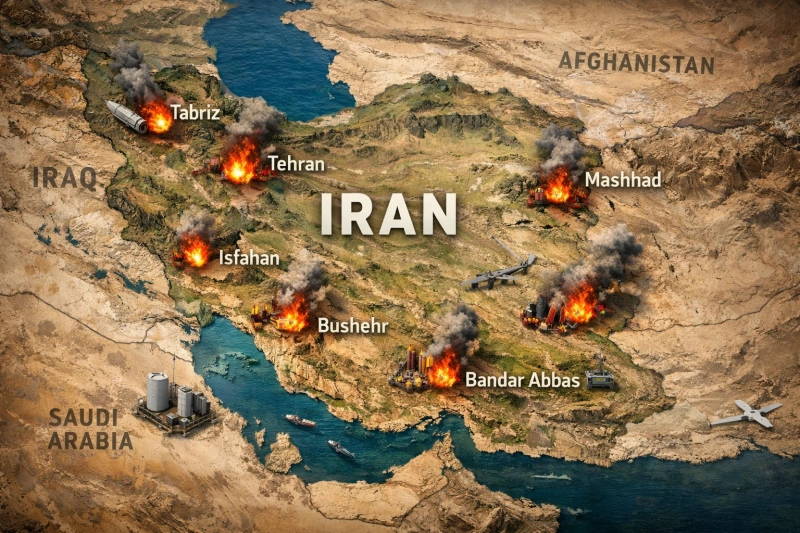
The world woke up to a different map this morning. Following a high-precision joint military operation by US and Israeli forces, the world is now grappling with an Iran Conflict Update 2026. Codenamed “Epic Fury” in the Pentagon and “Operation Genesis” in Tel Aviv, the mission has achieved what many thought impossible: the confirmed death of Ali Khamenei, the Supreme Leader who has defined the Islamic Republic for nearly four decades.
Inside Tehran: A Regime in Total Disarray
Intelligence reports and local witnesses from the “Pasteur” district describe a scene of unprecedented devastation. This was not a mere strike on military infrastructure; it was a surgical removal of the state’s decision-making core.
The Decapitation of the Command Structure
Military analysts are calling the Saturday-Sunday strikes a “decapitation operation.” It is now confirmed that the top tier of the Iranian military and clerical hierarchy was eliminated in a single, coordinated wave of “bunker-buster” munitions. Among the confirmed dead are:
-
Ali Khamenei: The 86-year-old Supreme Leader.
-
Abdolrahim Mousavi: Chief of Staff of the Armed Forces.
-
Aziz Nasirzadeh: Minister of Defence.
-
Hossein Salami: The commander-in-chief of the elite IRGC.
This loss creates a vacuum that the Artesh (regular army) and the IRGC (Revolutionary Guard Corps) are already struggling to fill. Ground reports suggest that as the Iran Conflict Update 2026 spreads, localized units are acting without central orders, leading to chaotic skirmishes across the country.
The Fragile Emergency Council
A makeshift Emergency Governing Council has been announced to manage the transition, including the President and the Head of the Judiciary. However, with the IRGC’s Sarallah Headquarters in ruins, the regime’s ability to maintain internal security is at its lowest point in 47 years. In some districts of Tehran, the morality police have vanished, replaced by an eerie silence as residents brace for what comes next.
The Regional “Axis” Response: Fires in Lebanon and Iraq
While many observers feared an immediate global conflagration, the physical retaliation has remained strategically concentrated in historic flashpoints.
-
The Lebanon Front: Hezbollah has formally declared its entry into the war, launching “revenge” rocket barrages into northern Israel targeting missile defence sites near Haifa. The Israel Defence Forces (IDF) responded with an intense aerial campaign in Beirut’s southern suburbs, with the Lebanese Health Ministry reporting at least 31 deaths this morning.
-
The Baghdad Standoff: In Iraq, supporters of the Popular Mobilisation Forces (PMF) have swarmed the Green Zone, attempting to breach the outer perimeter of the US Embassy. While volatile, Iraqi security forces are currently holding the line.
-
Symbolic Protests in Kashmir: In Srinagar and Budgam, thousands of Shia mourners gathered to protest the killing of Khamenei. These demonstrations remain symbolic outpourings of religious grief rather than direct military mobilisations.
Shipping Crisis: The “Cape of Good Hope” Strategy
The most immediate global threat in this Iran Conflict Update 2026 is the closure of the Strait of Hormuz. The IRGC Navy has issued VHF radio warnings that “no ship is allowed to pass,” effectively choking off 20% of the world’s oil supply overnight.
The Pivot to Africa
Commercial shipping is not waiting for a ceasefire. Major carriers like Maersk and MSC have ordered their fleets to bypass the Suez Canal entirely. Vessels are now rerouting around the Cape of Good Hope.
For African nations, this shift is a double-edged sword:
-
The Logistics Windfall: Ports such as Durban (South Africa), Walvis Bay (Namibia), and Lagos (Nigeria) are suddenly the most vital refuelling stops on the globe. This “bunkering” surge will bring millions in revenue to port authorities and local service providers.
-
The Inflationary Hammer: The detour adds 12 to 14 days to a standard journey. For East African nations like Kenya and Ethiopia, which rely on timely imports of fuel and fertiliser, the costs are about to rise violently.
The Market Reality (2 March 2026)
The Final Word: What it Means for Africa
As the dust settles over the rubble in Tehran, African policymakers are facing a “winter of discontent.” The Iran Conflict Update 2026 is no longer just a Middle Eastern headline; it is an African economic emergency.
Exporters like Nigeria and Angola may see a temporary revenue bump from higher oil prices, but this will likely be offset by the soaring cost of refined fuel and food imports. The African Union must now act to secure maritime corridors and price-stabilisation funds. The military war is being fought in Iran, but the economic consequences are being felt at the fuel pumps from Johannesburg to Nairobi.

