



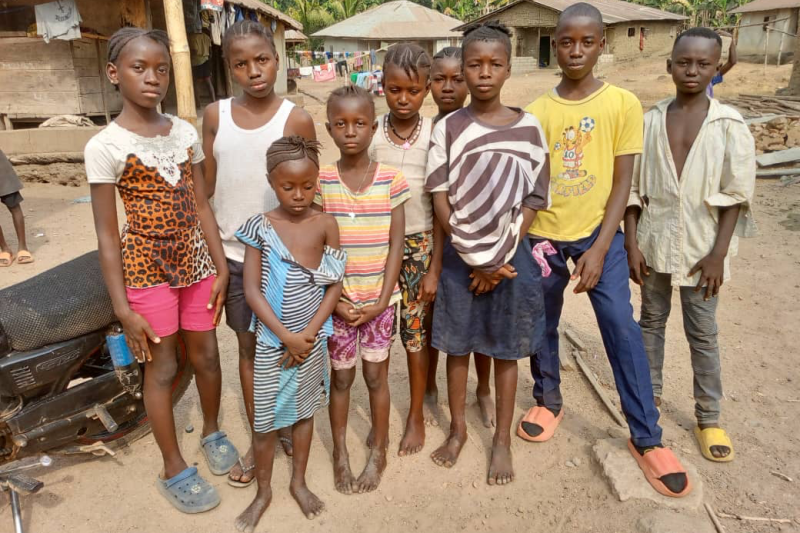
A decade after Ebola loosened its grip on Sierra Leone, Ebola orphans in Sierra Leone, particularly in Bombali District, continue to live with the long-term consequences of the outbreak. The virus no longer stalks homes or overwhelms treatment centres, but its legacy remains visible in classrooms, farms, and family compounds, carried by children who grew up without parents.
Between 2014 and 2016, the Ebola virus disease outbreak tore through Sierra Leone, killing nearly 4,000 people and infecting close to 9,000. Entire communities were hollowed out. In the north, Bombali District became one of the hardest-hit areas, driven by dense settlements, porous borders with Guinea, and burial traditions that required close contact with the dead.
When the epidemic finally ebbed, it left behind more than survivors and statistics. It left children, thousands of them, without mothers, fathers, or both.
A Generation Orphaned
Government figures estimated 8,354 Ebola orphans nationwide. NGOs put the number closer to 12,000. Bombali alone accounted for roughly 950 to 1,000 of them, making it one of the most affected districts in the country. In villages like Pate-Bana Marank, at least 245 children lost one or both parents, many within the same extended families.
Some lost fathers. Others lost mothers. More than a quarter lost both. Many were absorbed into already strained households. Others found themselves heading child-led homes, quietly assuming adult responsibilities before adolescence.
At the height of the crisis, quarantines split families apart. Children were taken to interim care centres. Others were left behind when adults were removed for treatment. Traditional mourning rituals were banned. Bodies were buried by strangers in protective suits. Grief had no ceremony, only silence.
“Ebola Children”
When schools reopened and movement restrictions eased, survival did not bring belonging.
Children orphaned by Ebola in Bombali were often labelled “Ebola children”, a name rooted in fear rather than fact. Communities worried about lingering infection. Playmates avoided them. Some were harassed. Others were simply excluded. The stigma followed them into classrooms, markets, and churches.
A 2015 consultation with children affected by Ebola captured the emotional residue, including persistent sadness, nightmares, fear of illness, and distrust of authority figures in uniforms. In Bombali, those feelings hardened into long-term psychosocial trauma, particularly as mental health services faded once emergency funding ended.
Guardians, mostly women, struggled to provide emotional and financial care. Food was scarce. Bedding was shared. School fees went unpaid. In some homes, orphans were treated differently from biological children, reinforcing a quiet hierarchy of worth.
Education Lost, Futures Deferred
Education became one of Ebola’s most enduring casualties.
Schools in Bombali were closed for up to nine months during the outbreak. Radio learning programs barely reached rural villages without electricity. When schools finally reopened, many orphans did not return. Fees were unaffordable. Uniforms were missing. Some children felt ashamed to sit in classes with peers who were now far younger than they were.
Girls drifted toward early marriage, sometimes for protection, sometimes to ease household burdens. Boys, idle and disconnected, gravitated toward gangs or drug use, including marijuana and Kush. What began as survival choices hardened into pathways that narrowed future opportunity.
NGO-backed education grants once filled the gap. But by 2021, many of those programs had ended. In their absence, dropout rates quietly climbed again.
Poverty After the Plague
Ebola devastated Bombali’s economy. Lockdowns collapsed subsistence farming and petty trading. Crops rotted. Markets closed. Households that took in orphans absorbed new mouths without new income.
For children, poverty translated into risk, including child labour, exploitation, teenage pregnancy, and malnutrition. Health systems, already fragile, struggled to recover. During and after the outbreak, malaria treatment for children fell sharply, routine immunisation stalled, and non-Ebola child deaths rose.
In Bombali alone, under-five mortality surged in the immediate post-Ebola years, often from preventable causes unrelated to the virus itself.
Help That Came and Left
In the early years, help arrived.
UNICEF supported interim care centres, family tracing, psychosocial services, and reintegration ceremonies. Street Child and Save the Children delivered food, clothing, and education grants to thousands of orphans nationwide. World Hope International built community care centres in Bombali and continues to operate an Ebola Survivor Clinic, supporting affected children with healthcare and trauma recovery.
But emergency compassion proved easier to mobilise than long-term commitment.
Several emergency and recovery programmes established after the Ebola outbreak ended operations between 2019 and 2021. Following their conclusion, care for Ebola-orphaned children in Bombali continued mainly through extended family arrangements.
In 2023 to 2024, the government implemented a school-fee support initiative covering approximately 1,000 orphans. No comprehensive national programme addressing long-term psychosocial or livelihood support for Ebola-affected orphans was in place as of that period.
Living With the Aftermath
Today, Ebola is no longer an immediate threat in Sierra Leone. Preventive vaccination campaigns now protect frontline workers. Surveillance systems are stronger. Preparedness has improved.
But in Bombali, the epidemic’s legacy persists, not in treatment centres, but in unfinished childhoods.
Orphans and survivors continue to report discrimination. According to survivor groups and child-focused organisations working in Bombali, many adolescents affected by Ebola-related bereavement continue to report anxiety, grief, and feelings of neglect.
The children themselves have been clear about what they need: free and sustained education, food security, livelihood support for guardians, access to healthcare, and an end to stigma. Above all, they ask to be included, not as symbols of a past tragedy, but as citizens with futures still worth investing in.
A decade on, Ebola no longer kills in Bombali.
For the children it orphaned, the recovery remains unfinished.

